The fight was a few weeks ago. Your friend said something at a birthday dinner, in front of everyone, and you left early. Since then you’ve typed a message more than once and deleted it each time. You’re still angry, and you still want to tell them about your week.
Forgiving a friend and getting the friendship back are two separate decisions. This guide walks through both in order: give the anger room, name what hurt, decide what you want, look for signs of repair, and then talk. At the end there’s one card and a short list of questions for the conversation itself, with or without the Thesis deck.
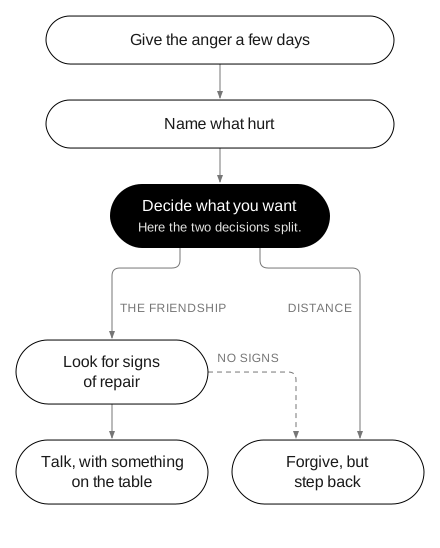
Step 1: Give the anger a few days
Anger and forgiveness pull in opposite directions. A meta-analysis of 175 studies with 26,006 participants found that state anger was negatively related to forgiveness (r = −.41), and empathy for the offender was positively related to it (r = .51) (Fehr et al. 2010). These are correlations, so they don’t say which comes first. They fit a familiar feeling: while the anger is high, forgiving can feel out of reach.
So the first step is to wait before you decide anything. Don’t send the long message late at night. Write it in your notes app if it helps, and read it again a few days later. This step is easy to skip, because silence can feel like losing the friend. A few days of quiet after a fight is a pause, and you can say so in one line: “I need a few days, I’ll write.”
Step 2: Name what hurt, in one sentence
“She’s selfish” is a verdict. “She told the table about my breakup before I was ready” is an event. Forgiving is easier to think about when you know what exactly you’re forgiving.
Try to put it in one sentence that describes the act. Then add a second sentence about why it landed so hard. Maybe it was the audience. Maybe it wasn’t the first time. Maybe it touched something you’d told them in confidence. The same meta-analysis found that perceived intent was one of the strongest correlates: people who saw the harm as intended forgave less (r = −.49). Your sentence can hold the question open: did they mean it, or did they not think?
Step 3: Decide what you want
Here the two decisions split. You can forgive a friend and keep a distance. You can also want the friendship back before you’ve forgiven anything. Both are honest positions, and knowing which one you hold makes the next talk shorter.
A few things help sort it out:
- The friendship before the fight. Was this person a regular call or a rare dinner?
- The pattern. Is this the first time, or the latest in a series?
- The loss. What would you miss a few months from now: the person, the group around them, or the habit?
- The cost. What would going back ask of you?
If the answer is “forgive, but step back,” that’s a full outcome. It needs no announcement. Some friendships shrink to a nod at a wedding, and the anger still goes.
Step 4: Look for signs of repair
What the friend does after the fight changes what forgiving takes. In a study of 337 people who had recently been hurt by a relationship partner, apologies and offers to make up for it went with a rise in how much people valued the relationship and a drop in how likely they thought the person was to hurt them again. Those two changes were linked to faster forgiveness and less anger (McCullough et al. 2014).
Trust sits in the middle of this. Closeness is one of the best predictors of forgiveness, and across three studies the link between closeness and forgiveness was explained by how much people trusted the offender after the hurt (Strelan et al. 2017). For friends, that means the question isn’t only “how close were we.” It’s “do I believe this won’t happen again.”
Signs of repair can be small. A message that names what they did. A question about how you are. Not bringing up the topic again in the group chat. If none of these come, the step-back option from step 3 may fit better.
Step 5: Talk, with something on the table
The first conversation after a fallout can be hard to start. Two friends sit down, and both wait for the other to say the first word. Meet somewhere with a thing to do: a walk, a coffee to go, a card on the table. A shared object gives the talk a place to start that isn’t the fight.
In two longitudinal studies of people who had been hurt by someone, researchers found that forgiving went with higher life satisfaction and better mood, and the link was stronger when people were closer to the person before the hurt and when the person had apologized (Bono et al. 2008). These are associations over time, not proof of cause. They fit the steps above: the link was strongest in close ties and after an apology.
Forgiveness has Door on its other side. The idea side lets two friends talk about forgiving in general first: a parent, a teacher, a past friend, a time one of them was forgiven. That’s easier than starting with each other. The door side is the light way in: a door someone slammed, a door left open for a late friend, the door of a shared flat. It can bring back the friendship as it was before the fight.
Look at the word from six sides
The Thesis die has six faces: MEMORIES · BODY · PEOPLE · VALUES · CHILDHOOD · FUTURE. The only instruction is “Look at the word from that side.” Roll it with the Forgiveness card, and you get six ways into the same word. A friend who can’t talk about the fight yet can still talk about the word.
Agree on passing before the first card. The rules say “Before you start, decide together how passing works.” After a fallout, a pass with no reason needed keeps the talk safe for both sides. The rules also say “What is said at the table stays there,” which matters when the fight started with something said in front of a group.
Without a deck, open the online table on a phone between you.
Questions for the talk after a fallout
These questions go from the word in general to the friendship itself. Use two or three, not all of them:
- Who’s someone you forgave a long time ago?
- What did forgiving them look like from the outside?
- Is there something you were forgiven for that you still think about?
- What makes an apology land for you?
- What’s the difference, for you, between forgiving and forgetting?
- What do you miss about how we were last year?
- What did that evening look like from your side?
- What would make it easier to trust each other again?
- What do you want this friendship to look like in a year?
Three follow-ups work for any answer: What did that feel like? Who else was there? Has it always meant that to you? A short answer is fine. The rules put it this way: “Say as much or as little as you like. The others ask, gently.”
Two cards close to Forgiveness
Two more cards fit a friendship fallout.
Trust has Window on its other side. It’s the card for step 4: what would need to happen for trust to come back. The window side is gentler: a window you looked out of as a kid, a window someone left open for you.
Anger has Ring on its other side. It fits when the anger is still in the room and naming it out loud helps both friends. The ring side can go to a phone ringing late at night, a boxing ring, or a ring someone gave away.
What to do this week
Write the one sentence from step 2. Then decide which outcome from step 3 you want. If it’s the friendship, send a short message that suggests one small thing, a walk or a coffee, and bring one word.
See the rules and the box, or play on the online table. The cards have their own pages: Forgiveness, Trust and Anger. For more on playing with friends, see Thesis for friends. See also the research behind the deck. If the friendship faded without a fight, see when friends drift apart.