An icebreaker helps people who don’t know each other start talking. A check-in gives each person in a group one short turn to say how they’re arriving, at the start of a meeting. An energizer is a short activity in the middle of a session that wakes a tired room up. All three are short, so they get mixed up, but each one answers a different problem. This page gives facilitators a definition of each, when it goes in a session, and a way to pick.
The three definitions in one place
Each term below has one job and one usual place in a session:
- Icebreaker: an opening activity that helps group members get acquainted and begin talking. It’s for a group that is new to each other, or new to working together.
- Check-in: one short turn per person at the start of a meeting, on one prompt, about how they’re arriving today. It’s for a group that already knows each other.
- Energizer: a short break in the middle of a session that brings attention and energy back. It’s for a group that has been sitting and listening for a while.
The quickest test is the question each one answers. An icebreaker answers “Who are these people?” A check-in answers “How is everyone today?” An energizer answers “Can we focus again?”
Icebreaker: for people who are new to each other
An icebreaker is the first activity of a session with people who haven’t met, or who haven’t worked together yet. In a practitioner article on adult learners, Chlup and Collins describe icebreakers as activities that help group members get acquainted, begin conversations and relieve tension between people (Chlup and Collins 2010). That’s the core of the definition: the group learns names, voices and a little about each other, so the first real discussion has less to push against.
The same article argues that icebreakers aren’t one-time events for the first day of class. In practice, the word still fits best at the start, when the ice is there. A team that has met every week for months doesn’t have much ice left to break. Asking them for a fun fact can read as a sign that nobody has thought about the group in front of them.
A good icebreaker gives everyone the same small, low-risk task. Names plus one answer to a light prompt is enough. The prompt works best when it doesn’t ask for family, money or health details, because a new group hasn’t decided yet what it shares.
Independence has Mug on its back. For a group of strangers, the Mug side is the easy way in: everyone has a mug they reach for, and the story behind it is short. Independence suits a group that will work together, because answers can be about how someone likes to work, alone or with others, and that’s useful for the weeks ahead.
Check-in: for a group that already knows each other
A check-in is a round at the start of each meeting where each person says, in a word or a sentence, how they’re arriving. The group already knows each other. The point is to hear where people are today: tired, rushed, focused or distracted by a deadline. A facilitator can use that. If several people say they’re stretched thin, the agenda may need a shorter list.
The minutes before an agenda already do some work. In a survey of 252 working adults, Allen, Lehmann-Willenbrock and Landowski found that small talk before a meeting predicted how effective people rated the meeting, even after accounting for good meeting procedures. The link was stronger for less extraverted people (Allen et al. 2014). It was a one-time survey, so it shows a link and not a cause, and it looked at informal talk, not formal check-in rounds. A check-in is one way to give that talk a shape, so the quieter people get a turn too.
A check-in runs on three parts: one prompt, one turn each, and a pass rule said before the first turn. The Thesis rule card opens with the same agreement: “Before you start, agree together how passing works.” For the step-by-step version, see how to run a check-in round.
Joy has Chair on its back. As a check-in word, Joy asks about today without asking for a report. Someone might name a small good thing from the morning. Someone who’d rather keep the day to themselves can pick the chair and talk about where they’re sitting right now, which still tells the room something about how they’re arriving.
Energizer: for the middle of a long session
An energizer comes after the group has been sitting, listening or concentrating for a while. Chlup and Collins call these re-energizers and describe them as transitions, or a time to clear the mind, that bring back vitality and enthusiasm (Chlup and Collins 2010). It can mean standing up, moving or changing seats for a few minutes.
Placement decides whether an energizer works. At the start of a session, the group isn’t tired yet, so a burst of activity has nothing to fix. After lunch, or before a hard topic in a long workshop, the same activity answers a real need. An energizer also doesn’t ask anyone to share anything about themselves, which is why it can fit groups at any stage.
A card round asks people to sit and think. In a long session, put the energizer first and the conversation after it.
How to pick the right one
The choice comes down to two facts about the group: whether they know each other, and where you are in the session. Run through them in this order:
- At the start, with people who are new to each other: an icebreaker.
- At the start, with a group that already works together: a check-in.
- In the middle, when attention drops: an energizer.
- At the start, when the meeting is short and the agenda is full: none of them. Start the agenda.
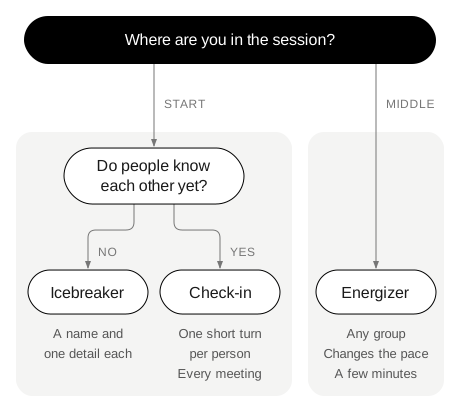
Some sessions use all three. A workshop over several days with people from different teams might open with an icebreaker on the first morning, start each later morning with a check-in, and use an energizer after lunch.
Prompts that fit an icebreaker or a check-in
The questions below work in either format. The first four suit a new group, and the last four suit a group that knows each other:
- What’s an object you use every day that has a story?
- What’s something you learned outside work that you still use?
- How do you like to get started on a new project?
- What’s a place where you think well?
- What’s one word for how you’re arriving today?
- What’s taking most of your attention right now?
- What’s one small thing that went well since we last met?
- What would make this meeting useful for you?
For more prompts in the second group, see check-in questions for team meetings.
Using one word for both
A single word can serve as an icebreaker prompt or a check-in prompt, depending on how you frame it. With a new group, the frame is “say your name and what this word makes you think of.” With a team, the frame is “how does this word fit your week?” A word on a sticky note works. With the Thesis deck or the free online table, each turn has the same steps: draw a card, choose the idea or the thing, roll the die and look at the word from that side. The die has six plain words: MEMORIES · BODY · PEOPLE · VALUES · CHILDHOOD · FUTURE. The only instruction is “Look at the word from that side.”
The rule card keeps the turn short: “A short answer is a full answer. You can always ask for more.” If someone wants to hear more, the card gives three example questions: What did that feel like? Who else was there? Has it always meant that to you?
Before your next session, write down whether the group knows each other and where the activity sits in the agenda, then pick from the four lines above. The cards in this post have their own pages: Independence, Joy and, for a word about breaks and fun, Play. For more on running it at work, see Thesis for teams and classes. For the studies behind the deck, see the research page. See the rules and the box.