Twelve people signed up, and you have one room and one evening. For the sharing part of a support group, circles of 4–6 people give everyone time to talk and a few people to answer them. If more people come, split them into several small circles and bring everyone back together at the end. This guide covers why that range holds up, what the arithmetic of a session looks like, and how to run the split.
It’s written for hosts of peer support groups, grief circles, recovery meetings and workshops where people share in turns. You know your group and its purpose, and you decide the format. The numbers below help with one decision: how many people sit in one circle.
What research says about conversation size
There’s no single study that sets the right size for a support group. There is research on how conversation changes as a group grows, and it points in one direction.
Dunbar, Duncan and Nettle observed freely forming conversations in several settings. Their data suggest an upper limit of about four people who can take part in one spontaneous conversation (Dunbar et al. 1995). The authors link the limit to the mechanics of speaking and hearing.
Fay, Garrod and Carletta compared discussion groups of 5 and 10 people. In groups of 5, the talk worked like a dialogue: members were influenced most by the people they talked with. In groups of 10, it worked like a series of monologues: members were influenced most by the dominant speaker (Fay et al. 2000).
Cooney, Mastroianni, Abi-Esber and Brooks reviewed research on disclosure in pairs and groups. They argue that adding people to a conversation creates systematic challenges for speakers and listeners, and that this can change what people disclose and how much (Cooney et al. 2020). They call it the many minds problem.
A turn-based circle is more structured than a chat at a party. One person speaks at a time, so a circle can hold more than four. The follow-up questions and replies after each turn are still conversation, though. In a circle of 4–6, those replies stay close to the group size where Fay et al. found dialogue.
The arithmetic of one session
Size decides how much time each person gets. Take the length of your session, set aside time for opening, the pass agreement and a closing round, and divide what’s left by the number of people in one circle.
- 4 people: each person gets a quarter of the sharing time.
- 6 people: each person gets a sixth.
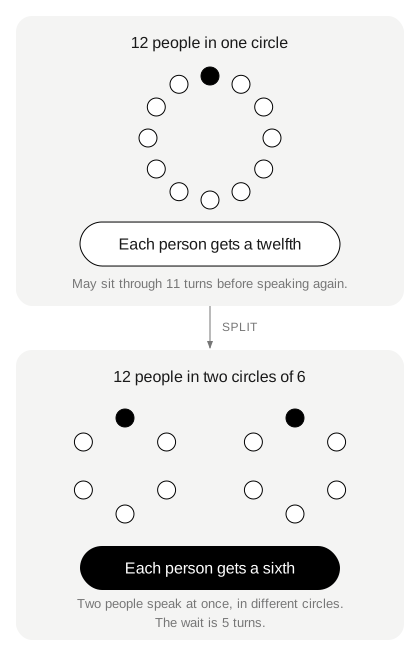
- 12 people in one circle: each person gets a twelfth.
- 12 people in two circles of 6: each person gets a sixth, and both circles run at the same time.
Splitting doesn’t add time to the session. It doubles the time each person has, because two people speak at once in different circles.
Waiting matters too. In a circle of 12, a person may sit through 11 turns before speaking again. That’s a long time to hold a thought, and a long time for a nervous person to rehearse. In a circle of 6, the wait is 5 turns.
What group members describe
People in a grief forum thread wrote about their first in-person groups. One member couldn’t open up at first with so many others sharing, and waited until they felt ready. Another said their hospice kept its groups small on purpose, so everyone had a chance to talk. The same member described a small group where one newly bereaved member took most of the session.
A small circle gives everyone room, and it doesn’t share the time out by itself. Turn order and a clear end to each turn do that part. If one person fills the space, see how to run a grief support group for setting up the session.
How to split a large group into circles
A split is easier to run when it’s part of the plan from the start. These steps cover a group of 7 or more.
- Count, then divide. Aim for circles of 4–6. Eight people make two circles of 4. Eleven make one of 5 and one of 6.
- Mix the circles. Separate people who came together, unless someone asks to stay with a friend. A new member can sit in a circle with at least one regular.
- Give each circle a host. One person per circle watches the time and reminds the circle of the pass agreement. It can rotate.
- Use the same prompt in every circle. A word on an index card, or a card from a deck, so the circles share a starting point.
- Set a clear end time. Say it at the start and give a two-minute warning.
- Come back together. Close in one circle, with each person saying one short line. Nobody repeats what was said in their small circle.
If space is tight, circles can sit at separate tables in one room, far enough apart that each circle hears only its own talk.
When the group is smaller than 4
Two or three people can share well. Turns come around faster, and each person gets more follow-up questions. The main change is that each answer carries more weight, so a short answer may feel more visible. The Thesis table card covers that: “A short answer is a full answer. You can always ask for more.”
These questions help you decide on size before the session:
- How many people do you expect, and how many may come late?
- How long is the sharing part, without opening and closing?
- How many minutes do you want each person to have?
- Do you have a second person who can host a circle?
- Is there room for two circles to sit apart?
- Are there new members to seat with a regular?
- Will you close together or in the small circles?
- What will you do if only two people show up?
Thesis as one prompt for small circles
Thesis is built for 2–6 players, which matches one sharing circle. Its rule card reads “2–6 players · 16+” and opens with “Before you start, agree together how passing works.” Each circle needs its own set of cards, or a few words written on index cards. The deck isn’t needed for the split to work.
Community sits on the back of Mirror. It suits the session where a group first splits into circles, because people can talk about the groups they’ve belonged to. A player can also take the everyday side and talk about a mirror in a house they grew up in. Both are complete turns.
Belonging is on the back of Headphones. In a newly formed circle, it gives people a way to talk about where they feel at home without naming anything painful. Headphones open a lighter turn: what someone listens to on the way to the group.
Loneliness is on the back of Perfume. It’s a heavier word, and a circle of 4–6 gives each person time to answer it and hear a reply. A host can keep it for a later session, once the circles have met a few times.
Try one round in a small circle
Before your next session, count your expected group and write down how many circles you’ll need. Then test one round with 4–6 people on a shared screen.
The die has six faces: MEMORIES · BODY · PEOPLE · VALUES · CHILDHOOD · FUTURE. The only instruction is “Look at the word from that side.” For the closing round, the rule card gives one line that works across circles: “each player names one thing they discovered about someone at the table today.”
For more on hosting, see Thesis for therapy groups. The three cards above have their own pages: Community, Belonging and Loneliness. You can play online for free, see the rules and the box, or read the research behind the deck. Related: check-out questions for group therapy and support groups. See also grief support group for all losses: holding different losses at one table.