Picture one circle on a Tuesday evening. A woman whose husband died in the spring sits next to a man whose mother died after a long life. Across from them are a student who lost a close friend and a father whose son died without warning. At some point in the evening, each of them may wonder if their loss belongs in this room. A grief support group for all losses holds together when the host names the mix out loud, sets an agreement against ranking losses, and opens with prompts that any loss can answer. This guide is for volunteer hosts of open hospice, church, and community groups.
The steps work with any prompt. The examples use the Thesis card deck, and a word written on an index card works the same way.
What the research covers, and where your judgment comes in
A review by Pistrang, Barker, and Humphreys looked at 12 studies of mutual help groups for mental health problems, including groups for bereavement. It called the evidence “limited but promising.” Seven studies reported positive changes, five found no differences, and none found negative effects (Pistrang et al. 2008). The abstract says nothing about mixing different losses in one group. Whether an open table suits a given member is a judgment you make with that member.
Members of bereavement forums describe both sides of that judgment. One person wrote that a group for everyone grieving anyone wasn’t for them. Another valued being free to listen first and speak when they chose. The first tells a host what to name early. The second tells them what to protect.
Step 1: Name the mix at the start
A newcomer may scan the room for someone with the same loss and, finding nobody, decide they’re in the wrong place. A short welcome that names the mix answers that worry early.
Keep the welcome to three sentences and say it every session. For example: “This group is for any loss. People here have lost partners, parents, children, siblings, and friends. Nobody has to say whom they lost.” The last sentence matters. The host doesn’t announce anyone’s loss, and a member can keep theirs to themselves for as long as they like. Put the same lines on the flyer and the sign-up page.
Step 2: Agree that losses aren’t ranked
Comparison is the friction that’s specific to a mixed table. It runs in two directions. A member may hear another story and think theirs is too small to mention: a grandparent, an ex-partner, a friend they hadn’t seen in years. Or a remark slips out that measures one loss against another, such as “At least you had all those years together.”
An agreement made out loud before the first turn gives the group words for this. These four lines cover moments of comparison, and a group can reword them:
- Every loss counts here. Nobody’s grief needs a reason to be in the room.
- We speak about our own loss. We don’t weigh it against anyone else’s.
- “At least” stays out of the circle. If it slips out, the host names it gently and moves on.
- Passing is allowed. A person can say “pass” with no reason given.
The Thesis rule card starts in the same place: “Before you start, agree together how passing works.” It also says: “Every view is welcome, especially one that differs from yours.” Read both lines aloud with the agreement.
Step 3: Open with words any loss can answer
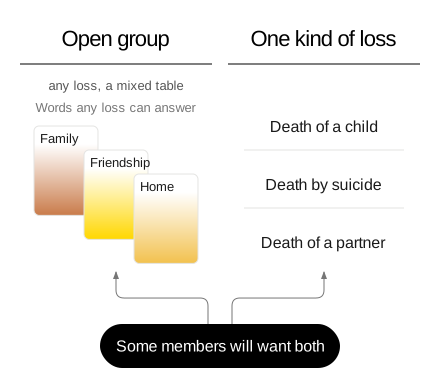
A prompt like “How did they die?” leads straight to the differences in cause, age, and timing. A single word about the life around the person gives everyone a shared starting point. A widow, a bereaved parent and a grieving friend can all talk about family, friendship, or home.
The 16+ rules are short. Draw a card, then “Choose a side: the idea or the thing.” Roll the die, and “Look at the word from that side. Say as much or as little as feels right.” The die has six faces: MEMORIES · BODY · PEOPLE · VALUES · CHILDHOOD · FUTURE.
Family has Bread on its other side. Family can reach any loss at the table, including families people chose. A member can talk about who holds the family together now. Bread can bring out ordinary scenes: who baked, who sliced it at the table, which shop someone always went to.
Friendship has Ball on its other side. A friend’s grief can be treated as smaller than a relative’s, and this card gives it a full turn. Ball can lead to a game played in a yard, or a match someone watched every weekend.
Home has Spoon on its other side. A partner may talk about the house that’s quieter now. A grown child may talk about clearing out a parent’s kitchen. Spoon keeps the turn small and concrete, which can help on a night when a feeling is too big to say.
If the group has no deck, these questions also start from shared ground. Each one works for any relationship and any cause of death:
- What’s one thing they did every day?
- Where at home do you notice they’re gone?
- What’s a meal that makes you think of them?
- What did they call you?
- Who has kept showing up for you?
- What do you still do the way they did it?
- What surprised you about how others treated this loss?
- What’s one thing you’d like this group to know about them?
- What’s a place you went together?
After a turn, the others can ask one short, open question. The rule card gives three: What did that feel like? Who else was there? Has it always meant that to you?
Step 4: Expect people to be in different places on the same night
A mixed table brings different points in grief together, and on any one evening those points can be far apart. Stroebe and Schut’s dual process model describes grieving people alternating between facing the loss and turning to the rest of life, and it treats taking breaks from grief as part of coping (Stroebe and Schut 1999). At an open group, one member may be facing the loss tonight while the person beside them needs a break.
Let both happen in one round. A member who talks about a ball game on the Ball side is taking part as fully as one who talks about the funeral. The table card says so in one line: “A short answer is a full answer. You can always ask for more.” Keep turns roughly the same length, so a recent or sudden loss doesn’t take the whole evening and a quieter loss still gets its turn.
Step 5: Know when to suggest a loss-specific group
An open group can sit alongside groups for one kind of loss: the death of a child, a death by suicide, the death of a partner. Some members may want both. Some may try the open group and say it isn’t for them.
Keep a short list of local and online loss-specific groups next to the sign-in sheet. When a member says the mix doesn’t fit, thank them and offer the list in private, without trying to change their mind. A peer group makes no clinical promises. Where a member needs more than any group can hold, a bereavement service or a doctor is the next step.
Step 6: Close with what people found in each other
The last round is where a mixed table shows what it can offer. The Thesis rule card ends every game the same way: “each player names one thing they discovered about someone at the table today.” In an open group, that can mean one member naming something they heard from a person whose loss looks nothing like theirs.
Keep the closing round short and the same every session. It can move attention from the differences in loss to the people in the room.
Try it at your next session
Thesis is a conversation format and makes no clinical claims. You know your group and its limits, and you decide what fits. To test the shared-word opening, play one round on a shared screen before the members arrive.
Before your next session, write your three-sentence welcome that names the mix, then the no-ranking agreement in the words you’ll say on the night. Pick three words for the opening round: Family, Friendship, and Home each have a page with their objects. For the full setup of a session, see how to run a grief support group. You can play online for free, see the rules and the box, read Thesis for therapy groups, or read the research behind the deck. For prompts on other nights, see grief support group discussion questions. Related: death Cafe or grief group? How to choose what to host. Related: when a share turns heavy: holding the room in a non-clinical group.