Someone starts their turn and their voice breaks. They stop, look at the table, and say “sorry.” The group waits to see what you do. You’re hosting a peer group, a discussion circle or a card evening, and the group meets to talk. What helps in that moment is small: slow down, offer a choice, keep the others from rushing in, and know in advance where the format ends. This guide gives the steps in the order you’ll use them, for hosts of peer and discussion groups that make no clinical promises.
The steps work with any prompt. The examples use the Thesis card deck, a conversation format with an idea on one side of each card and an everyday thing on the other. A question on a sticky note works the same way.
Before the session: say what the group is
A heavy share is easier to hold when everyone knows the scope of the room. Say it in one or two sentences at the start: what the group is for, and what it can’t offer. Death Cafe states its own scope plainly: “It is a discussion group rather than a grief support or counselling session” (Death Cafe). A line like that protects the person who shares and the host who listens.
Honest scope also fits what is known about peer groups. A review of 12 studies on mutual help groups for mental health problems, including bereavement, called the evidence “limited but promising” (Pistrang et al. 2008). Seven studies found positive changes for members, five found no differences, and none showed negative effects. That’s a reason to run the group well, and a reason not to promise more than it does.
These questions help a host prepare for a heavy moment before it happens:
- What one sentence tells people what this group is for and what it can’t offer?
- How does passing work here, and who says it out loud?
- Is there a second host who can step out with someone?
- Where can a person sit quietly if they leave the circle?
- Which local contacts do you have written down for people who want more support?
- What do you do if someone says they’re in danger?
- How long is a turn, and who keeps time?
- How will you close the session so nobody leaves mid-thought?
Write the answers on one card and keep it with you. A written plan is easier to reach for in the moment than one you only thought through.
In the first moment: slow down
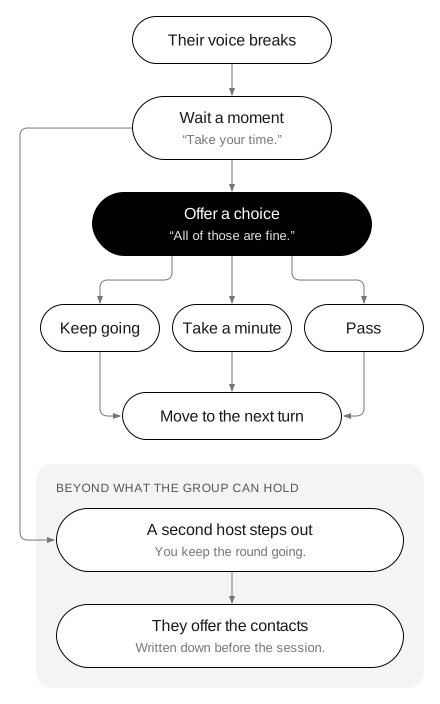
The first reaction can set the tone for everyone at the table. A host who speeds up, jokes or changes the subject can signal that strong feelings aren’t welcome. A host who waits a moment and stays calm signals the opposite.
Keep your words few. “Take your time” is enough. Put tissues within reach and let the person take them when they want to. Let the silence sit for a moment before anyone speaks.
Rest sits on the back of Clock. It’s a useful word to have in the deck for nights like this. A player can talk about rest they didn’t get, or about a clock in a kitchen they grew up in. Either side gives the room a slower pace, and the word itself reminds the host that a turn can pause.
Offer a choice, then follow it
Give the person in the middle of a hard share control over what happens next. Offer it in one plain sentence: “You can keep going, take a minute, or pass. All of those are fine.” Then do what they choose, without checking twice.
If the group agreed on passing before the first turn, this is where that agreement pays off. The Thesis rule card opens with it: “Before you start, agree together how passing works.” The table card adds: “A short answer is a full answer. You can always ask for more.” A person can end a heavy turn with one sentence and it still counts.
Hold the others back gently
The rest of the group may want to help, and help can arrive too fast. One person offers advice, another tells a similar story, a third reaches across the table. Each act is kind, and together they can take the turn away from the speaker.
Ask the group to listen first. A short line works: “Let’s give them the space.” When the speaker is done, follow-up questions can come, and the rules set their tone: “The others ask what they’re curious about, gently, without judging.” Good questions stay short and open, such as What did that feel like? or Who else was there? Advice can wait until the person asks for it.
Death is on the back of Phone. It can bring up a heavy share, so it helps to know it’s in the deck. A player can choose the phone side and talk about a call they remember, or stay with the word. If the card comes up early in a new group, a short reminder about passing before the turn makes both choices easy to see.
When it goes beyond what the group can hold
Some moments are outside what a discussion group is for. Signs include a person who can’t settle after several minutes, who asks for help the group can’t give, or who says they might harm themselves or someone else. In those cases, stop being a discussion host and become a connector.
If there’s a second host, they step out with the person while you keep the round going. Out of the room, they listen, ask what would help, and offer the contacts you wrote down before the session. If someone is in immediate danger, call your local emergency number. You know your group, its purpose and its limits, and you decide where that line sits. Thesis is a conversation format and makes no clinical claims.
After the turn: bring the room back
The group needs a way to continue once the moment has passed. Thank the speaker by name, in one sentence, and move to the next turn. Don’t summarize their share or explain what it meant; it belongs to them.
At a break, check in privately with the person: “How are you doing? Do you want to keep playing?” Let them leave early if they want to, and let them stay without comment if they want that. After a heavy share, repeat the rule card line on confidentiality at the close: “What is said at the table stays at the table.”
Kindness is on the back of Book. It works well as a closing card after a hard evening. A player can name an act of kindness they saw at the table, or a book someone gave them. Both turns lift the room without asking anyone to go back to what was said.
Close on something lighter
A heavy evening still needs a clear ending. Thesis finishes with a last round where “each player names one thing they discovered about someone at the table today.” After a heavy turn, it gives everyone, including the person who shared, a way to end on what they heard from the others.
To test the format with your group before a real session, open the online table on a shared screen and play one round together.
The die has six faces: MEMORIES · BODY · PEOPLE · VALUES · CHILDHOOD · FUTURE. The only instruction is “Look at the word from that side.”
Before your next session, write your scope sentence and your list of local contacts on one card. Read the scope sentence out before the first turn.
For more on running the game in a session, see Thesis for therapy groups. The three cards above have their own pages: Rest, Death and Kindness. You can play online for free, see the rules and the box, or read the research behind the deck. For groups that meet around loss, see grief support group discussion questions. When one person takes most of the time, see how to handle someone dominating a group discussion. Related: how to end a support group session after a heavy share.