You put the question on the board: is competition healthy? A few minutes in, the room has split. One side says it teaches you to win and lose. The other side remembers a sports day where the slowest kid finished last in front of everyone. Then both sides repeat themselves, and the talk stops.
This guide is for teachers, conversation club hosts and team leads who want that discussion to keep going. It gives a short answer from research, eleven questions in two groups, and a way to run the talk with one word. The questions use plain English, so they work in an ESL class at B1 and up. You can use the Thesis deck, the free online table, or the word Competition written on the board.
The short answer
Competition is healthy for some people, in some settings, and harmful in others. The research below suggests the difference may sit in what a contest makes a person aim for. A contest can push someone to aim to win. It can also push them to aim not to lose. The same race can pull in both directions.
That’s why the debate splits so fast. Each side is describing a real contest it lived through. The questions in this post ask people to tell those contests as stories, with a place, a year and a person. A story can be harder to argue with than an opinion, and it gives the next speaker something to answer.
What the research says
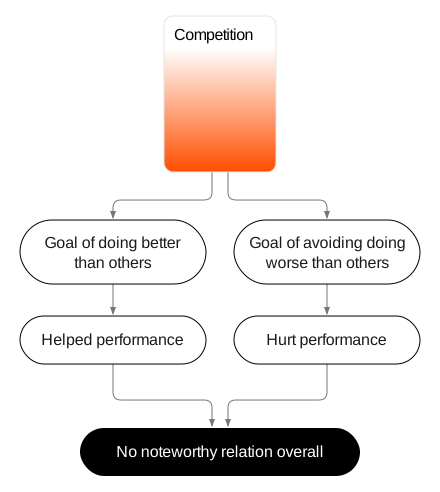
Kou Murayama and Andrew Elliot pulled together earlier studies on competition and performance in a meta-analysis. They found no noteworthy relation between the two overall. A second meta-analysis and three new studies showed why. Competition prompted a goal of doing better than others, and that goal helped performance. It also prompted a goal of avoiding doing worse than others, and that goal hurt performance. The two pulls worked against each other, which explains the missing overall effect (Murayama and Elliot 2012).
A second line of research looks at classrooms. Cary Roseth, David Johnson and Roger Johnson reviewed 148 studies covering more than 17,000 early adolescents from 11 countries. Higher achievement and better peer relationships went together with cooperative goal structures more than with competitive or individualistic ones (Roseth et al. 2008). For a teacher, it’s a reason to ask how a contest is set up, and who it’s set up against.
Competition also brings envy into the room. Richard Smith and Sung Hee Kim describe envy as an unpleasant mix of inferiority, hostility and resentment. They also describe a benign form of envy without the hostility (Smith and Kim 2007). The line between the two forms is a good thing to name before the questions start.
Questions about competing with others
The first six questions ask for a memory or a scene. Each one has an answer the speaker already knows, so in an ESL class the effort goes into the English.
- What was the first competition you remember? Did you win or lose?
- Who did you compete with as a child: a brother, a sister, a classmate?
- Describe a time when losing taught you something.
- Was there a contest at school that felt unfair to you? What happened?
- When did you feel happy for someone who beat you?
- In your family, was it good to win, or was it rude to show it?
Question 6 can open a cultural comparison in a mixed class. In some families a child is praised for coming first. In others, talking about it is seen as bragging. Let two students from different places answer it back to back.
Questions about competing with yourself
The next five move the contest inside. They may suit C1 students, native speakers and teams, because each one leaves room for a longer answer and a disagreement.
- Is beating your own record a kind of competition? How does it feel compared with beating a person?
- When do you compete to win, and when do you compete so you won’t lose?
- What would change at your school or job if nobody was ranked?
- Who do you compare yourself with without telling them?
- What did winning mean to you ten years ago, and what does it mean now?
Question 8 comes straight from the Murayama and Elliot finding. Read the finding to the group first, in one sentence. Then let each person place themselves on one side or the other, with an example.
Look at the word from six sides
A second way in is to stay with the word and change the angle. The Thesis die has six faces: MEMORIES · BODY · PEOPLE · VALUES · CHILDHOOD · FUTURE. The only instruction is “Look at the word from that side.” Roll it, or pick a face, and say what Competition brings up from there. A roll gives the next speaker a new angle on the same word, so the room stops repeating the two first opinions.
Competition has a Bench on its other side. Choose the idea when the group wants to talk about winning, rankings and rivals. Choose the Bench when a story is easier. A bench is where players wait to be picked, and where the ones not picked sit through the game. In a class, the Bench side can bring out the sports day memory without anyone having to argue for or against.
Run it as a round
Turn-taking can keep one loud opinion from filling the talk. In a class, split into small groups with one card per group.
Before you start, agree how passing works. The Thesis rules open with “Before you start, agree together how passing works.” Then take turns:
- Draw a card. Choose a side: the idea or the thing.
- Roll the die.
- Look at the word from that side. Say as much or as little as feels right.
- The others ask what they’re curious about, gently, without judging.
- Hand the die to the left.
The rule card gives three follow-up questions that fit every word: What did that feel like? Who else was there? Has it always meant that to you? For Competition, the second one matters most. A contest always has someone else in it, and naming that person turns an opinion into a story.
The rules also say “Every view is welcome, especially one that differs from yours.” Read that line aloud before the first turn. A topic with two camps needs it.
Two words close to Competition
Two other cards in the deck pull the talk toward the parts of competition that hurt.
Jealousy has a Kitchen table on its other side. It fits the envy research above. Ask the group where the line sits between wanting what someone has and wanting them to lose it. The Kitchen table side can bring up a family dinner where grades or salaries were compared.
Fairness has a Sweater on its other side. A contest may feel healthier when people think the rules are fair, and the group can say what fair means to each of them. The Sweater side can lead to an old school uniform or a hand-me-down. If the word lands too close, choose the other side, or pass.
What to do in your next class
Write Competition on the board. Read the Murayama and Elliot finding in one sentence, then ask question 8. Give each person one minute to answer with an example. “A short answer is a full answer. You can always ask for more.”
End the way every game of Thesis ends: each player names one thing they discovered about someone at the table today. “Sometimes one word is enough.”
See the rules and the box, or open the free online table. The cards above have their own pages: Competition, Jealousy and Fairness. For using the deck in a classroom or a team, see Thesis for teams and classes. For the research behind the deck, see Research. If a question lands too close for someone in the group, see how to ask sensitive questions.