The group chat lights up on a Tuesday night. A friend from school got the promotion, or the house, or the baby news after years of trying. You type “Congrats, so happy for you” and put the phone face down. Then you feel tired for the rest of the evening, and a little ashamed of feeling tired.
Researchers have studied that reaction. This post explains why a close friend’s win can hurt more than a stranger’s, what to do in the first minute after the news, and how to talk about the feeling later without making it a confession. It ends with three cards and a few questions you can use at the next meetup.
Why a friend’s news hits harder than a stranger’s
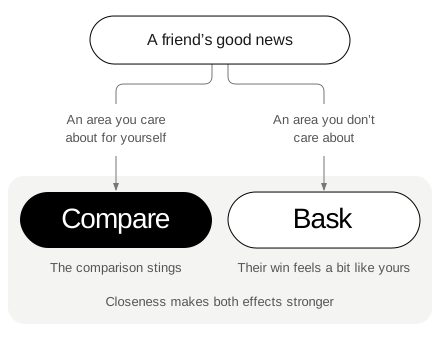
Psychologists Abraham Tesser and colleagues described two ways another person’s success touches your sense of yourself. If the success is in an area you care about for yourself, you compare, and the comparison stings. If it’s in an area you don’t care about, you can bask in it, and their win feels a bit like yours. In their model, closeness makes both effects stronger.
Their lab studies tested this with feedback on tasks, comparing a close friend with a stranger. Being outperformed by a close other produced more arousal than being outperformed by a stranger. On tasks that mattered little to the participants, positive feeling was higher when a friend did better than them (Tesser et al. 1988).
So the drain after a friend’s news can say more about the area than about the friendship. A friend who runs marathons can win every race and you may cheer. The same friend getting the book deal you’ve wanted since you were 20 lands differently.
Why “be happy for them” falls short
The usual advice is to be happy for your friend and move on. It skips the part where you already are happy for them and also feel low. Both are there at once, and when the second one stays unspoken, it can show up later as distance: slower replies, skipped birthdays, a vague feeling that the friendship got heavy.
Old friends can make this harder. You started at the same point: the same school, the same first jobs, the same cheap flat. Every gap since then is easy to measure, because you remember where you both were. A new acquaintance’s success has no starting line next to yours.
There’s also less room to say it. Admitting envy to a friend can feel like asking them to apologize for their good news. So it stays unsaid, and the next piece of news drains you a little more.
What to do in the first minute
The news can arrive before you’ve sorted out what you feel. A few moves help in that window:
- Answer the event, not your feeling. Ask one thing about what happened: how they found out, what the first day was like, who they told first.
- Give it a sentence more than “congrats.” A few lines of interest read differently from an emoji.
- Take the low mood elsewhere. Notice it, name it to yourself, and leave it for later.
- Check the area. Ask yourself whether this is a field you want for yourself. If it is, the sting is about you, and that’s useful to know.
The first point has research behind it. In four studies of sharing good news, telling others about positive events went with better daily mood and well-being. The benefit was larger when the listener responded actively and constructively, and couples whose partners usually met good news with enthusiasm reported more intimacy and satisfaction (Gable et al. 2004). Those studies looked at mood and relationships in general, not envy. Still, they point to the reply itself: an engaged, interested reply is part of what makes sharing good news pay off.
Talking about it later
Envy can come up between friends without a big talk. It can work better as a topic than as an admission. “I’ve been thinking about how we compare ourselves to each other since school” opens more than “I need to tell you I’m jealous.”
A word on the table can help here. It gives both people something to look at besides each other. When the word is Jealousy, the friend with the good news can talk about it too: the friends they’ve envied, the parent who compared siblings, the time they were on the other side. You don’t have to be the only one with something to say.
A few things make this easier. Choose an evening with no fresh news in it. Talk about the feeling in general before your own case. Let the friend set how far it goes. If one of you wants to stop, stop. The rules put it this way: “Before you start, decide together how passing works.”
The card for this conversation
Three cards from the deck fit this topic. Each has an idea on one side and an everyday thing on the other.
Jealousy has Kitchen table on its other side. The idea side can lead to what you’d want for yourself, which can be the useful part of envy, or to where the feeling sits after the group chat: the tight jaw, the phone face down. The kitchen table side goes to family meals, where siblings and cousins get compared out loud.
Success has Notebook on its other side. Old friends can carry definitions of success from when they were 18 that nobody has checked since. Asking what the word means now can show that the friend with the promotion counts something else as success entirely. The notebook side brings back school, lists and plans people wrote and didn’t follow.
Friendship has Ball on its other side. It moves the talk from the news to the history: how you met, the games you played, the years you were the same. That history is the reason the news hits, and it’s also the reason the friendship is worth the conversation.
The die adds an angle to any of these. Its six faces are MEMORIES · BODY · PEOPLE · VALUES · CHILDHOOD · FUTURE. “Look at the word from that side.” You can play on the online table with a friend in the same room or on a call.
Questions to start with
These questions work with the Jealousy card or with the word written on a napkin. They go from light to deeper:
- Who did you compare yourself to as a kid?
- What’s something a friend has that you’d like, and something you wouldn’t want at all?
- When did you last feel proud of someone else’s win?
- Which kind of news from friends is easiest for you to hear?
- Which kind is hardest, and why that one?
- Has someone ever envied you? How did you find out?
- What did success mean to you at 20, and what does it mean now?
- What would you want a friend to say if they envied you?
After an answer, the rule card’s follow-ups keep it going: What did that feel like? Who else was there? Has it always meant that to you? “Say as much or as little as you like. The others ask, gently.”
Before the next piece of news
The next announcement will come. Before it does, write down the one area where a friend’s win would sting the most. That can point to a direction you want for yourself, and knowing it in advance can make the next reply easier to write.
Then, at your next meetup, put the Jealousy card on the table. See the rules and the box, or play on the online table. The cards above have their own pages: Jealousy, Success and Friendship. For more on playing with a group, see Thesis for friends, and for the studies behind the deck, see the research page. For questions that go further with a close friend, see deep questions to ask friends. Related: friends at different life stages: what success means to each of you.