A friend gets the job you both applied for. You feel a sting and call it jealousy. Later your partner laughs a little too long at a coworker’s joke, and you call that jealousy too. The two feelings share a name in everyday speech. They aren’t the same feeling, and they need different conversations.
This post explains the difference between jealousy and envy in plain words. It covers what the research found, how to tell which one you’re feeling, and how to say it out loud to someone you trust. At the end there are ten questions and a way to try them tonight.
The short answer
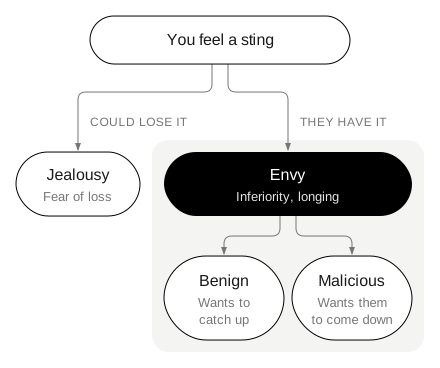
Jealousy is about something you have and could lose. Envy is about something someone else has and you don’t. Jealousy can involve three people: you, someone close to you, and a person who might come between you. Envy can involve two: you and the person who has what you want.
The job your friend got is envy. The coworker’s joke is jealousy. Naming the right one changes what you talk about next. Envy leads to a talk about what you want. Jealousy leads to a talk about what you’re afraid of losing.
What the research found
W. Gerrod Parrott and Richard Smith tested whether the two feelings differ in how they feel as well as in the situations that cause them. In one experiment, people recalled a time they felt envy or jealousy. In a second, people read stories where the conditions for envy and for jealousy were varied separately. Both experiments found the two emotions felt different (Parrott and Smith 1993).
The differences were specific. Envy came with feelings of inferiority, longing and resentment, and with disapproval of the feeling itself. Jealousy came with fear of loss, distrust, anxiety and anger. That list is a useful map. If the main feeling is “I’m less than them,” it’s likely envy. If it’s “I’m about to lose this,” it’s likely jealousy.
Smith later reviewed envy research with Sung Hee Kim. They define envy as an unpleasant emotion that mixes inferiority, hostility and resentment, set off by noticing that another person or group has something desirable (Smith and Kim 2007). The review also separates two kinds: envy proper, which carries hostility, and benign envy, which doesn’t.
Two kinds of envy
Benign envy wants to catch up. Malicious envy wants the other person to come down. Niels van de Ven, Marcel Zeelenberg and Rik Pieters studied this split in three countries (van de Ven et al. 2009). The Netherlands has separate words for the two kinds of envy. The United States and Spain use one word for both. The researchers found both experiences in all three countries, with or without a separate word.
In everyday life, the two kinds sound different. Benign envy says, “How did she do that? I want to learn it.” Malicious envy says, “She only got that because she knew someone.” Both start from the same sting. The difference is the direction the sting pushes you: toward your own goal, or against the other person.
Telling them apart helps the conversation. Benign envy can be said to the person you envy, for example as a question about how they did it. Malicious envy may be easier to say first to someone outside the situation, because it’s about wanting another person to lose.
How to tell which one you’re feeling
A quick test helps. Finish the sentence “I’m afraid I’ll lose” and then the sentence “I wish I had”. The one that comes easier may be the one you’re feeling. Some moments hold both, for example when a sibling gets a parent’s praise you wanted and also seems to take a parent’s attention away.
“I envy you” can be hard to say out loud, and the research hints at a possible reason. In Parrott and Smith’s studies, envy came with disapproval of the feeling itself. So envy can get called jealousy, which sounds more acceptable, or gets said as a joke. The cost is that the conversation goes to the wrong place: to trust, when the real topic is a goal you haven’t reached.
How to talk about it
The conversation can go better when it starts with your own feeling and the situation that set it off. A few steps help:
- Name the feeling with the right word. “I felt envy when you told me about the promotion” says more than “I’m a bit jealous, ha.”
- Say what it’s about. For envy, name the thing you want. For jealousy, name the thing you’re afraid of losing.
- Tell one story behind it. A feeling about a promotion can start in a school year when a sibling got the prize.
- Ask for one thing, if there’s one to ask for: advice, reassurance, or time to talk again later.
Envy carries a sense of being less, and that can sit close to shame. If the talk goes there, the difference between shame and guilt helps. See shame vs guilt for that part.
Ten questions about jealousy and envy
These questions work with a pen or with a friend asking them. Answer with a specific story where you can: a place, a year, a person.
- When did you first feel envy, and who was it about?
- Who in your family was easy to envy when you were a child?
- When did jealousy feel fair to you, and when did it feel out of proportion?
- What’s something you envied once and later stopped wanting?
- Whose success makes you want to work harder?
- Whose success is hard for you to hear about, and why that person?
- What do you protect most in a friendship?
- When did someone envy you, and how did you find out?
- What did your family say about jealousy when you were growing up?
- What would “enough” look like for the thing you envy most?
Look at which answers come with a person attached and which come with a thing. That pattern shows which feeling comes up for you more often.
Look at the word from six sides
A second way in is to stay with one word and change the angle. The Thesis die has six faces: MEMORIES · BODY · PEOPLE · VALUES · CHILDHOOD · FUTURE. The only instruction is “Look at the word from that side.” Roll it, or pick a face, and say what the word brings up from there.
Jealousy has a Kitchen table on its other side. Choose the idea when you want to talk about the feeling directly. Choose the Kitchen table when a scene is easier: who sat where, who got served first, whose news got the most attention at dinner. Early jealousy and envy between siblings can start at a table like that.
Competition has a Bench on its other side. It’s the word for envy that comes from ranking: grades, races, promotions, followers. The Bench side brings up the person waiting to be picked, which can be where envy starts. If the conversation turns sour, switch to the Bench and tell the waiting story instead.
Enough has a Photograph on its other side. Envy rests on a gap between what you have and what someone else has. Enough asks where your own line is. The Photograph side brings up a time when life felt like enough, and who was in the picture.
Try it with someone
Feelings like envy can be easier to say when the deck brings up the word. The rules allow 2–6 players, so two people at a table after dinner are enough. Before you start, agree how passing works. The Thesis rules open with “Before you start, agree together how passing works.”
The rule card gives three follow-up questions that fit every word: What did that feel like? Who else was there? Has it always meant that to you? For Jealousy, the second one may help most. It turns the feeling back into a scene with people in it, and the people show whether it’s jealousy or envy.
“Every view is welcome, especially one that differs from yours.” That line helps here, because someone at the table may have felt envy toward you.
What to do tonight
Write the word Jealousy on a piece of paper. Think of the last time you used it, and ask yourself whether it was about losing something or about wanting something. Then tell that story to one person you trust and let them ask one follow-up. “A short answer is a full answer. You can always ask for more.”
See the rules and the box, or open the free online table. The cards above have their own pages: Jealousy, Competition and Enough. For playing with a few close people, see Thesis for friends. For the studies behind the deck, see the research page. Related: lonely vs alone: what’s the difference?.