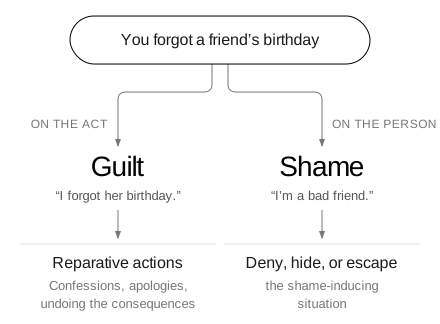
You forgot a friend’s birthday. One voice says, “I forgot her birthday.” Another says, “I’m a bad friend.” The first one is guilt. The second one is shame. Same event, two different feelings, and they lead to different next steps.
This post explains the difference between shame and guilt in plain words. It covers what the research found, how to tell which one you’re feeling, and how to talk about either with someone you trust. At the end there are ten questions and a way to try them tonight.
The short answer
Guilt is about something you did. Shame is about who you are. The psychologist Helen Block Lewis drew the line this way, and later research kept it: “shame involves a negative evaluation of the global self; guilt involves a negative evaluation of a specific behavior” (Tangney et al. 2007).
The same review puts it in one sentence said two ways. With shame, the stress falls on the person: “I did that horrible thing.” With guilt, it falls on the act: “I did that horrible thing.” The words are the same. What hurts is different.
Both feelings are unpleasant. The review says so directly: “Both shame and guilt are negative emotions and as such, both can cause intrapsychic pain.” The difference shows up in what each one pushes you to do next.
How each one feels
Shame feels like shrinking. The review describes “a sense of shrinking or of ‘being small’” and adds that “shamed people also feel exposed.” The urge is to disappear, change the subject, or leave the room.
Guilt feels like tension about one act. It replays the moment and the person who got hurt. The urge is to go back and fix it: send the late message, return the borrowed money, say sorry.
A quick test helps. Finish the sentence that starts with “If only” in your head. Paula Niedenthal, June Tangney and Igor Gavanski asked people to undo shame and guilt situations they’d read about or remembered. People tended to undo shame situations by changing qualities of the self and guilt situations by changing actions (Niedenthal et al. 1994). In everyday words, that sounds like “if only I weren’t so careless” against “if only I hadn’t said that.” The paper’s title carries the test: “If only I weren’t” versus “if only I hadn’t.”
What each one leads to
The two feelings point in opposite directions. In the review, shame “corresponds with attempts to deny, hide, or escape the shame-inducing situation.” Guilt “corresponds with reparative actions including confessions, apologies, and undoing the consequences” (Tangney et al. 2007).
The review also links each feeling to how people treat others. It reports that “guilt goes hand in hand with other-oriented empathy.” Proneness to shame, on the other side, “is positively correlated with anger, hostility,” and shame-prone people “are more likely to engage in externalization of blame.” The authors suggest that “blaming others may help individuals regain some sense of control and superiority in their life.”
The authors sum it up: “On balance, guilt appears to be the more adaptive emotion, benefiting individuals and their relationships.” In everyday terms, guilt keeps the problem the size of one act, and an act can be repaired.
Why the two words blur
The two words can get used as one. The review notes that “many individuals, including clinicians, researchers, and lay people, use the terms ‘shame’ and ‘guilt’ synonymously.”
One common belief is that shame is public and guilt is private. A study by June Tangney and colleagues asked 182 students to describe their own times of shame, guilt and embarrassment. Shame didn’t happen in front of others more often than guilt did, and a significant share of both happened when people were alone (Tangney et al. 1996). The same students also judged themselves more harshly than they thought others judged them. For a related pattern about how people judge their own vulnerability, see the beautiful mess effect.
Another reason the words blur is that one event can bring both. A missed deadline can start as guilt (“I sent it late”) and turn into shame (“I’m the kind of person who lets everyone down”). Naming which voice is talking can be a useful first step.
Ten questions about guilt and shame
These questions work for a quiet talk with a friend, a partner, or yourself with a pen. Answer with a story where you can: a place, a year, a person. Skip any that land too close.
- When did you last say sorry, and was it for something you did or for who you are?
- What’s something you felt guilty about and fixed?
- What’s something you felt ashamed of as a child that seems small now?
- Who in your family said “shame on you,” and about what?
- What do you do with your hands or your eyes when you feel ashamed?
- When did someone’s reaction make a mistake feel smaller?
- What’s an “if only I weren’t” sentence you’ve said about yourself?
- How would you rewrite it as “if only I hadn’t”?
- What’s something you once hid and would tell a friend about today?
- What does an apology need for you to believe it?
Look at your answers to 7 and 8 side by side. The second version may be easier to say out loud, and easier to act on.
Look at Shame from six sides
The Thesis deck has a card for Shame. The die has six faces: MEMORIES · BODY · PEOPLE · VALUES · CHILDHOOD · FUTURE. The only instruction is “Look at the word from that side.” Each roll gives the same word a new angle, and the story that comes out can be about one moment, which is where guilt and shame can be told apart.
Shame has a Letter on its other side. Choose the idea when you want to talk about the feeling. Choose the Letter when a story is easier: a note you never sent, a letter that said sorry, a message you wrote and deleted. A letter can be where guilt goes to repair something, so the object side can open the topic from the gentler end.
Forgiveness has a Door on its other side. Guilt asks for an apology, and Forgiveness is the other half of that exchange. A player might talk about forgiving someone else, or about the harder part: forgiving themselves. The Door side can bring up rooms that were closed and ones that opened again.
Regret has a Lamp on its other side. Regret sits close to guilt: both look back at an act. A regret named out loud can turn out to be about a choice, which keeps it the size of a choice. If the word lands too close, choose the Lamp side, or pass.
Try it with someone
Talking about shame is easier when the rules are clear before anyone starts. The Thesis rules open with “Before you start, agree together how passing works.” Then the table follows a few steps.
- Whoever suggested the game goes first.
- Draw a card. Choose a side: the idea or the thing.
- Roll the die.
- Look at the word from that side. Say as much or as little as feels right.
- The others ask what they’re curious about, gently, without judging.
- Hand the die to the left.
The rule card offers three follow-up questions that fit every word: What did that feel like? Who else was there? Has it always meant that to you? For Shame, the third one can open the most. A feeling that has followed someone since childhood can sound different when said out loud as an adult.
Two lines from the rules help here. “A short answer is a full answer. You can always ask for more.” And: “What is said at the table stays at the table.” For more on raising heavy topics carefully, see asking sensitive questions.
What to do tonight
Write the word Shame on a piece of paper, or pick something you still feel bad about. Say it out loud once as a sentence that starts with “I am” and once as one that starts with “I did.” Notice which version you can do something about. Then tell one person the “I did” version, and let them ask one follow-up.
When you’re done, end the way every game of Thesis ends: each player names one thing they discovered about someone at the table today. “Sometimes one word is enough.”
See the rules and the box, or open the free online table. The cards above have their own pages: Shame, Forgiveness and Regret. For a few close people around one word, see Thesis for friends. The research behind the deck explains where the words came from.