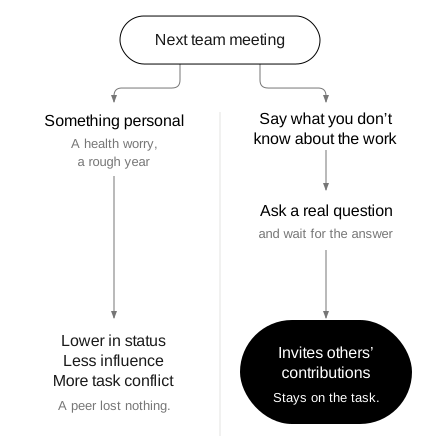
You’ve read that a good manager goes first. So at the next team meeting you open with something personal: a health worry, a rough year, a thing you’re bad at. The room goes quiet, and the next week your team pushes back on your calls more than before. Lab research points to a reason. When a higher-status partner shared a weakness, people saw them as lower in status and took less of their advice, while a peer who said the same thing lost nothing. This post is for managers who want a more open team. It covers what the studies found, where they stop, and what to share instead.
What the studies found
The clearest evidence comes from three experiments by Gibson, Harari and Marr, with 667 undergraduates in the final samples. Each student worked on a judgment task with an online partner who gave them feedback. The partner was scripted. In one condition the partner had higher status, such as an MBA student, and in the other the partner was a fellow undergraduate. Midway through, the partner mentioned a weakness: being on academic probation, being told by a doctor to lose weight, or seeing a therapist every week (Gibson et al. 2018).
When the higher-status partner disclosed, students rated that partner lower in status. They changed fewer of their answers in response to the partner’s feedback, and they reported more task conflict. In the first study they liked the partner less, and in the other two they had less interest in staying in touch. A peer who shared the same weakness faced none of this. In the third study a partner who mentioned a strength, winning a marathon, didn’t come across as vulnerable, so the cost came from the weakness and not from talking about oneself.
Why the same words cost a manager more
The authors trace the effect to expectations. People expect someone above them to be confident and steady. A weakness signals vulnerability, and that signal clashes with the role. It clashed for higher-status partners only, even though peers who said the same thing seemed equally vulnerable.
The paper also names an irony. A manager may share a weakness to close the distance and work better together. In the study, the share did close the distance, by lowering the manager’s status, and that brought less influence and more conflict. The authors add that people with more power tend to have a harder time taking others’ perspective. A manager may feel closer after the share without the team feeling the same.
Where the evidence stops
These were short lab tasks with students and a new partner. Nobody could answer the disclosure with one of their own, and the authors note that a chance to reply might change how it lands. They didn’t test long working relationships, a share made over lunch instead of during the task, or the gender of the discloser. So the finding is a warning about one situation: a personal weakness, shared by the person in charge, early in a working relationship, in the middle of the work.
The authors also leave room for a deliberate choice. A team lead might share a weakness on purpose to draw in quieter members who feel the status gap. Less influence and more debate can be what a team needs. The question is whether the manager chose that trade or walked into it.
What to share instead
A manager can be open about the work itself. The moves below come from research on humble and inclusive leaders, and each one keeps the focus on the work.
Say what you don’t know about the work. Owens and Hekman interviewed 55 leaders from a wide range of settings about humble leadership. Their model describes leaders who show their team how to grow, which tells people that their own uncertainty and development belong at work (Owens and Hekman 2012). “I haven’t run a launch this size, and I’m not sure our timeline holds” is open and stays on the task.
Ask a real question and wait for the answer. Nembhard and Edmondson define leader inclusiveness as words and deeds that invite and appreciate others’ contributions. In survey data from 23 neonatal intensive care units, inclusiveness predicted psychological safety and softened the effect of status differences between professions (Nembhard and Edmondson 2006). An invitation does the work a confession was meant to do.
Show what happened to the last idea. Detert and Burris studied 3,149 employees and 223 managers in a restaurant chain. Managerial openness was more consistently related to employees speaking up with improvement ideas than transformational leadership was, and the link ran through psychological safety (Detert and Burris 2007). Telling the team which suggestion changed a plan shows openness in a way a story about yourself can’t.
Keep your first answer short. In a round, the manager’s answer is the example everyone else hears. A sentence or two about the week tells the team that a short answer is welcome, and it leaves room for others to go further if they choose. For the employee side of the same check-in, see sharing personal information at work.
Save the personal story for a chosen moment. If something in your life will change the work, the team needs the work-sized version: “I’m out Thursday afternoons for the next month.” A fuller story can go to one person you trust, at a time you pick.
Questions that hand the floor to the team
The questions below put the manager’s uncertainty on the table and hand the next turn to the team:
- What am I missing about this plan?
- Where do you think this timeline is weakest?
- What would you do differently if this were your project?
- What’s one thing I could stop doing that would help you?
- Which part of this are you more sure of than I am?
- What did we learn from the last project that we’re not using?
- What question would you ask if you were sure it was welcome?
- What should we check before we commit?
A card round with a shared topic
A word gives the team a shared topic, so nobody has to bring a confession to the table. Each Thesis card has an idea on one side and an everyday thing on the other, and the speaker picks the side. The manager draws like everyone else.
Honesty has Radio on its back. On a team, Honesty can open a talk about feedback that arrived too late, or a status report that hid a problem. The Radio side gives a lighter way in: a station from a commute, or the one in a parent’s car.
Failure has Washing machine on its back. A manager can take Failure toward a project that didn’t work and what the team changed after it, which keeps the turn on the work. The Washing machine side lets anyone talk about a chore, a first apartment or a machine that broke at the worst time.
Trust has Window on its back. Trust can lead to what makes a handoff feel safe, or how a new teammate earns room to decide. Window can stay plain: the view from a desk, or a window someone always opens first thing.
Running it as a card round
With the deck or the free online table, the rules open with “Before you start, agree together how passing works.” Each player draws a card, chooses the idea or the thing and rolls the die. The die has six words: MEMORIES · BODY · PEOPLE · VALUES · CHILDHOOD · FUTURE. The only instruction is “Look at the word from that side.” The rule card keeps each speaker in charge of depth: “A short answer is a full answer. You can always ask for more.” The others can ask short, open questions, such as What did that feel like? Who else was there? Has it always meant that to you?
Before your next team meeting, write down one thing you’re unsure about in the current project and one question you’ll ask about it. Open with those two sentences instead of a story about yourself, then wait. The cards above have their own pages: Honesty, Failure and Trust. For more on running it at work, see Thesis for teams and classes. For the research behind the deck, see the research page. See the rules and the box. Related: why deep conversations at work feel riskier than they are.