Your company starts a weekly check-in. Each person names the best and the worst thing that happened in their private life that week, and the first listener is a manager you don’t trust. A worker described this policy on a workplace forum. The short answer to “where’s the line” is this: in a work check-in, share the part of your week that changes the work, and keep the rest yours unless you choose otherwise. This post gives employees a test for what to say, and gives managers a check-in that keeps private life optional.
What a work check-in is for
A check-in at work has a job. It tells the team who has energy, who is stretched and what might slow the week down. A round that collects private stories goes past that job. In a tech forum thread, one commenter put it plainly: a long personal backstory about why someone became an engineer doesn’t help the team plan anything.
Employees describe the same line from their side. In a UK forum about workplace training, one person wrote that their personal life is theirs to share on a need-to-know basis. The team needs to know what affects the work. The rest is the speaker’s to give or keep.
The work-sized version of a private thing
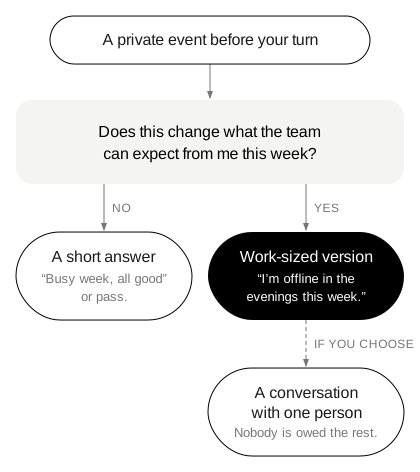
A private event can be told in a work-sized version. It keeps the fact the team can use and leaves out the part that belongs to you. Here are four examples, each with the private version first and the work-sized one second:
- “My dad had surgery and I’m driving to the hospital every evening” becomes “I’m offline in the evenings this week.”
- “We’re in the middle of a divorce” becomes “I’ve got a lot going on outside work, so I’d like fewer new tasks.”
- “I didn’t sleep because of the baby” becomes “I’m low on energy today, so I’ll take the review tomorrow.”
- “My therapy session is Thursday afternoon” becomes “I’m blocked Thursday afternoons.”
The work-sized version is a complete answer. It gives the team what it needs to plan, and nobody is owed the rest.
Three questions help find the work-sized version before your turn. Does this change what the team can expect from me this week? Would I be fine with this person knowing it at my next review? Is this the room for it, or a conversation with one person? If the first answer is no, a short “busy week, all good” is enough.
Why a manager’s personal story can backfire
A manager may want to go first with something personal to make the room feel safe. A set of lab studies points to a cost. Gibson, Harari and Marr ran three experiments with 667 undergraduates who worked on a shared task with what they believed was a partner. In the middle of the task, the partner disclosed a weakness: being on academic probation, being told by a doctor to lose weight, or seeing a therapist every week. When that partner had higher status, participants then saw them as lower in status. The partner had less influence over the answers, more task conflict and a weaker working relationship. A peer who said the same thing faced none of these effects (Gibson et al. 2018).
The third study also tested a different kind of share. A higher-status partner who mentioned winning a marathon didn’t come across as vulnerable, and the penalty came from the weakness, not from talking about oneself at all. The limits: participants were students, the relationships were new, and nobody could reply with a disclosure of their own. The authors also note that a team lead might choose to share a weakness on purpose, to draw in quieter members.
For a manager, the practical reading is about size. The first answer is the example everyone else hears. A two-sentence answer about the week shows that a short answer is welcome.
When the check-in is required
Managed closeness can backfire. Fleming studied a communications firm where managers built a “culture of fun” around family, lifestyle, school and consumption. Blurring the line between work and the rest of life left some employees cynical about the program (Fleming 2005). That was one case study of one firm, so it shows what can happen, not how often.
If your team has a required personal round, two moves keep you in the round on your own terms. Give the work-sized version every time, so the round stays useful and nobody can say you didn’t take part. Then raise the format with the manager once, in private, and frame it around the goal. For example: “I’m glad to say how my week is going for work. I’d rather keep family news out of the round. Could the question be about workload?” The manager can change that without losing face.
How a manager can set the line for the team
A check-in with a clear line needs a few choices made in advance. The steps below follow the order of the meeting:
- Ask about the week at work: energy, load and what’s in the way.
- Say before the first turn that anyone can pass, with no reason given.
- Go first with a short answer about the work week.
- Leave private details to the speaker, and don’t ask for more in the round.
- Keep what was said out of notes, reviews and later jokes.
- End on time and move to the agenda.
Step 5 is what makes the other steps believable. The Thesis rule card says it in one line: “What is said at the table stays at the table.”
Check-in questions that stay on the work side
The questions below give each person room to answer about work. Anyone can go deeper if they want to, and nobody has to:
- What’s taking most of your energy this week?
- What’s one thing that would make this week easier?
- What are you looking forward to on the project?
- What’s in your way right now?
- How full is your plate, from one to five?
- What’s something you finished that nobody saw?
- What do you need from this team before Friday?
- What’s a boundary you’re keeping this week, such as a time you’re offline?
Three cards for a team round
A word gives a check-in a topic without asking for a life update. Each Thesis card has an idea on one side and an everyday thing on the other, and the speaker picks the side.
Privacy has Diary on its back. At work, Privacy can open a talk about what a team keeps in the room and what goes in the shared channel. The Diary side lets someone describe the planner they write their week in, which is a work topic that stays far from home.
Boundaries has Shoes on its back. A team can read Boundaries as working hours, a meeting-free morning or a rule about weekend messages. Shoes gives anyone a lighter turn: the pair they wear for long days, or the ones they keep under the desk.
Work has Stone on its back. Work invites talk about the part of the job someone enjoys or the task they keep moving to next week. Stone can stay plain: a stone on a desk, a heavy task, or a path someone walks to the office.
Running it as a card round
With the deck or the free online table, the rules start with “Before you start, agree together how passing works.” Then each player draws a card, chooses the idea or the thing and rolls the die. The die has six words: MEMORIES · BODY · PEOPLE · VALUES · CHILDHOOD · FUTURE. The only instruction is “Look at the word from that side.” Whatever word comes up, the rule card keeps the speaker in charge: “A short answer is a full answer. You can always ask for more.” The others can ask one short question, such as What did that feel like? Who else was there? Has it always meant that to you?
Before your next check-in, write the work-sized version of one thing from your week in a single sentence. If you run the round, change its question to one about the work week and say the pass rule out loud. Related posts: oversharing and where the line is, icebreakers without personal questions and check-in questions for team meetings. The cards above have their own pages: Privacy, Boundaries and Work. For more on running it at work, see Thesis for teams and classes. For the studies, see the research page. See the rules and the box.