A while back you told a coworker about a hard stretch at home. It felt fine over lunch. Now that coworker is your manager, and you think about that lunch every time you sit down for a review. So at the next dinner with friends, when the talk turns personal, you keep your answers short and safe.
This post is for anyone who has said more than they meant to and now holds back. The line between oversharing and opening up is about fit: whose story it is, who’s listening, what they’ve shared so far, and whether you can still take a step back. Below are four checks you can run before you speak, and the reason a game rule that lets you pass can make opening up easier.
The short answer
Oversharing is sharing that doesn’t fit the person, the moment, or the owner of the story. Opening up is sharing that does. The same sentence can be both. A breakup told to a close friend over a long walk fits. The same breakup told to a new coworker in a short coffee break may not.
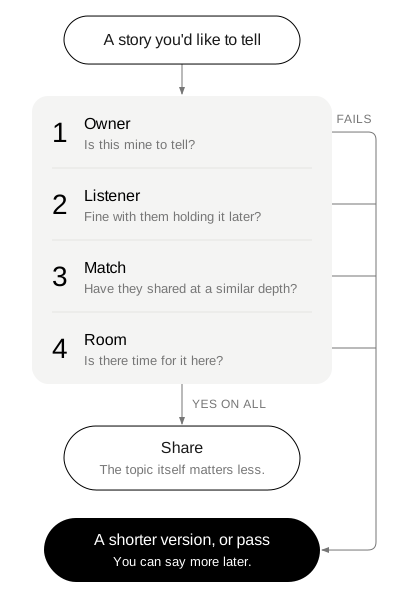
So the useful question is about fit, and it has a few parts. Is this mine to tell? Does this person know me well enough to hold it? Have they shared at a similar depth? Is there time for it here? If the answer is yes on all of them, the topic itself matters less.
Why opening up still pays off
The fear of oversharing can push a person to share nothing. Research on disclosure points the other way. A meta-analysis by Collins and Miller found three links between self-disclosure and liking: people who disclose more intimately tend to be liked more, people disclose more to those they already like, and people come to like the ones they’ve disclosed to (Collins & Miller 1994).
The same review found that these links depended on other factors, including the type of disclosure and the study setup (Collins & Miller 1994). That fits everyday experience. Sharing can bring people closer, and how and where it happens shapes how it lands. The lunch with the coworker shows the second half. It doesn’t cancel the first.
Whose story it is
Communication privacy management theory, developed by Sandra Petronio, gives a plain picture of what happens when you share. People feel they own their private information and have the right to control it. When they tell someone, that person becomes a co-owner of it, and the privacy boundary stretches to include them (Petronio & Venetis 2017).
Two things follow from that picture. First, a person can share information that belongs to someone else, such as a family matter or a friend’s secret (Petronio & Venetis 2017). Some of what feels like oversharing afterward can be that: a story that was partly someone else’s. Second, every listener is a new co-owner. The coworker from lunch now holds part of your story, and you can’t control where it goes next. The same theory describes the pull between sharing and concealing as a tension people move back and forth in.
Four checks before you share
These checks take a few seconds and work in any conversation, at work or at a kitchen table. Each one looks at fit from a different side.
- Owner. Is this my story, or does part of it belong to someone who isn’t here? If it’s partly theirs, tell only your part.
- Listener. Would I be fine with this person holding it later, in a different role? A future manager is a different listener from an old friend.
- Match. Has the other person shared at about this depth? If they’ve shared one level, go one level, and let them choose the next step.
- Room. Is there time and quiet for this here? A heavy story in a busy hallway leaves both people stuck when the conversation ends.
When one check fails, a shorter version can fit. “Things at home have been hard this month” is a full sentence. You can say more later, to the same person, when the checks pass.
Why passing is allowed
The checks work best when stepping back costs nothing. In a conversation that has no rule for it, saying “I’d rather not” can feel like a scene. So a person may say more than they planned, then regret it, then share less next time. A pass breaks that loop. It lets a person keep a story inside their own boundary without making the room awkward.
The Thesis rules start there: “Before you start, agree together how passing works.” The group decides its own version before the first card. Step 4 of the rules sets the depth: “Say as much or as little as feels right.” The table card adds: “A short answer is a full answer. You can always ask for more.” A pass is a choice about ownership. It says “this one stays with me for now,” and the game goes on.
A pass also protects the listeners. When anyone can stop at any point, nobody has to brace for a story they didn’t ask to hold. That can make the next honest answer easier for everyone at the table.
Questions to find your own line
These questions help you see where your line sits before the next conversation where it matters. They work alone, in a journal, or with one person you trust.
- What did I share once that I’m still glad I said?
- What did I share that I’d take back, and what made it wrong for that moment?
- Who in my life could hold almost anything I told them?
- Which stories in my life are partly someone else’s?
- What do I share at work that I’d never put in an email?
- How do I let someone know I’ve said enough?
- What does a pass sound like when I say it?
- When someone else overshared with me, what did I want to do?
- What would I tell a close friend about where my line is?
Three cards for this conversation
The cards below fit a conversation about how much to share. Each one has an idea on one side and an everyday thing on the other, and either side is a full turn.
Privacy is on the back of Diary. The word invites talk about what a person keeps to themselves and why. Diary gives an easier way in: a diary someone kept as a kid, or one they found. Both sides lead to the same question of who gets to read what.
Boundaries sits on the back of Shoes. A player can describe a limit they learned to set at work or at home. Or they can talk about shoes that never fit and how long they wore them anyway. The second story can say something about the first.
Trust is on the back of Window. It fits the listener check above: who do I trust with what? Window can be lighter, a view from a childhood room or a window someone always sits by. A player picks the side that matches what they want to share today.
Try one round
One way to feel the line is one round with people you know. Agree on passing first, then play a turn each at the online table.
The die has six faces: MEMORIES · BODY · PEOPLE · VALUES · CHILDHOOD · FUTURE. The only instruction is “Look at the word from that side.” If a face leads somewhere you don’t want to go, a pass covers it like any other turn.
Before your next deep conversation, pick one story you’d like to tell and run it through the four checks. If one fails, write down the shorter version you’d say instead. You’ll have it ready when the moment comes.
For more on playing with friends, see Thesis for friends. To set up a pass agreement in a group, read the right to pass in groups, and for why personal talk can feel awkward at the start, see why deep conversations feel awkward. The three cards have their own pages: Privacy, Boundaries and Trust. You can play online for free, see the rules and the box, or read the research behind the deck. For what decades of research say about sharing, see self-disclosure and closeness. For the line at work, see sharing personal information at work.