The lease is ending, and the plan is to save money in his parents’ house for a while. Or her mother needs help after a fall, and the spare room is now yours. The move date is set. What nobody has set yet is how the two of you will live in a house where one of you grew up and the other is a guest.
This post is for married couples about to move in with one spouse’s parents, or a few weeks into it. It gives you one conversation to have as two, before the boxes arrive: what home means to each of you, where the doors close, and how you’ll raise a problem. It runs in four parts, in order. You need no deck. A word written on an envelope works.
How common a shared house is
Living with in-laws is common. In March 2021, 59.7 million people in the US lived in multigenerational family households, 18% of the population, according to a Pew Research Center report. In Pew’s survey of adults in those homes, financial issues topped the list of reasons, and about a third named caregiving as a major reason. Among adults living with adult relatives other than a partner, 54% said the arrangement was rewarding all or most of the time, and 23% said it was stressful all or most of the time.
Both numbers can be true in the same house. On marriage forums, couples living with in-laws describe the stress in concrete terms. A mother-in-law reorganizes the kitchen. A father-in-law comments on when the couple gets up. Dinner is at the hour it has been at for decades. One spouse feels at home and the other feels watched. In a long thread from an engaged couple, one partner refused to move in with the future in-laws at all, and much of the argument was about what each of them assumed married life would look like.
Why the two of you talk before anyone else
Setting boundaries with the parents is a separate conversation, and it comes later. The first one is between the two of you, because the two of you may not see the house the same way.
Research on in-laws points at that gap. Fiori and colleagues followed 355 married couples for 16 years. In the first year of marriage, husbands and wives reported how much time they spent with each other’s families, whose family they turned to for support, and how close they felt to them. Spouses often disagreed. Even after accounting for each spouse’s own answers, disagreement about closeness with the wife’s family predicted divorce (Fiori et al. 2021). The study didn’t look at couples living with parents, and it can’t say that talking prevents anything. It does suggest that whether you read those ties the same way matters as much as the ties themselves.
That’s the reason to start as two. The spouse whose parents own the house knows the rules without thinking about them. The other spouse finds them out one by one, sometimes by breaking one.
The first talk, in four parts
Have this talk somewhere outside the house: a walk, a café, the car in a parking lot.
- What home means to each of you. Each of you describes a home you felt good in, and what made it feel that way. A quiet morning, a door you could close, a kitchen you could use without asking. This part has no decisions in it. It shows what each of you will miss first.
- What’s ours and what’s theirs. Name the spaces and things that belong to the two of you: a room, a shelf in the fridge, an evening a week, your car. Then name what stays the parents’ way. Write both lists down.
- How a problem gets raised. Agree who speaks to which parent. One split that can work: each of you raises things with your own parents, and the other doesn’t go around them. Agree also that a problem comes to your partner first, in private, before it reaches the dinner table.
- When you’ll check in. Pick a day for a short talk about how the house is going, every week or every two weeks. Agree on how you’ll know it’s time to look for your own place: a date, a savings number, or a change in the reason you moved in.
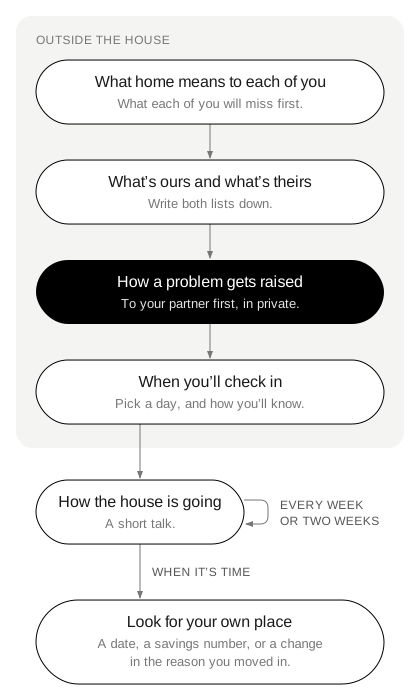
The third part carries the most weight. Without it, a small thing like towels on the wrong hook turns into a talk between one spouse and a parent, with the other spouse in the middle.
Three words for the first talk
A word gives each of you a neutral place to start, ahead of any complaint. These three from the Thesis deck fit a shared house. Take one per evening, and take turns saying what it brings up.
Home has Spoon on its other side. In this house, one of you may say “home” and mean exactly these rooms. The other may mean the apartment you left last month. Spoon is a gentler way in: whose spoons are in the drawer now, a dish one of the parents makes, the kitchen you each grew up eating in.
Boundaries has Shoes on its other side. Boundaries is the word for part two, said out loud before a parent opens your door without knocking. Shoes can lead to house rules from childhood: shoes off at the door, shoes by the bed, whose house had which rule. That’s a short way into how differently your two families ran a house.
Privacy has Diary on its other side. Privacy in a shared house is thin walls, a shared bathroom, and a parent who hears you argue. Talking about it can show what each of you needs to feel unwatched. Diary can lead to a memory of the first place either of you kept something to yourself.
Thesis has a die with six words on it: MEMORIES · BODY · PEOPLE · VALUES · CHILDHOOD · FUTURE. Roll it, then follow the rule line: “Look at the word from that side.”
Questions for the first weeks
If you’d rather start with a question, these keep the talk on the two of you and the house:
- What did a normal weekday evening look like in the home you grew up in?
- Which room in this house feels most like ours?
- What’s one thing your parents do here that I might read the wrong way?
- What’s one thing I do that your parents might read the wrong way?
- When do you want time with only me, and how will I know?
- Which house rule here would you change if you could?
- What would make you feel like a guest in this house?
- What do we want to keep from living here when we have our own place?
After each answer, use one of the follow-ups from the Thesis rule card: What did that feel like? Who else was there? Has it always meant that to you? The rules add one line that fits a shared house well: “What is said at the table stays at the table.” In this house, that means it stays between the two of you.
When the word lands on a parent
Talking about a partner’s parents can sting, even when it’s said gently. Agree before you start how passing works, as the Thesis rules ask. Either of you can pass, or turn the card to the object side. A short answer counts: “A short answer is a full answer. You can always ask for more.”
Start before the move
Pick an evening this week, outside the house. Write Home on a scrap of paper, and each of you describes a home you felt good in. Then go through the four parts, and write down the two lists from part two. End the way a game of Thesis ends: each of you names one thing you found out about the other today.
The three cards have their own pages: Home, Boundaries, and Privacy. For more on playing as two, see Thesis for couples. For the studies behind the deck, see the research page. To play with the cards on screen, open the online table. To see the cards and die, read the rules and the box. If the move comes in your first year together, see why the first year of marriage is hard. If you’re moving in to care for a parent, see how to talk to your parents about death.