Your toothbrush has lived at their place since spring. A few of your sweaters are in their closet. One lease ends in March, and someone says, half joking, that paying two rents is silly. Nobody sat down and decided anything, but the move is already happening.
This post is for dating or engaged couples who are about to move in together, or who notice they’re drifting that way. Researchers have a name for the difference between drifting and choosing: sliding vs deciding. Below is what the studies found, in plain words, and one evening conversation that turns the move into a decision you both made. You need no app and no deck for it. A word on a napkin works.
What “sliding vs deciding” means
Sliding is when a big step happens through small ones. A night becomes a weekend, the weekend becomes most of the week, and then a lease makes it official. Deciding is when both of you talk about the step, say yes to it, and know why.
The term comes from Scott Stanley, Galena Rhoades, and Howard Markman. In a 2006 paper, they looked at a pattern seen in US studies: couples who lived together before marriage had a higher risk of divorce and distress. Their explanation was inertia. Living together adds ties, like a shared lease, that make it harder to leave, so some couples who slid in end up marrying when they might not have chosen each other on purpose (Stanley et al. 2006). The paper argues for deciding at each transition.
What the studies found
Later studies tested parts of that idea. Each of the four findings below has limits.
Timing. Rhoades and colleagues surveyed 1,050 people married in the past 10 years. Those who lived together before getting engaged reported somewhat lower marital satisfaction, dedication, and confidence than those who moved in after engagement or after the wedding. The differences were small. People who moved in after getting engaged didn’t differ from those who waited for marriage (Rhoades et al. 2009). The authors call this a pre-engagement, but not a premarital, cohabitation effect.
Deciding as a habit. Owen, Rhoades, and Stanley asked 252 adults who were dating, living together, or married how much thought they put into relationship steps. Those who reported more deliberate decisions also reported more dedication and higher satisfaction, in all three groups (Owen et al. 2013). The study took one snapshot in time, so it can’t say which comes first.
Reasons for moving in. Chapman and colleagues followed 485 unmarried adults who moved in with a partner during a five-year study, with up to 11 surveys. Moving in to spend more time together went with better relationship functioning afterward. Moving in to test the relationship went with worse functioning and a higher chance of breaking up. Convenience, like sharing rent, predicted neither (Chapman et al. 2025).
What the reasons reflect. The same study found that the reasons didn’t change how couples developed over the years. Groups differed in where they started. The authors suggest the reason for moving in mostly reflects how the relationship was already going. A couple who moves in “to test it” may already have doubts.
The studies are observational. They don’t show that living together harms a couple, or that a couple who slid in is in trouble. They point to one place where the choice happens: the talk before the move.
Why couples skip the talk
The obvious advice is “talk about it first.” Couples who skip it can have reasons.
The move can look like logistics: rent, commute, a lease date. Raising what it means can also feel like a test. One partner worries that asking “why are we doing this?” sounds like doubt. And some couples fear the answer: if the reasons differ, it’s easier not to know.
A word gives the talk a softer start. Talking about what “home” meant in each of your families is less loaded than asking “are we ready?” It still gets to the same place.
One evening before you sign
This format needs a word, a table, and a calm evening. It works best before anyone signs a lease or gives notice.
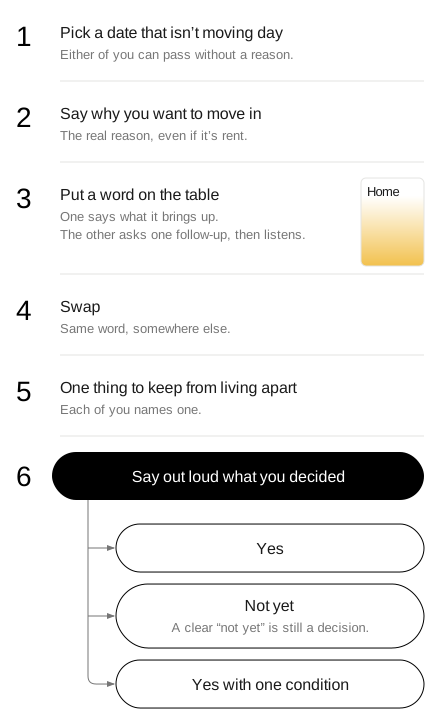
- Pick a date that isn’t moving day, and agree how passing works before you start. Either of you can pass without a reason.
- Each of you says, in one or two sentences, why you want to move in. Say the real reason, even if it’s rent.
- Put a word on the table. One of you says what it brings up. The other asks one follow-up, then listens.
- Swap and take the same word somewhere else.
- Each of you names one thing you want to keep from living apart.
- End by saying out loud what you decided: yes, not yet, or yes with one condition. A clear “not yet” is still a decision.
The Thesis rule card has three follow-up questions that fit any word:
What did that feel like? Who else was there? Has it always meant that to you?
Three words for this talk
These three cards from the Thesis deck fit a couple about to share a home.
Home has Spoon on its other side. Home is the word this whole step is about, and each of you brings a different one. One partner’s home growing up was loud and open-door. The other’s was quiet, with closed rooms. Spoon is a gentle start: whose spoons go in the drawer, the one you ate from as a kid, the meal that made a place feel like home.
Independence has Mug on its other side. It names a fear that can go unsaid: losing the life you had alone. Talking about it before the move lets each of you say what you want to protect, like a morning routine or an evening with friends. Mug is the small version of the same thing: the one cup that’s yours.
Privacy has Diary on its other side. Sharing a space changes what’s private, from mail to phone calls to time alone in a room. Diary can bring up a childhood diary, a sibling who read it, or a place you went to be alone.
You can also roll the die. Its six faces are MEMORIES · BODY · PEOPLE · VALUES · CHILDHOOD · FUTURE. Look at the word from that side.
Questions to ask before moving in together
If you’d rather start with a question, these keep the talk on meaning and away from the furniture list:
- Why do you want to move in now, and not six months from now?
- What did home feel like when you were 10?
- What’s one habit from living alone you want to keep?
- How much time alone do you need in a week?
- Who in your family showed you how to share a space?
- What would make our place feel like ours and not yours or mine?
- How do you want to handle a night when one of us wants quiet?
- What does moving in mean to you about where we’re headed?
- If it doesn’t work, how would we want to talk about it?
Use two or three in one evening. Follow each with one of the three follow-ups and let the answer run.
When the answers don’t match
Sometimes the talk shows that one of you sees the move as a step toward marriage and the other sees it as saving on rent. That’s useful to learn before the lease, not after. The rules put it this way: “Every view is welcome, especially one that differs from yours.”
A mismatch isn’t a verdict. It can mean waiting, or moving in with a clear agreement about what it means for now. If the talk gets heavy, the pass agreement from step 1 covers it. “A short answer is a full answer. You can always ask for more.”
Before the boxes come out
Write “Home” on a scrap of paper this week and leave it on the table at whichever place you’re at more often. After dinner, each of you says what it brings up. Then one of you asks Has it always meant that to you? End the way a game of Thesis ends: each of you names one thing you found out about the other.
The three cards have their own pages: Home, Independence, and Privacy. For more questions to ask as two, see deep questions for couples. More on playing as a couple is on Thesis for couples, the research behind the deck covers the studies, and you can play online or read the rules and the box.