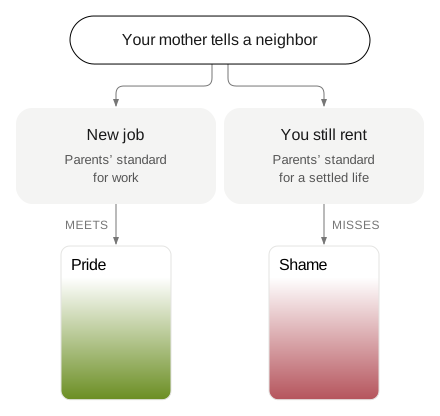
Your mother tells a neighbor about your new job, and your face goes warm. A few minutes later she mentions that you still rent, and your face goes warm again. The first time it was pride. The second time it was shame. Same person, same kitchen, same heat.
This post explains how pride and shame connect, what researchers found about each one, and how to talk about both with someone you trust. It ends with ten questions and a way to try them tonight, with the Thesis deck or a word written on a napkin.
The short answer
Pride and shame are two reactions to the same act: looking at yourself and judging what you see. When you meet a standard you care about, pride comes. When you fall short of it, shame comes. Both need a self to judge, and both can come with an audience in mind, real or imagined.
Psychologists group them together. June Tangney and colleagues review shame, guilt and embarrassment as “self-conscious” emotions, and they add pride to the moral emotions as a positive feeling that is sometimes morally relevant. They describe moral emotions as shaping the link between moral standards and moral behavior (Tangney et al. 2007). The standard is what ties pride and shame together. Change the standard and both feelings move with it.
The body shows both
Pride has its own posture, and people can read it. In three experiments, Jessica Tracy and Richard Robins found that judges could tell a posed pride expression apart from happiness. The expression included a small smile, the head tilted slightly back, a visibly expanded posture, and arms raised above the head or hands on the hips (Tracy and Robins 2004).
The same body shows shame after a loss. Tracy and David Matsumoto studied athletes after victory and defeat at the Olympic and Paralympic Games. Sighted, blind and congenitally blind athletes from more than 30 nations showed pride behaviors after winning. Athletes from most cultures also showed shame behaviors after losing, including those blind from birth, who had never seen anyone else do it (Tracy and Matsumoto 2008).
One detail from that study matters for conversation. Among sighted athletes, the shame response was weaker in highly individualistic cultures that value self-expression, mainly in North America and West Eurasia. The authors suggest some sighted people hold the shame display back in line with cultural norms. Pride may get shown while shame gets held back, even when the body starts to show it.
What you tell yourself about the cause
The story you tell about why something happened shapes which feeling arrives. In four studies, Tracy and Robins found that blaming failure on something inside you that is stable and out of your control went with shame. Blaming it on something inside you that can change and that you control went with guilt (Tracy and Robins 2006). “I’m bad at this” and “I didn’t prepare” lead to different evenings. The difference between those two is the subject of shame vs guilt.
Pride splits in a similar way. Across seven studies, Tracy and Robins found two facets of pride, which they call authentic and hubristic. The two had different personality correlates and different causes people pointed to (Tracy and Robins 2007). So the story about the cause matters for pride too. One question works for both feelings: does this say something about what I did, or about who I am?
Why one event brings both
A single event can hold both feelings because it touches more than one standard. The new job meets your parents’ standard for work. Renting misses their standard for a settled life. Each standard has its own audience, and each one gives its own verdict.
Time moves the verdict too. An adult sees a photo of old school friends at dinner and feels ashamed of who they used to be. The photo didn’t change the past. It brought back an old audience and an old standard. Pride works the same way: a story you were proud of at 25 can sound different told years later.
That’s a reason to talk about pride and shame together. Once the standard behind a feeling has a name, you can ask whose it is and whether you still hold it.
Ten questions about pride and shame
These questions work with a pen or with a friend asking them. Answer with a story where you can: a place, a year, a person.
- What’s something you’re proud of and a little ashamed of at the same time?
- Whose voice do you hear when you feel proud?
- Whose voice do you hear when you feel ashamed?
- What were you proud of at 10 that you’d keep quiet about now?
- What were you ashamed of at 16 that doesn’t bother you anymore?
- Which standard did you inherit, and which one did you choose?
- When did someone else’s pride in you feel like pressure?
- What do you hide that someone close to you would be proud of?
- When did you feel proud of something nobody else knew about?
- What would help you let one old shame go?
Look for the people who show up in your answers. The same name behind both pride and shame may point to the standard that matters most.
Look at the word from six sides
A second way in is to stay with one word and change the angle. The Thesis die has six faces: MEMORIES · BODY · PEOPLE · VALUES · CHILDHOOD · FUTURE. The only instruction is “Look at the word from that side.”
Pride has a Calculator on its other side. Choose the idea when you want to talk about what you’ve done and who saw it. Choose the Calculator when a story is easier: a school test, a first budget, a bill paid on time. Counting is a quiet kind of keeping score, and the score shows whose standard you were counting against.
Shame has a Letter on its other side. The idea can land close, so the second side matters here. A Letter brings up things written and never sent, or sent and regretted, or kept in a drawer for years. A player can tell the shame story through the letter, or pass. Both are full answers.
Try it with someone
Pride and shame are easier to sort out loud. A friend hears which standard you’re using and can ask whose it is. Two or three people at a table after dinner is enough.
The Thesis rules include one line for before play: “Before you start, decide together how passing works.” For these two words, agree on it before anyone draws. Then play:
- Draw a card. Pick a side: the idea or the thing.
- Roll the die and look at the word from that side.
- “Say as much or as little as you like. The others ask, gently.”
- Hand the die to the left.
The rules suggest three follow-ups: What did that feel like? Who else was there? Has it always meant that to you? For Pride and Shame, the second one does most of the work. It brings the audience into the room. “What is said at the table stays there.” With shame on the table, say that line out loud at the start.
Failure has a Washing machine on its other side. It sits between the two words: the same failure can end in shame, and the story told later can end in pride. The Washing machine side is lighter. It brings up chores, first apartments and the small things that went wrong and got fixed.
What to do tonight
Write the words Pride and Shame on one piece of paper. Pick one event from your life that brings up both. Tell it to one person you trust and let them ask one question: Who else was there? Then name whose standard you were measuring yourself against.
When you’re done, end the way a game of Thesis ends: each player names one thing they discovered about someone at the table today. “Sometimes one word is enough.”
See the rules and the box, or open the free online table. The cards above have their own pages: Pride, Shame and Failure. For playing with a few close people, see Thesis for friends. The research behind the deck explains where the words came from.