One of you found out. Maybe it was a message, a credit card statement, or a promise that turned out to be broken for months. You’ve both decided to stay. Now one of you picks up the other’s phone without meaning to, and the other keeps asking how long this will take.
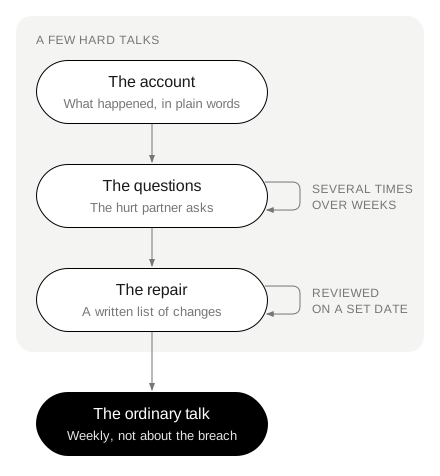
This post is for couples in that stretch: after the breach, after the decision to stay, before things feel normal. It walks through four conversations couples describe on the way back, in the order couples describe them, and what research says about each one. It covers lies, hidden spending, and broken promises. For an affair, repeated deception, or any fear for your safety, a couples counselor is the better place to start, and this post can sit next to that work.
What couples say the hard part is
People who write about this on marriage forums describe two separate problems. The partner who was hurt describes an urge to check: the phone, the bank app, the location. The partner who broke the trust describes a different worry: that every apology lands the same way, and that nothing they do counts.
Behind both sits one question couples ask in nearly the same words: can trust come back, and can the resentment go? Nobody can promise yes. What couples describe is that trust came back slowly, through a few hard talks and many small ordinary ones, and that the hard talks went better when they weren’t all crammed into one night.
Conversation 1: the account
The first conversation is the one where the partner who broke the trust says what happened, in plain words, without being dragged to each detail. It has one job: the hurt partner hears the facts from the person, not from a screen.
Research on apologies points at what this talk needs most. In two experiments with 755 participants, Lewicki, Polin, and Lount varied which of six elements an apology contained: regret, an explanation, acknowledgment of responsibility, repentance, an offer of repair, and a request for forgiveness. Acknowledging responsibility rated as the most important element, an offer of repair came second, and asking for forgiveness mattered least (Lewicki et al. 2016). The scenario was a job candidate and a wrong tax return, not a couple. The order still matches what forum posters report: “I did this” lands, and “please forgive me” too early can feel like a request to close the topic.
In practice, three sentences cover the top two elements: what I did, that it was my choice, and what I’ll do differently.
Conversation 2: the questions
The second conversation belongs to the hurt partner. They ask what they need to know, and the other answers. Couples describe this talk coming back several times over weeks, sometimes late at night.
Two agreements make it easier on both sides. First, the answers are true, including the dull or embarrassing ones. Second, the hurt partner can stop. A line from a Thesis rule card fits here word for word: “A short answer is a full answer. You can always ask for more.”
It helps to give this talk a container: a time, a place outside the bedroom, and an end. A talk on a walk is easier to come back from than a long one in the middle of the night.
Conversation 3: the repair
The third conversation turns the offer of repair into something both people can see. Couples who describe getting through this name concrete changes: a shared account for the money, a phone that’s no longer face-down, a check-in text when plans change. The hurt partner says what would help. The other says what they can keep up long after the first days.
Write the list down and put a date on it to review it together. Agreeing in advance that the list will change keeps it from turning into a permanent test.
Conversation 4: the ordinary talk
The fourth conversation is the weekly talk about anything except the breach: a memory, a worry about work, a plan. Couples describe this as the point where they noticed trust coming back, because talking felt like talking again and not like a hearing.
Studies of everyday upkeep in relationships point the same way. A meta-analysis by Ogolsky and Bowers pooled 35 studies with 12,273 participants on maintenance behaviors such as openness, assurances, and positivity. These behaviors correlated positively with satisfaction, commitment, and love (Ogolsky & Bowers 2013). The data is correlational and not specific to couples after a breach.
A format that works here: one word on the table, one of you says what it brings up, the other asks a follow-up, then you swap. A word written on a napkin works. The three follow-ups from the Thesis rule card fit any word:
What did that feel like? Who else was there? Has it always meant that to you?
Forgiveness is its own track
Forgiveness and trust can get treated as one thing. Couples describe them as two. A person can forgive and still check the bank app, or trust again and still feel angry on some evenings.
Research on married couples shows how much the motive behind forgiveness matters. In two studies, Fincham, Beach, and Davila measured forgiveness as the urge to retaliate, the urge to avoid, and goodwill toward the partner. Wives’ goodwill predicted better conflict resolution, as their husbands reported it, in both samples. Husbands’ urge to retaliate in one study, and to avoid in the other, predicted poorer resolution as their wives reported it. The links held regardless of how satisfied either spouse was with the marriage (Fincham et al. 2004). The study shows associations, not causes, and it didn’t look at breaches specifically.
What couples take from this: avoiding the topic can pass for forgiveness for a while. Saying out loud where you are (“I’m still angry about the money, and I want us to be okay”) gives the other person something real to work with.
Words for the ordinary talk
These three cards from the Thesis deck sit close to the topic without forcing it. Each has an everyday object on the other side, for evenings when the idea side is too much.
Trust has Window on its other side. Talking about trust in general, not about this breach, can show how each of you learned it: who you trusted as a kid, who let you down, what earned it back. Window is a gentler way in: a window you looked out of as a child, or one you left open.
Forgiveness has Door on its other side. It fits a later evening, once the account and the questions are behind you. Each of you can talk about someone you forgave, or didn’t, outside this relationship. Door can lead to a door you slammed, or one somebody held open.
Honesty has Radio on its other side. Honesty can open what each of you grew up believing about small lies and white lies, which can be where couples find they had different rules all along. Radio leads to a kitchen radio, a song in a car, a station a parent kept on.
Questions for the weeks after
These questions suit the ordinary talk once the first hard conversations are done. Use one per evening:
- Who did you trust most when you were a child, and why?
- What did your family do after someone broke a promise?
- What’s something you were told was a small lie that didn’t feel small?
- When did someone earn your trust back, and what did they do?
- What does an apology need for you to believe it?
- What helps you feel safe on a bad day?
- What’s a promise you’ve kept for years?
- What would you like us to be doing a year from now?
Try it this week
Pick the conversation you’re in. If the account hasn’t happened yet, start there, with the three sentences: what I did, that it was my choice, what I’ll do differently. If you’re past it, set one evening this week for the ordinary talk. Write Trust on a scrap of paper and end the way a game of Thesis ends: each of you names one thing you found out about the other today.
The three cards have their own pages: Trust, Forgiveness, and Honesty. For more on playing as two, see Thesis for couples. For the studies behind the deck, see the research page. To see the cards and die, read the rules and the box, or play online. For a longer list of questions that build closeness step by step, see 36 questions for couples.