A member finishes talking about the last week in the hospital. Her voice drops, she looks at the floor, and the circle goes quiet. You feel the pull to say something, anything, before the quiet gets heavy. In a grief group, that pause can be the room taking in what it heard. A workable starting point for “how long do I wait”: three slow breaths after a heavy share, longer if the speaker is still with her thoughts, shorter if she looks lost or overwhelmed. This guide covers why the quiet feels longer than it is, how to tell three kinds of silence apart, and the short lines that end a silence without cutting it off.
The guide is written for volunteer and peer facilitators. You know your group, and you decide how much quiet it can hold. Nothing here is a clinical method.
Why a few seconds feel like a long time
Ordinary conversation runs on short gaps, and a group circle breaks that habit. A study by Stivers and colleagues recorded conversations in 10 languages. Speakers in all of them avoided talking over each other and kept the silence between turns to a minimum. Each language’s average gap was within about 250 ms of the cross-language mean (Stivers et al. 2009). A grief circle asks people to leave far longer gaps than they’re used to, so a pause of a few seconds can register as something going wrong.
There’s also research on what a brief silence does to the people in it. In experiments at the University of Groningen, viewers watched a six-minute video of three people talking. In some versions a 4-second silence interrupted the talk. Viewers who saw it reported less self-assurance and more feelings of rejection, though they didn’t consciously notice the silence (Koudenburg et al. 2011). These were viewers of a recorded talk, with no grief group involved. Still, it fits what a host feels in the chair: the urge to fill the quiet comes fast and doesn’t wait for a decision.
That’s the case for agreeing on silence out loud. When the group knows the quiet is planned, the pause carries a different meaning.
Three silences in a grief circle
A quiet circle can mean different things, and each calls for a different wait. Watch the speaker and the room for a moment before you decide which one you’re in.
- The silence after a share. Someone has told the group something heavy. People look at the speaker or down at their hands. Nobody is reaching for a turn. This is the room holding what it heard, and it’s the one most worth protecting. A member who cries after speaking is in this silence too.
- The silence after a question. You’ve asked the circle something. People look away, shift in their seats, or look at the middle of the room. They’re thinking, or deciding whether to speak.
- The stuck silence. People glance at each other or at you. Nobody knows whose turn it is, or the thread got lost. This one ends best when you end it, with a plain next step.
How long to wait
Each kind of silence gets its own working rule. These are starting points to adjust for your group, not research findings.
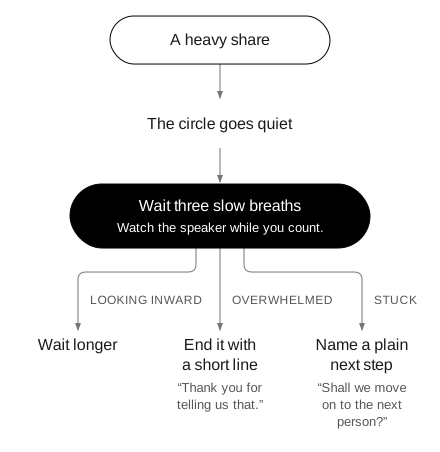
- After a share: wait three slow breaths before anyone speaks, you included. If the speaker is still looking inward, wait longer.
- After a question: let the quiet run until someone shifts toward speaking or it turns into the stuck kind. Counting breaths in your head keeps you from answering your own question.
- Stuck: end it as soon as you recognize it. A longer wait here adds pressure and nothing else.
What you do while you wait matters as much as how long it lasts. In a survey of 81 therapists by Hill, Thompson and Ladany, therapists described using silence to encourage reflection, to let feelings come up, to avoid interrupting the flow of a session, and to show empathy. During the silence they watched the client and showed interest. They said they wouldn’t use silence with severely disturbed clients, and most had learned to use it through clinical experience (Hill et al. 2003). That survey is about one-to-one therapy, but two points carry over to a circle: watch the person while you wait, and end the quiet sooner for someone who seems overwhelmed.
What to say when the wait ends
A silence ends well with a short line that names it and moves on. These lines can fit a grief circle:
- “Thank you for telling us that.”
- “Let’s stay with that for a moment.”
- “Take your time. We’re here.”
- “Whenever someone’s ready.”
- “Shall we move on to the next person?”
After a share, avoid a question straight away. A question puts the speaker back on the spot before she’s finished with the quiet. If the group uses follow-ups, they fit after the line, and only if the speaker looks open to them. The Thesis rule card gives three short ones: What did that feel like? Who else was there? Has it always meant that to you? One is enough in a grief circle.
Agree on silence before the first turn
A silence the group expects is easier to sit in. At the start of each session, say what the quiet means and what happens during it. One sentence does it: “After each person speaks, we’ll leave a little quiet before anyone else talks. It means we’re listening.”
Put this next to your pass agreement, so both are read out together. The pass covers the person who doesn’t want to speak. The silence agreement covers the moment after someone has.
Using a word to open the quiet
Some groups use a single word as a prompt for a round. The Thesis deck has 50 double-sided cards, with an idea on one side and an everyday thing on the other. A word written on an index card works the same way.
Silence is on the back of Tree. In a grief group it can make the topic of this guide a round of its own. A member might talk about the quiet of a house after a death, or about a silence with the person they lost that felt easy. Tree is the lighter side: a tree in a garden someone planted, or one that marked the way home.
Death has Phone on its other side. Some members will want the idea side and some won’t, and the card lets each person choose. Phone can lead to a saved voicemail, a number still in the contacts, or the call that brought the news. Silences may run longer after this card, so plan for fewer turns in the round.
Loneliness is on the back of Perfume. In a grief circle it names something members may not have said out loud. Perfume can bring back a person through a scent on a scarf or a bottle still on the shelf. Both sides can lead to the first kind of silence, so give it room.
The Thesis table card has a line that fits a quiet circle: “A short answer is a full answer. You can always ask for more.” A member who says one sentence and stops has taken a full turn, and the silence after it is part of that turn.
Try one round with your group
The online table lets you test a round on a shared screen before you bring cards to a session.
The die has six faces: MEMORIES · BODY · PEOPLE · VALUES · CHILDHOOD · FUTURE. The only instruction is “Look at the word from that side.” When the group is ready to stop, the rules end with one last round: “each player names one thing they discovered about someone at the table today.”
Before your next session
Write your silence agreement in the words you’ll say out loud, and put it on the same card as your pass agreement. In the session, after the first heavy share, count three slow breaths before you speak, and watch the speaker while you count.
For the rest of the session plan, see how to run a grief support group. For prompts that leave room for quiet, see grief support group discussion questions. The three cards above have their own pages: Silence, Death and Loneliness. For using the deck in sessions, see Thesis for therapy groups. You can play online for free, see the rules and the box, or read the research behind the deck. Related: check-in questions for group therapy: a new word each week.