The release slipped. Everyone on the team knows whose ticket it was, and so does the person who owns it. At the retro, one of two things can happen. The room goes quiet and the notes say “communication issues.” Or one person ends up explaining themselves at length while the others look at their screens. This guide is for the team lead who runs that meeting. It gives a seven-step running order for one failure, phrasings that keep the talk on the work, ten questions and one word you can put on the table.
The short answer
Talk about one event, in the order it happened. For each step, ask what people knew at that moment and why their choice made sense then. The lead goes first with their own part. The meeting ends with one change and a name next to it.
Google’s site reliability engineers call this a blameless postmortem. Their book says it “must focus on identifying the contributing causes of the incident without indicting any individual or team.” It also says the review “assumes that everyone involved in an incident had good intentions and did the right thing with the information they had” (Google SRE book). The steps below bring that idea from incident reviews into an ordinary team retro.
Why teams go quiet after a failure
People can stay quiet when speaking up has cost someone before. In threads about workplace feedback, people describe giving a careful, softened comment and then being ignored, or treated as a problem from then on. Once a team has seen that, “what went wrong?” sounds like a trap. The SRE book names the result: where people are blamed and shamed, they “will not bring issues to light for fear of punishment” (Google SRE book).
The research points the same way. Amy Edmondson studied patient care groups in two hospitals. The groups differed in how often errors happened, and also in how likely errors were to be detected and learned from by group members (Edmondson 1996). In a later field study of 51 work teams at a manufacturing company, she found that team psychological safety, a shared belief that the team is safe for interpersonal risk taking, was associated with learning behavior. Learning behavior in turn mediated the link between safety and team performance (Edmondson 1999). Both studies show associations, and not a recipe.
How to run the Failure retro in seven steps
The steps go in the order you’ll do them, for one failure per meeting.
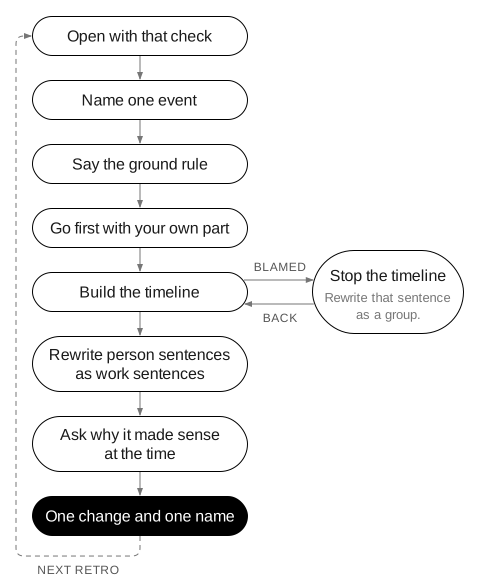
1. Name one event. Pick a single failure with a date: the release that slipped, the outage on Tuesday, the client demo that broke. A whole bad quarter is too big to describe step by step. Say in one sentence why the team is looking at it.
2. Say the ground rule before anyone speaks. Read the SRE line out loud: everyone involved had good intentions and did the right thing with what they knew. Then agree how passing works. Anyone can pass on a question without giving a reason.
3. Go first with your own part. The lead’s story can set the level for the room. Two or three sentences are enough: “I approved the date without asking QA. I knew the test plan was thin.” When the person with the most power names a mistake first, the next person may have less to lose.
4. Build the timeline together. Write the events in order on a shared board, with times. Ask what each person knew at each point. “By the afternoon we had a green build and no load test” gives the team something to work with. The question “why didn’t you test it?” gives one person something to defend.
5. Rewrite person sentences as work sentences. When a note names a person as the cause, the group rewrites it to describe what happened to the work. Four examples show the pattern:
- “Ana missed the bug” becomes “The bug passed review and the tests.”
- “Ops didn’t tell us” becomes “The alert went to a channel nobody on the team reads.”
- “Ben’s estimate was wrong” becomes “The estimate didn’t include the data migration.”
- “Someone pushed on Friday” becomes “The deploy rules allowed a Friday push.”
6. Ask why it made sense at the time. For the one or two steps that mattered most, ask what made that choice reasonable then. The answers can point to pressure, missing information or a rule that allowed it. The SRE book puts it in one line: “You can’t ‘fix’ people, but you can fix systems and processes.”
7. End with one change and one name. Pick one change the team will make, and write down who owns it and when you’ll check. Open the next retro with that check. A complaint that comes up in developer threads is that nothing changes after a retro. A check at the start of the next meeting shows the team that this one did.
When someone gets blamed in the room
Sometimes a teammate says “this is on Ben” in the middle of step 4. Stop the timeline and apply step 5 to that sentence, as the group, with the same calm as any other note. Then go back to the board. If one person keeps returning to blame, talk to them after the meeting, one on one. Describe what they said and what it did to the room.
Ten questions for a failure conversation
These questions keep the talk on events, information and choices, and each one works at any depth:
- What did we know at that point, and what didn’t we know yet?
- What made that choice the reasonable one at the time?
- Where did the first sign show up, and who saw it?
- What were we under pressure to finish?
- Which rule or habit allowed this to happen?
- What would have made the problem visible a day earlier?
- What went right while things were going wrong?
- Where did information stop on its way to the people who needed it?
- What’s one thing we’d do the same way again?
- What’s the smallest change that would help next time?
One word on the table
A single word can open a failure talk before the team is ready for a real incident. Each Thesis card has an idea on one side and an everyday thing on the other. Play a few rounds on a day before the retro, so the team has talked about failure in general before talking about this one.
Failure has Washing machine on its back. For a team, the Failure side brings up an exam, a first job or a launch from years ago, which can be easier to tell than last Tuesday. The die gives the same word a new angle on each roll, so two people can draw Failure in one session and tell different stories. The Washing machine side gives anyone who’d rather not tell a failure story a neutral way in: a machine that runs the same cycle every time, like a process nobody has checked in a while.
Honesty has Radio on its back. Honesty fits a team that has learned to soften bad news. A person can talk about a time they said the hard thing, or a time they didn’t. The Radio side is lighter: a station from home, or where someone first heard the news.
Courage has Bicycle on its back. Courage suits step 3, where the lead goes first. It lets people talk about what it takes to admit a mistake without naming one yet. The Bicycle side brings up learning to ride, and the first falls that came with it.
Running it as a card round
With the deck or the online table, each turn follows the same steps. Draw a card, choose the idea or the thing, roll the die. The die has six plain words: MEMORIES · BODY · PEOPLE · VALUES · CHILDHOOD · FUTURE. “Look at the word from that side.” The rule card adds “There are no right answers” and “A short answer is a full answer. You can always ask for more.” The others can ask short, open questions, such as What did that feel like? Who else was there? Has it always meant that to you?
Before your next retro, write your own part in the last failure in two sentences, and plan to say them first. For more on running it at work, see Thesis for teams and classes. For more on how personal a work conversation can get, see deep conversations at work. The same topic with friends is in how to talk about failure. For the studies behind the deck, see the research page, and for the full set, see the rules and the box.