You have a failure story ready. It has a challenge, a lesson, and a happy ending, and it got you the job. Then a friend asks how the startup went, or why you left the program, and that story sounds wrong at the kitchen table. So you make a joke, change the subject, and drive home with the real version still in your head.
This guide is about the other version: the one you tell a friend. It covers how to tell it, how to listen to one, ten questions to start with, and one word you can put on the table. You can use the Thesis deck, the free online table, or a word written on a napkin.
The short answer
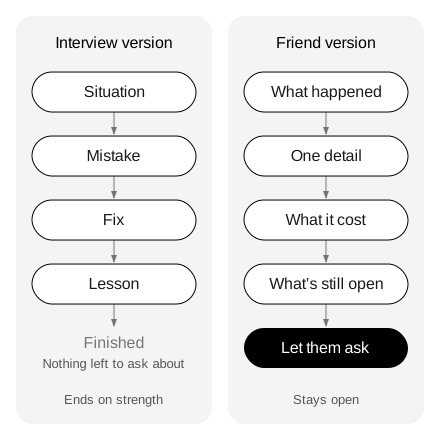
With friends, tell the failure before it has a lesson. Say what happened, what it cost, and what you still don’t know about it. Then let your friend ask. The interview version is finished, so there’s nothing left to ask about. The friend version stays open, and the open part is where the conversation starts.
The interview format has a fixed order: situation, mistake, fix, lesson. It’s built to end on strength. A friend doesn’t need the strength. A friend needs the part you’d cut for a recruiter: the night you told your parents, the money, the month you didn’t answer messages.
Why it’s harder than it looks
You may judge your own failure story more harshly than your friend does. Anna Bruk, Sabine Scholl and Herbert Bless ran seven studies on showing vulnerability, in situations such as confessing love, revealing imperfections of one’s body, or asking for help. People judged their own shows of vulnerability more negatively than the same acts by others (Bruk et al. 2018). The authors name taking responsibility for a mistake as one more example of such a moment. From the inside you see the risk. From across the table your friend may see someone being honest.
Friends who are doing well have a second reason to share their failures. Alison Wood Brooks and colleagues found across four experiments that people are reluctant to reveal failures, both while they happen and afterward. When a successful person revealed the failures on the way to success, observers felt less malicious envy than when they heard only about the successes (Brooks et al. 2019). If you’re the friend with the promotion, the story about the jobs that didn’t work out makes the promotion easier to hear.
The awkward pause after the story also gets misread. Christopher Welker and colleagues found that people rate their conversation skills more pessimistically than their skills at other common activities. They also put the low points of a conversation more on themselves than on the other person (Welker et al. 2023). So when the table goes quiet after you say “it didn’t work,” the silence feels like your fault. Your friend may be thinking of what to ask.
How to tell it
The steps below follow the order of telling. They work for a big failure and for a small one.
- Say what happened, in one or two sentences. “The shop closed in March. We lost the savings we’d put in.”
- Add one detail from the day. A place, a phone call, what you ate. Details make the story yours.
- Say what it cost you. Money, a friendship, a year, the way you saw yourself.
- Leave out the lesson for now. If you have one, it can come later, after questions.
- Name the part that’s still open. “I still don’t know if I quit too early.”
- Stop and let them ask. A short answer is fine. “A short answer is a full answer. You can always ask for more.”
How to listen to one
When a friend tells you about a failure, the first reply can decide whether the story continues. Advice and silver linings can close it: “at least you learned something” sounds kind and may end the topic. A question about the person keeps it open.
The Thesis rule card gives three follow-up questions that fit any story: What did that feel like? Who else was there? Has it always meant that to you? For a failure, the second one can be an easy way in. It moves the story from the result to the people around it: a partner, a boss, a parent who said “I told you so” or didn’t.
Ten questions about failure
These questions work at a dinner table, on a walk, or in a message. Answer with a story where you can, and keep it specific.
- What’s a failure you’re glad happened?
- What did you fail at as a child that still comes up?
- Who was the first person you told about your biggest failure?
- What failure do you tell as a joke, and what’s the serious part?
- When did you quit something, and was it a failure?
- What did your family call a failure when you were growing up?
- What’s something you tried that nobody saw you fail at?
- Which failure changed what you wanted?
- What would you try again if you knew how it ended?
- What failure of a friend’s made you like them more?
Look for the people who show up in your answers. A failure story can be a story about who was watching.
One word on the table
Sometimes a single word is an easier start than a question. The word Failure sits on one side of a Thesis card, and you can say as much or as little about it as feels right.
Failure has a Washing machine on its other side. Choose the idea when you’re ready to talk about something that didn’t work. Choose the Washing machine when the word lands too close: the first apartment with a broken machine, the laundry after a breakup, the parent who did everyone’s washing. The everyday side can lead back to a failure by a quieter road.
The die adds an angle. Its faces are MEMORIES · BODY · PEOPLE · VALUES · CHILDHOOD · FUTURE. Look at the word from that side. Failure from CHILDHOOD and Failure from FUTURE give two different stories from the same person.
Shame has a Letter on its other side. Shame can sit under a failure story and decide how much of it gets told. The Letter side can bring up a rejection letter, a report card, or a message you never sent. If the word feels too heavy, pass.
Courage has a Bicycle on its other side. Courage is the word for the attempt before the failure. Talking about it shows that a failed try and a try nobody made are two different things. The Bicycle brings up the first fall, and who was holding the seat.
Try it with friends
A failure is easier to tell when everyone at the table takes a turn. Two to six people and one deck is enough, or one word written on paper.
Before you start, agree together how passing works. Then play by the rule card: draw a card, choose a side, roll the die, and look at the word from that side. “The others ask what they’re curious about, gently, without judging.” Then hand the die to the left. “There are no right answers.” “What is said at the table stays at the table.”
What to do this week
Pick one failure you tell as a joke. Tell it to one friend with the cost included and the lesson left out. Then ask them one question back: Who else was there? At the end of a game of Thesis, each player names one thing they discovered about someone at the table today. A failure story can be that thing.
See the rules and the box, or open the free online table. The cards above have their own pages: Failure, Shame and Courage. For playing with a few close people, see Thesis for friends. For the studies behind the deck, see the research page. If your friends’ talk stays on weather and work, read what comes after small talk. Related: how men can talk about feelings with friends.