The plates are full, someone taps a glass, and the host asks everyone to say what they’re thankful for. Your uncle says “family.” Your cousin says “health.” The teenager says “food” and gets a laugh. Everyone speaks, and the table learns nothing new about any of them.
Gratitude talk works better when it gets smaller: one person at the table, one moment, one specific thing they did. This guide shows how to set that up, how a single word like Gratitude can carry it, and which questions open it without a speech. It works with the Thesis deck, the free online table, or a word written on a place card.
Why the go-around sounds like a toast
The go-around asks for a category, and categories have safe answers. “What are you thankful for” invites a list: family, health, a job, the meal. Each answer is true, and each one could come from anyone at any table.
The format adds pressure on top. Everyone speaks in order, everyone hears everyone, and whoever goes later has already heard answers to match. So the answers shrink toward what’s easy to say in public. That’s the toast feeling: words said to the room, aimed at nobody.
A conversation about gratitude needs two things the toast leaves out. It needs a person, and it needs a detail.
Thank someone at the table, with a “you”
A thank-you seems to land better when it’s about the other person, and less about what you got. In two studies of couples, researchers coded recorded conversations where one partner thanked the other. Statements that praised the partner, such as saying they were good at something, were linked to the partner feeling more loved and seeing the speaker as more responsive. Statements about how the speaker benefited showed no such link once praise was taken into account (Algoe et al. 2016).
At a holiday table, the shift fits in one sentence. “I’m thankful for my sister” is a category. “You drove all the way here with a pie on your lap” is a person. “You’re the one who remembers everyone’s allergies” is praise for who they are, and it gives the table a story to ask about.
Why people skip it
The obvious advice is to thank people directly, and it gets skipped because it feels awkward. In three experiments, people wrote gratitude letters and predicted how the recipient would react. They underestimated how surprised and how positive the recipients would feel, and overestimated how awkward the recipients would feel (Kumar and Epley 2018). Expected awkwardness was tied to how willing people were to express thanks at all.
That gap is worth knowing before dinner. In those studies, the awkwardness people expected was larger than what the recipients reported. A short, specific line is enough, and nobody has to stand up.
A format: one word instead of a round of thanks
A word gives gratitude an angle, so the answer turns into a memory or a person. Put the word on the table and let one person at a time take it. Here’s the setup:
- Agree on passing. The rules say “Before you start, decide together how passing works.” A pass with no reason keeps it light for the relative who hates being put on the spot.
- Put out one word. Draw the Gratitude card, or write the word on a place card.
- Pick a side. Each card has an idea on one side and an everyday thing on the other. Gratitude has Fence.
- Roll the die. The faces are MEMORIES · BODY · PEOPLE · VALUES · CHILDHOOD · FUTURE. Look at the word from that side.
- Talk, then hand it on. “Say as much or as little as you like. The others ask, gently.” Then hand the die to the left.
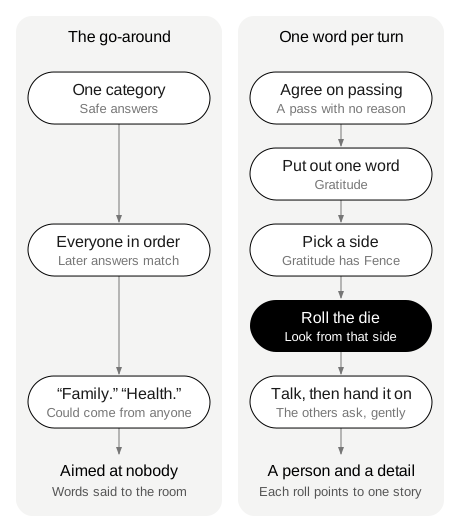
The die does the work the toast can’t. Depending on the roll, the same word might bring up a neighbor who fixed a bike, or land on someone across the table. Each roll points to one story, so nobody has to sum up a year of thanks.
No deck at the table? Open the online table on a phone in the middle of the table. It draws, flips and rolls.
Follow-ups turn thanks into a conversation
A thank-you on its own ends the turn. A follow-up keeps it going and lets the person who was thanked say something back. The rule card gives three questions that fit any word:
What did that feel like? Who else was there? Has it always meant that to you?
Ask one, then wait. If the answer is short, the rule card covers it: “A short answer is a full answer. You can always ask for more.” What gets said stays there too: “What is said at the table stays there.”
Gratitude questions for the Thanksgiving table
If you’d rather start with questions, these move from light to closer. Each one asks for a person or a moment, and leaves the category out:
- Who fed you well this year, in any sense?
- What’s a small thing someone here does that nobody mentions?
- Who taught you to cook the dish you brought?
- What did you get from a stranger this year?
- Who did you thank too late, or never?
- What’s an object in your home that came from someone at this table?
- Who made a hard week easier, and how?
- What did a grandparent do that you only understood later?
- What would you like someone here to know you noticed?
- What would you like to be thanked for ten years from now?
Pick a few of these for the stretch between the main course and dessert.
Three cards for the gratitude round
Each of these three cards opens gratitude from a different side.
Gratitude has Fence on its other side. The idea side is the direct way in, so roll the die first and let the face narrow it down to one moment. The fence side works for the guests who’d rather not say thanks out loud. A fence brings up yards, neighbors and who built what, and a story about who helped can follow.
Kindness has Book on its other side. Kindness sits close to gratitude, but it starts from the act, so the talk can start from what someone did and get to how it felt later. The book side can lead to a teacher, a library, or a book someone gave you and wrote in.
Enough has Photograph on its other side. At a table with too much food, it can open what “enough” looked like in other years and other kitchens. The photograph side can bring up old holiday pictures and the people in them, which is a quiet way to thank someone who isn’t at the table this year.
End with the last round
The game has its own closing line, and it fits the holiday better than a toast: “When the group is ready to stop, finish with one last round: each player names one thing they discovered about someone at the table today.” It’s gratitude in a form that names a person and a detail.
Before Thursday, pick one person at the table and one thing they did this year. Say it with a “you” in it. For the cards and how the game works, see the rules and the box, or play on the online table. The words above have their own pages: Gratitude, Kindness and Enough. For more on playing with a group, see Thesis for friends, and for the studies behind the deck, see the research. If the table tends to drift into an argument, see how to avoid politics at Thanksgiving.