A group chat plans a weekend away. Someone posts a cabin link, a few people react with a heart, and one friend goes quiet. Later they say they’re busy that weekend. Nobody mentions the price, and the friend misses the trip anyway.
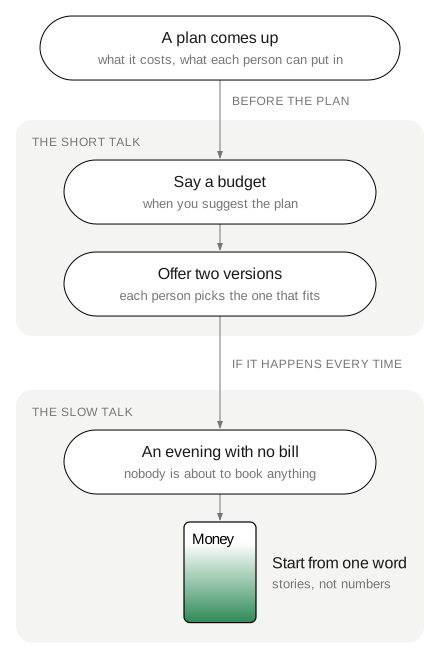
Money between friends works best as two separate talks. The first is practical: say a number before anything is booked, and agree on the split before the bill comes. The second is slower: one evening where everyone says what money means to them, with no plan on the table. This guide covers both. The second one works with the Thesis deck, the free online table, or the word “Money” written on a napkin. It’s about the conversation. It isn’t financial advice.
Two talks, two moments
The practical talk belongs at the start of a plan. A trip, a birthday dinner, a shared gift, a flat for a festival. At that point a number is a planning detail, and nobody has to explain why it’s too high. Once the booking is done, the same number turns into a confession.
The word talk belongs on an ordinary evening with nothing to decide. Friends who’ve known each other for years may know each other’s jobs but not what money meant in each other’s homes. That gap is where the awkward moments come from: one friend splits every bill to the cent because their family counted, another rounds up because their family never did.
Keeping the two apart helps both. The practical talk stays short because nobody has to defend a value. The word talk stays open because nobody has to agree on a price.
Why the question feels riskier than it is
Asking a friend about money feels like a test of the friendship. Research on sensitive questions suggests the fear is bigger than the cost. In five experiments with 1,427 participants, people avoided sensitive questions, such as asking about salary, because they expected the other person to feel uncomfortable and judge them. Partners rated people who asked sensitive questions about as favorably as people who asked neutral ones, and this held for friends as well as strangers (Hart et al. 2021).
Comparison is the other reason money feels loaded. In large European survey data, three-quarters of respondents said income comparisons were at least somewhat important to them, and comparing was associated with lower subjective well-being (Clark and Senik 2010). A money talk that turns into a ranking of who earns what may leave everyone worse off. A talk about what money means to each person has no ranking in it.
Before a group plan: five steps
These steps fit a group chat or a quick call. Do them in this order, before anyone pays a deposit.
- Say a number early. Put a rough cost in the first message: “Cabin for the weekend, about this much each.” A number in the first message is information. The same number after the booking is pressure.
- Offer two versions. A cheaper and a fuller one: a cabin or a tent, dinner out or dinner at someone’s place. Friends can pick a version without saying why.
- Say your own limit first. “My budget this month is tight, so I’d go for the cheaper one.” When one person names a limit, it can get easier for the next.
- Make opting out free. Agree that anyone can skip without a reason. The Thesis rules open the same way: “Before you start, agree together how passing works.”
- Agree on the split before the bill. Even split, pay what you ordered, or one person pays and the others send their share. Any of these works if it’s said out loud before the waiter comes.
Step 3 is the easiest one to skip. It feels like admitting something. In a group, it can give a quieter friend the opening they were waiting for.
When incomes drift apart
Friend groups formed at school or university can start with similar budgets. Years later, one friend earns far more, one has a child, one freelances, and one is retraining. Nobody chose the gap, and it changes the evenings anyway. The restaurant one friend picks without thinking is a careful decision for another.
Friends in this spot describe two moves that both cause distance. The friend with more money stops suggesting plans, so as not to seem showy. The friend with less money turns down plans, so as not to slow the group down. Both mean well, and both end with fewer evenings together.
A short sentence can break the loop. “I’d love to come, but that place is out of my budget. Could we do the pub instead?” Or, from the other side: “I picked this because I like it, not to make a point. Tell me if it’s too much.” Neither sentence needs a salary attached.
The word talk: one evening on Money
The second talk works with no decision on the table. Draw the Money card, or write the word on a piece of paper. Each person says what it brings up, as much or as little as feels right.
The Thesis die adds angles. Its six faces are MEMORIES · BODY · PEOPLE · VALUES · CHILDHOOD · FUTURE, and the only instruction is “Look at the word from that side.” The same word comes out as a first pocket money story from one friend and a worry about rent from another.
The rule card covers the moments when it gets quiet. “A short answer is a full answer. You can always ask for more.” And “What is said at the table stays at the table.” For money, that second line matters: a friend who mentions debt at the table shouldn’t hear about it in the group chat later. If someone wants more, the rule card gives three follow-ups: What did that feel like? Who else was there? Has it always meant that to you?
Questions about money to ask friends
The questions below ask about memories and meanings, not amounts. Answer one yourself before you ask it, so it reads as a trade.
- What’s the first thing you bought with your own money?
- How was money talked about in your home growing up?
- Who in your family was good with money, and how could you tell?
- What’s something you spend on that others might find strange?
- What’s something you’d never spend on, even with more money?
- When did you first feel you had enough?
- What did money mean to you at 20, and what does it mean now?
- Which shared expense between friends feels fair to you?
- What would you do with a year off work?
- What do you hope money means to you in ten years?
One or two of these can fill an evening. The rest can wait for the next one.
Three cards for a money evening
Each of these cards reads in its own way for friends whose lives have gone in different directions.
Money has Backpack on its other side. The idea side goes straight to the topic, which works for old friends who already know a lot about each other. The backpack side is the gentler way in: a school bag, a backpacking trip on a small budget, what you’d pack if you left tomorrow. Those stories can drift toward money on their own.
Enough has Photograph on its other side. It’s the money word with no number in it, so a friend who earns much more and a friend between jobs can answer it on equal terms. The photograph side brings up old pictures of the group, maybe from years when everyone had about the same budget.
Fairness has Sweater on its other side. It fits the bill-splitting question without making it about one dinner. Friends may find that they mean different things by fair: equal shares, or shares by income. The sweater side leads to hand-me-downs, borrowed clothes, and who got what among siblings.
Start with the next plan
The next time someone in your group suggests a plan, add a rough price to the reply and offer a second version. That’s the practical talk done in one message. Save the Money card for an evening with nothing booked.
See the rules and the box, or open the online table on a phone in the middle. For more on playing with a group, see Thesis for friends. For the studies behind the deck, see the research page. If one of you lives with a partner and the money question is at home too, see how to talk about money with your partner.