You meet the friends from school once a year. Someone starts the camping story, someone adds the part about the tent, and everyone laughs at the same spot as last time. By the end of the night, the table has covered one summer from years ago in detail and this year hardly at all. On the way home, the friendship can feel like it belongs to the person you were at 20.
The past is a good topic for old friends. It gets stuck when it’s read only one way, as a rerun. This guide reads it twice in one evening: first the memory, then where that memory points for each of you now. It uses one word, Nostalgia, and works with the Thesis deck, the free online table, or the word written on a napkin.
Why old friends reach for the past
Shared memories are the ground an old group stands on. In a set of seven studies, nostalgic memories usually centered on the person with close others or at important events. They carried more positive than negative feeling, and often a bad moment turned good later in the story. The same studies found that nostalgia came up with low mood and loneliness, and that it strengthened social bonds (Wildschut et al. 2006).
So the camping story isn’t a failure of the evening. It’s the group reaching for what holds it together. A UK national survey points the same way: evening meals that left people feeling closer involved more laughter and more reminiscing (Dunbar 2017).
Where the rerun gets stuck
A rerun tells the story in its fixed version. Everyone keeps the role they had back then: the funny one, the one who got lost, the one who drove. The story replays the roles, and nobody says what that summer means to them today.
The obvious fix is to talk about the present instead. It gets skipped for a reason. Between old friends, the present is the least shared part. Jobs, kids and apartments make a catch-up, and the catch-up is over by dessert. The past is what everyone at the table owns. Keep it, and change how you read it.
Reading the past two ways
Nostalgic memories can point forward. Across four studies, nostalgic stories contained more expressions of optimism, and recalling a nostalgic event raised optimism. Part of that effect ran through feeling connected to others (Cheung et al. 2013).
Another set of seven studies found that nostalgia raised people’s intentions to pursue friendships. Nostalgia for times full of other people went with intentions to interact with others, and nostalgia for less social times didn’t (Abeyta et al. 2015). That fits a table of old friends: the memory you share is already a social one.
The first reading is the memory itself. The second reading takes the same memory and turns it toward what comes next. The Thesis die has six faces: MEMORIES · BODY · PEOPLE · VALUES · CHILDHOOD · FUTURE. The only instruction is “Look at the word from that side.” For this evening, two of the six carry the plan: MEMORIES first, FUTURE second.
A two-round evening with one card
The plan takes one card and two rounds, then the game goes on as usual. These are the steps in the order you’ll do them:
- Put the Nostalgia card in the middle. Pick a side: the idea or the thing.
- For round one, set the die to MEMORIES instead of rolling it.
- Each player in turn looks at the word from that side. Say as much or as little as you like.
- The others ask, gently. One follow-up per answer is enough.
- For round two, keep the same card and set the die to FUTURE. Each player takes a turn again.
- After that, roll as usual and draw new cards for as long as it feels good.
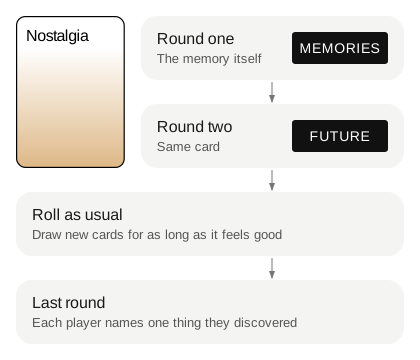
Here’s how the two rounds can sound. In round one, a friend talks about the key to the shared apartment at 22, which she never gave back. In round two, the same friend says she wants a place again where people can stay over without asking. Same card, same person, and the group hears something it didn’t know.
The online table draws, flips and rolls on one phone in the middle of the table. It also works on a video call for friends who live in different cities.
Passing and the stories that hurt
Old friends know each other’s sore spots, and some of them are in the shared past. For one player Nostalgia is warm. For another it brings back a parent who’s gone or a year they’d rather skip. The rules cover this: “Before you start, decide together how passing works.” A pass without a reason is a full turn. Turning the card to Key is another way out, since a key can lead to a door, a car or a bike lock instead.
Two more rule lines help with old groups. “What is said at the table stays there.” And from the rule card: “Every view is welcome, especially one that differs from yours.” Old friends can remember the same night differently, and the two versions are part of the conversation. For holding a line with a friend who pushes, see boundaries with friends.
Questions about the past for old friends
If you’d rather start with questions, these work for a group that shares years of history. They’re sorted from light to deeper:
- What’s a place we used to go that doesn’t exist anymore?
- What object from back then do you still own?
- Which story about you does this group tell wrong?
- What did you want at 20 that you still want?
- What did you think your life would look like by now?
- Who from those years do you still think about?
- What would you tell the group from back then about this year?
- What from those years would you like to bring into the next ten?
Each answer opens with one of the three follow-ups from the rule card: What did that feel like? Who else was there? Has it always meant that to you? The third one fits old friends best, because years change what a word means.
Three cards for old friends
These three cards read in their own way for a group that goes back years.
Nostalgia has Key on its other side. The idea side brings out the stories the group already tells, so it works best when each person says what the story means to them now. The key side is lighter: the key to a first apartment, a parent’s house, a locker. Keys also raise the question of who still has one, and why.
Adulthood has Coin on its other side. Old friends watched each other grow up, so this card can bring up when each of you felt grown up, and the answers can differ by years. The coin side goes to pocket money, a first wage, a bet between friends that nobody paid.
Home has Spoon on its other side. For friends who left the town they grew up in, home has moved, and this card shows where it is now for each of them. The spoon side goes to kitchens: a parent’s cooking, a shared apartment with too few spoons to go around.
End with the last round
When the evening winds down, finish the way every game of Thesis ends: “When the group is ready to stop, finish with one last round: each player names one thing they discovered about someone at the table today.” After two readings of the same past, each person has fresh material for it.
Before the next reunion, pick one shared memory and plan to tell it twice. See the rules and the box, or open the online table. The cards above have their own pages: Nostalgia, Adulthood and Home. For more on playing with a group, see Thesis for friends. For the studies behind the deck, see the research. Related: regret: the things left unsaid to old friends.