A song comes on in a shop, and you think of her. Or you pass the café where you both worked one summer, and he’s there again for a second. The friendship ended years ago, slowly or after one bad evening. What comes back is a sentence you never said: thank you for that winter, I’m sorry I stopped calling, I miss you.
If you regret losing a friend, the regret can have one sentence inside it. This post explains why that kind of regret keeps coming back. Then it gives three places to put the sentence: a message to the friend, a page you keep, or a table of friends who’ll listen. Pick one this week.
Why the unsaid part lasts
Regret has a timeline. A review of regret research by Gilovich and Medvec found that actions produce more regret in the short term. Over longer periods, the pattern flips, and things people didn’t do produce the more lasting regret (Gilovich and Medvec 1995).
A lost friendship can hold both kinds. The sharp thing you said in the last argument stings for a while. The call you didn’t make after they moved, the thank-you you meant to write, the apology you rehearsed in the shower and never sent: those are inactions. They’re the kind the research links to lasting regret, still there years later when the argument itself has gone blurry.
That’s also why “let it go” is hard to follow here. The regret is attached to something still undone. As long as the sentence stays unsaid, it has somewhere to come back to.
Find the sentence
The regret can start out vague: “I lost her,” or “we used to be close.” That’s too big to do anything with. Narrow it down to one sentence you’d say if the friend were across the table.
Unsaid sentences to old friends can fall into a few kinds:
- Thanks. “You let me sleep on your couch the whole spring I had nowhere to go.”
- Sorry. “I stopped calling after I moved, and I never told you why.”
- Missing them. “I still think of you when I make that pasta.”
- A question. “What happened between us? I never asked.”
Write yours down in one line. If it takes a paragraph, keep cutting until one sentence is left. The short version is easier to send, and easier to say out loud.
Three places to say it
Once the sentence is on paper, it needs somewhere to go. Each of these three works for a different kind of ending.
Send it to the friend. This fits a friendship that faded without a fight, or one where enough time has passed. Writing after years of silence feels like a risk, and research suggests it lands better than the sender expects. In a series of preregistered experiments, people underestimated how much others appreciated being reached out to. The gap was larger when the contact was more of a surprise, and between people who weren’t close at the time (Liu et al. 2023). In another set of experiments, people wrote gratitude letters and predicted how the recipients would react. They underestimated how surprised and positive the recipients would feel, and overestimated how awkward it would be (Kumar and Epley 2018).
Those studies looked at reaching out and saying thanks. An apology after a falling-out can land differently, and the friend may need time or may not reply. Keep the message short and ask for nothing back:
I found the photo from the lake trip today. I never thanked you for driving the whole way both times. I hope you’re well.
If they write back, how to reconnect with an old friend has the next steps and sample replies.
Write it and keep it. Some friendships can’t be reopened. You’ve lost every contact, they asked for space, or the ending needs to stay an ending. The sentence can still leave your head. Write it as a letter with their name at the top and keep it in a drawer. Nobody reads it, and it no longer has to live only in your memory late at night.
Say it at a table. The third place is other people. Telling a friend you have now about a friend you lost turns the sentence into a story someone else hears. They can ask who that person was, and you get to describe them out loud for the first time in years. A card game gives that kind of talk a frame, and a pass rule for when it gets too close.
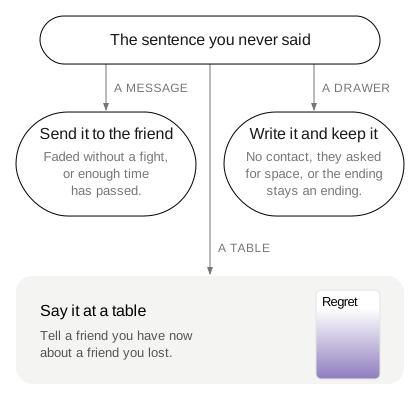
Saying it at a table with the Regret card
Regret has Lamp on its other side. The idea side goes straight to the topic of this post, and that can be a lot for a first round. The lamp side is the gentler way in: a desk lamp in a shared flat, a light someone left on for you, a room where two friends stayed up talking until it got light. Lost friends can turn up in those rooms too.
The die adds an angle to the word. Its six faces are MEMORIES · BODY · PEOPLE · VALUES · CHILDHOOD · FUTURE. The rule is “Look at the word from that side.” Some rolls will land close to the friend you lost, and some will take Regret somewhere else entirely. Both are fine.
Agree on passing before the first card. The rules say: “Before you start, decide together how passing works.” With a heavy word, a pass with no reason needed, or turning the card to Lamp, keeps the round easy to stay in. The rules also cover the person you’re talking about: “What is said at the table stays there.”
For the one telling the story, the rule is “Say as much or as little as you like. The others ask, gently.” The listeners have three follow-up questions that fit any word:
What did that feel like? Who else was there? Has it always meant that to you?
No deck at hand? Open the online table on a phone in the middle. It draws, flips, and rolls.
Questions about a friend you lost
If you’d rather talk it through without cards, these questions work between two friends or in a small group. They go from lighter to heavier:
- Who was your closest friend at 15, and where are they now?
- What’s an object you still have that belonged to a friend?
- What did that friend know about you that nobody else did?
- When did you last think of them, and what brought it up?
- What’s one thing they did for you that you never thanked them for?
- Is there something you’d take back from the last time you talked?
- What would you say if they walked in right now?
- What do you think they’d say about you today?
- Is there a friend in your life now you’d hate to lose the same way?
The last question points forward. It can be where the evening turns from the friend you lost to the friends at the table.
Two more cards for this talk
Forgiveness has Door on its other side. After a falling-out, this side can bring up who closed the door and whether it could open again. The door side is lighter: a front door you knocked on as a kid, a flat you moved out of, a door someone held open for you once.
Friendship has Ball on its other side. It moves the talk from one lost friend to friendship in general: what it meant at 10, what it means now. The ball side goes to playgrounds and sports clubs, and to the people who were there.
What to do today
Write the sentence in one line. Then decide where it goes: a message, a drawer, or a table. If it’s the table, bring one word, or see the rules and the box and play on the online table. The cards above have their own pages: Regret, Forgiveness and Friendship. For more on playing with a group, see Thesis for friends. For the studies behind the deck, see the research page. Related: talking about the past with old friends, two ways.