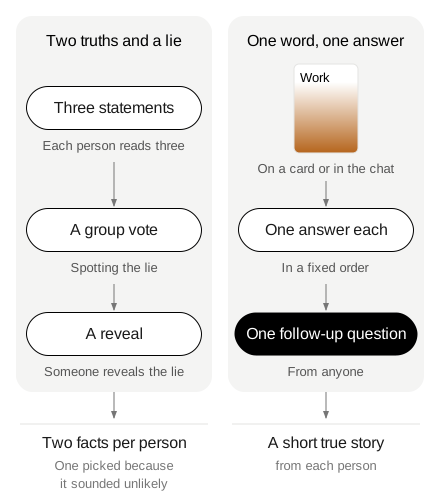
Two truths and a lie has a fixed shape. Each person reads three statements, the group votes, and someone reveals the lie. That’s one round of voting per person, and the team leaves knowing two facts per person, one of them picked because it sounded unlikely. The seven formats below keep the part that works, a short true story from each person, and drop the guessing. Each one runs with a pen and paper or a word on a sticky note, and the free online table covers the card version.
What the game gets right, and where it stalls
The game has two things going for it. Everyone gets a turn, and the format may already be familiar, so the rules take little explaining. The trouble sits in the middle of the turn. The group spends its attention on spotting the lie, and the true statements get a vote instead of a follow-up question. It also starts a working session with a task to mislead each other.
Teams may also expect a true answer to cost more than it does. In a series of experiments, Kardas, Kumar and Epley found that people expected deep conversations with strangers to feel more awkward than they did. Participants also underestimated how much their conversation partners cared about what they shared (Kardas et al. 2021). The studies were about strangers, so they don’t measure a team meeting. They do suggest that a round with one real answer can land better than people predict.
1. Two truths, no lie
Keep the familiar shape and remove the lie. Each person says two true things, and the group picks one to ask about. The asker gets one short question. The format is quick to explain to a team that knows the original, and the question goes to a true story instead of a guess. Ask for things that happened, such as “a place I worked before this one” or “something I fixed this year,” so nobody has to rank their own life for interest.
2. The object within reach
Each person picks up or names one object within arm’s reach and says where it came from. A mug, a pen, a charger cable with tape on it. Objects can work well at work because they give the speaker control over depth. The mug can be a mug from a conference, or a gift from someone who matters, and the speaker decides which. This format suits video calls, since everyone has a desk in front of them. Keep each answer short, then move on.
3. One word, one answer
Write one word on a card or in the chat, and each person says what it brings to mind for them. One answer each, in a fixed order, with one follow-up question from anyone. The word does the work that the three statements did in the old game: it gives everyone the same starting point, and the answers differ because the people do. A word with an obvious work angle can help a new team.
Work has Stone on its back. On a team, Work can open stories about first jobs, a manager who taught someone a habit, or a kind of task someone still enjoys. The Stone side suits anyone who’d rather not talk about their career that day. Someone might mention a stone they kept from a trip, a garden wall, or the weight of a task that felt like carrying one.
4. The skill nobody here knows about
Each person names one skill they have that hasn’t come up at work. Baking bread, fixing bikes, reading music, speaking a language they learned from a grandparent. This round has the surprise that two truths and a lie aims for, and it’s true from the start. It also gives teammates a reason to talk later, which a correct guess about a lie may not. Set one limit before the round starts: anything shared stays a fun fact, not a new assignment.
5. Write, then say one sentence
Give everyone a moment to write about a prompt tied to the meeting, then ask each person to read one sentence aloud. “What I want from today” and “One thing I’d like this project to get right” both work. Writing first can help the people who think before they speak, and reading one sentence keeps the round short. This is the format to pick when the opener has to connect to the agenda.
6. Pick a side
Give each person a card with two options and let them choose which one to talk about. With Thesis cards, that’s the idea on one side and an everyday thing on the other. On paper, write two prompts per slip, one personal and one about an object or a place. The choice is the point. The person who wants to say more takes the idea, and the person who wants to stay light takes the thing, and both answers count.
Honesty has Radio on its back. It’s a fair card for a team that used to start meetings with a lying game. Honesty can be read as a piece of direct feedback someone still remembers, or a time someone said “I don’t know” in a meeting. The Radio side can bring up a car radio on a long drive, a station a parent played in the kitchen, or a podcast someone listens to on the way to work.
7. The last thing that went right
Each person names one small thing that went well in the last week, at work or outside it. A bug found early, a hard email sent, a train that ran on time. The round is short and true, and it gives the team a picture of what each person counts as a good day. Run it at the end of a long project, when the team has had a lot of what went wrong.
Success has Notebook on its back. On a team, Success can open stories about what someone counts as a good outcome, which may differ from what the dashboard counts. The Notebook side gives a lighter way in: the notebook someone carries to every meeting, a list they keep, or the first page of a notebook they never finished.
Prompts for the true-answer formats
The questions below fit formats 1, 4 and 7, and each one works at any depth:
- What’s something you fixed recently?
- What’s a skill you learned outside work?
- What’s a tool you’d take to your next job?
- What’s a small thing that went right this week?
- What’s something you taught someone?
- What’s an object on your desk that has a story?
- What’s a place you worked before this one?
- What’s something you got better at this year?
Running it as a card round
With the deck or the online table, every turn follows the same steps. Draw a card, choose the idea or the thing, roll the die and look at the word from that side. The die has six plain words: MEMORIES · BODY · PEOPLE · VALUES · CHILDHOOD · FUTURE. The only instruction is “Look at the word from that side.” The rule card sets the tone with “There are no right answers.” It also sets the depth: “A short answer is a full answer. You can always ask for more.” The others ask what they’re curious about, “gently, without judging.” The rule card gives three examples of short, open questions: What did that feel like? Who else was there? Has it always meant that to you?
Agree on passing before the first turn. The rules put it in one line: “Before you start, agree together how passing works.” At work, a pass costs nothing and needs no reason, and the person running the meeting says so out loud.
For your next meeting, pick one format from the list and write it in the invite with a single prompt. If your team is remote, see virtual icebreakers for Zoom and Teams. The three cards above have their own pages: Work, Honesty and Success. For more on running it at work, see Thesis for teams and classes. For the studies behind the deck, see the research page. See the rules and the box.