The park is dark before dinner, and your group wants to meet without everyone paying for drinks. Berlin has a short list of indoor places where you can stay for an hour or two without buying anything. They’re built for looking or reading, so talking is limited. The place that lets a group talk for free all evening is someone’s flat.
This guide lists the free indoor spots that work for a small group, says what each one is good for, and then sets up a free evening at home. The home part works with the Thesis deck, the free online table, or a word written on a napkin.
Free indoor places that work for a group
These five places cost nothing to enter. Opening hours change, so check the official page before you go.
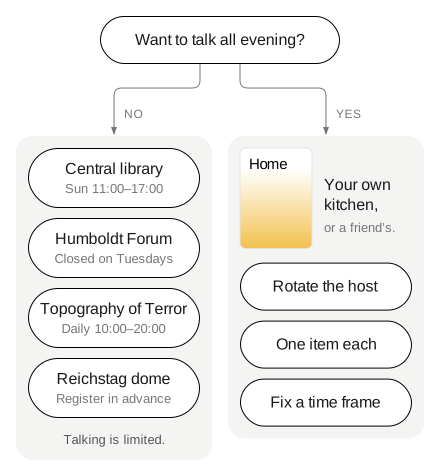
- Amerika-Gedenkbibliothek, Kreuzberg. The central library’s site lists it as open Mon–Fri 10:00–21:00, Sat 10:00–19:00 and Sun 11:00–17:00 (ZLB). Good for meeting, sitting, reading side by side. Talking stays quiet.
- Humboldt Forum, Mitte. Several areas are free, including the Sculpture Hall, the Palace Cellar, and the Video Panorama (Humboldt Forum prices). Exhibitions are open Wednesday to Monday, 10:30–18:30, and closed on Tuesdays (Humboldt Forum visit). Good for a slow walk and a talk about what you saw.
- Topography of Terror, Kreuzberg. Free admission, open daily 10:00–20:00 (Topography of Terror). The subject is heavy. It suits a group that wants to talk about history afterward.
- Reichstag dome, Mitte. Admission is free, but every visitor registers in advance with name and date of birth, and people 16 and older show an official photo ID (Bundestag). Good for one planned evening with a view, less so for a spontaneous meetup.
- Your own kitchen, or a friend’s. No opening hours, no booking, no quiet rule. The rest of this guide is about this one.
Why public places don’t hold a conversation
The spots above solve the cost. They don’t solve the talking. A library asks for quiet. A museum keeps the group walking, and the talk breaks off at every room. The dome needs a visit registered in advance.
Cafés and bars fix the talking but bring back the bill, and there can be pressure to order a second round to keep the table. That leaves the one place nobody has to pay for: a flat. A small flat or a shared one with flatmates can make hosting feel like a big step. A table and one free evening are enough.
How to host a free evening at home
A free evening needs three things settled in advance: who hosts, what people bring, and what you do once the catch-up is over. The setup below keeps it free and easy to repeat.
- Rotate the host. Each meetup, a different person offers their kitchen. Nobody carries the evening every time, and everyone sees how the others live.
- One item each. Each guest brings one drink or one snack. Tea and bread count. Nobody keeps score.
- Fix a time frame. Put a start and an end time in the invite. A clear end makes it easier for a flatmate to agree and for a tired friend to say yes.
- Ask the flatmates. A short message the day before. Invite them to join if they want.
- Plan one thing after the catch-up. The catch-up fills the start of the evening with news. After that, the evening needs something on the table.
One word for after the catch-up
The thing on the table can be one word. Thesis works like this: 2–6 players, 50 double-sided cards, an idea on one side and an everyday thing on the other. The rules fit on the back of the box:
- Draw a card. Pick a side: the idea or the thing.
- Roll the die. Look at the word from that side.
- Say as much or as little as you like. The others ask, gently.
- Hand the die to the left.
The die is a card you fold into a six-sided prism and roll like a pencil. Its faces are six plain words: MEMORIES · BODY · PEOPLE · VALUES · CHILDHOOD · FUTURE. Look at the word from that side.
The box isn’t on sale yet. The online table is free and runs on one phone in the middle of the table. It draws, flips, and rolls.
Settle passing before the first card. The rules say: “Before you start, decide together how passing works.” A friend who doesn’t want a card can pass or turn it to its other side. Another line from the rules helps in a shared flat with thin walls: “What is said at the table stays there.”
Questions for a free night in
If you’d rather start with questions, these fit a group that meets in each other’s kitchens. They go from light to deeper:
- Which room in Berlin feels most like yours, besides your flat?
- What did you do on a free evening as a teenager?
- Who in your family was the one who hosted?
- What’s something you own that you’d never give away?
- What’s the cheapest evening you remember liking?
- Which place in this city did you stop going to, and why?
- What does a good evening at home look like for you?
- Who would you like to bring next time?
Pick two. Use the rule card follow-ups when an answer is short: What did that feel like? Who else was there? Has it always meant that to you?
Three cards for an evening at home
These three cards fit a group that meets at home.
Home has Spoon on its other side. For anyone who moved to Berlin from somewhere else, the idea side brings up two homes at once: the one here and the one left behind. The spoon side stays in the kitchen you’re sitting in, with a family recipe, a soup someone made when you were ill, or the spoon nobody in the flat claims.
Community has Mirror on its other side. For a group that has been meeting for a few months, the idea side brings up what the group already is. The mirror side is lighter: a hallway mirror in a first flat, getting ready to go out, or the face you make in the mirror before a party.
Play has Laptop on its other side. The idea side fits a group of adults who meet to play a game, and it can bring back childhood games played for free in a courtyard. The laptop side brings up work, a first computer, or the evenings someone spent online instead of going out.
Send the first invite
Pick a date this week, choose whose kitchen it is, and send one message with the time frame and “bring one thing.” If you’re the one who always writes first, being the one who always reaches out looks at that from both sides. If your guests don’t know each other yet, see hosting a party where guests don’t know each other. For a regular night in English, see English speaking events in Berlin.
See the rules and the box, or open the online table. The cards above have their own pages: Home, Community, and Play. For more on playing with a group, see Thesis for friends.