The money argument in your house probably isn’t the one you have most often. It’s the one that comes back. In a study where 100 married couples logged every disagreement at home for 15 days, money came up less often than children or chores. Yet both partners rated money fights as more important, wives reported them as longer, and more of them ended with an agreement to discuss it later (Papp et al. 2009).
This post is for couples who keep having the same money argument: the same purchase, the same savings goal, the same “we can’t afford that.” It explains what the diary study found, why a money fight can stall on the numbers, and gives you one evening format that starts somewhere else.
What the diaries showed
Lauren Papp, Mark Cummings, and Marcie Goeke-Morey trained husbands and wives to fill in a short report after each disagreement at home. The 100 couples were parents, married for 12 years on average. Over 15 days they described 748 conflicts that both partners recorded.
Money was a topic in 18.3% of husbands’ reports and 19.4% of wives’ reports. Children came first, at 36.4% and 38.9%. So by count alone, money was a mid-table topic.
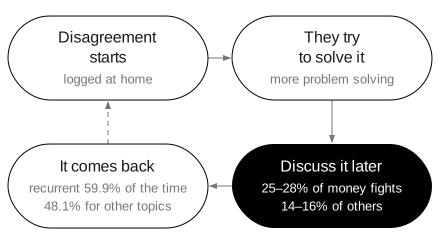
The difference showed up in how the money fights went. Both partners rated them as more important, now and for the long term. In wives’ reports, a money conflict lasted about 30.6 minutes, against 15.3 minutes for other topics. Husbands said money conflicts were recurrent 59.9% of the time, against 48.1% for other topics.
The detail that explains the loop is about endings. Wives reported more problem solving in money conflicts than in others. Even so, both partners were more likely to end a money conflict by agreeing to discuss it later: about 25–28% of money conflicts, against 14–16% of others. Those talks had more problem solving and still ended open more often.
The authors are clear about the limits. The data were collected in 1999–2000, the couples were mostly white parents, and the design can’t say what causes what. It describes the pattern at home. It doesn’t prove that money makes a marriage worse.
Why it matters past one evening
A second study looked further ahead. Jeffrey Dew, Sonya Britt, and Sandra Huston used survey data from 4,574 US couples and followed who later divorced. Disagreements about money predicted divorce more strongly than other common disagreements, for both wives and husbands (Dew et al. 2012). How couples argued and how satisfied they were explained that link.
One finding stands out in the abstract. Once money disagreements were counted, a couple’s financial well-being no longer predicted divorce. In that data, the arguing mattered more than the bank balance. The result is a pattern across thousands of couples. It can’t forecast one marriage.
Why the numbers don’t settle it
A money fight sounds like a math problem. Can we afford the trip, should we save more, who pays for what. One fix is a spreadsheet: agree on a number and move on. Then the same argument can come back.
Couples on marriage forums describe this loop in plain terms. One partner wants a child soon, the other wants savings first, and every talk ends with the same questions. Another couple, already engaged, found out late how different their long-term plans with money were. Neither thread is about arithmetic.
The diary result fits that. Wives in the study reported more problem solving in money fights, and couples still left more of them open. A plan for the next purchase can be right and still miss what each of you is protecting: safety, freedom, fairness, or a promise made to yourself at 15.
Start with what money meant before you met
A different starting point can help when the budget talk keeps stalling. Before the next decision, spend one evening on the history behind the numbers. It fits a night with no bill due and no purchase waiting.
- Pick a calm evening, away from payday and away from the purchase you disagree on.
- Agree how passing works before you start. Either of you can pass without a reason.
- Put one word on the table: Money, Fairness, or Enough. A card, the online table, or a word on a napkin all work.
- One of you says what the word brings up. A memory, a person, a place, an object.
- The other asks one follow-up, then listens. No advice and no counterpoint tonight.
- Swap, with the same word.
- Stop when it feels done. Leave the decision for another day.
The Thesis rule card has three follow-ups that fit any word:
What did that feel like? Who else was there? Has it always meant that to you?
For money, the third one carries the most. A partner who checks the account every morning may have grown up in a house where the rent was late. A partner who spends on trips may have watched a parent save for a retirement they didn’t get to enjoy. Neither story settles the budget. Both change how the next budget talk sounds.
Three words for a money evening
These three cards from the Thesis deck come at money from different sides. Each has an everyday object on its back, which helps on an evening when the idea feels too heavy.
Money has Backpack on its other side. Money is the word you’ve argued about, so it can feel close to the fight. Starting from childhood helps: who handled money at home, what was said about it at dinner, what a coin or a bill meant at age 8. Backpack is a softer way in: a school bag, a first trip, what you carried and who paid for it.
Fairness has Sweater on its other side. Some money fights can be fairness fights in another form: who earns more, who pays for what, who gave something up. Saying what fair meant in each of your families shows whether you mean the same thing by “half.” Sweater opens hand-me-downs, a gift, or something knitted by someone.
Enough has Photograph on its other side. Savings goals can stall on one question nobody asks out loud: how much is enough. One of you may hear a number. The other may hear a feeling of being safe. Photograph can lead to a picture from a time when there was little, or plenty.
When the old argument shows up
A word about money can slide back into the budget. If that happens, name it and go back to the story, or turn the card to its object. The rules put it this way: “Every view is welcome, especially one that differs from yours.”
The diary couples ended money fights with “discuss later” more often than other fights. That’s a fair choice when both of you set a time. Pick a day for the decision and keep the story evening separate from it.
Try it this week
Choose a quiet evening with no money decision on it. Write Money on a scrap of paper. One of you says who handled money in the house you grew up in, and the other asks Has it always meant that to you? Then swap. End the way a game of Thesis ends: each of you names one thing you found out about the other.
The three words have their own pages: Money, Fairness, and Enough. The studies behind the deck are on the research page, and for more on playing as two, see Thesis for couples. To see the cards and die, read the rules and the box. When the problem is a flat evening rather than an argument, see bored in a relationship.