A song comes on in a shop and you’re 17 again, in a friend’s car with the windows down. For a second the feeling is warm. A second later it’s mixed with something like loss. Then you wonder why your mind went there, and why now.
This post covers what psychology research has found about nostalgia: where the word came from, what sets it off, and what it does for us. At the end there are ten questions to talk it through with someone.
The short answer
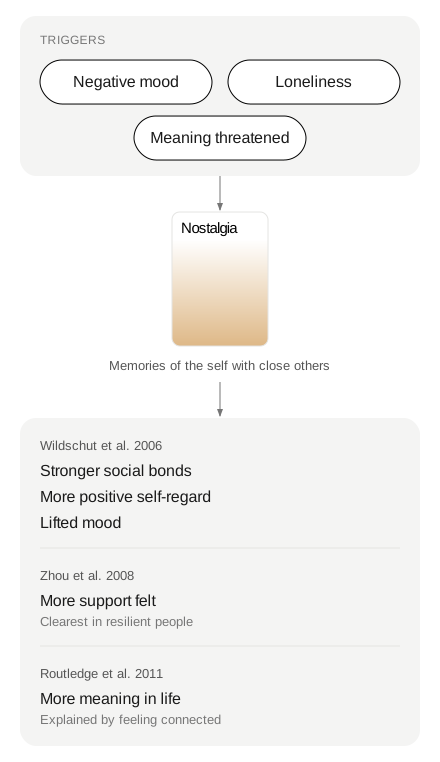
Nostalgia tends to show up when the present feels thin: a low mood, a lonely evening, a cold day. The memories it brings are usually about you with people who mattered. In experiments, calling up those memories made people feel more connected to others, better about themselves, and more sure their life had meaning. Read that way, nostalgia works like a reach backward for something the present is short on.
Where the word came from
Nostalgia started as a diagnosis. A Swiss medical student named Johannes Hofer coined the term in 1688 to describe the extreme homesickness of Swiss mercenaries posted far from home. He built it from two Greek words, nostos and algos, “return home” and “suffering.” Hofer treated it as a disease of the brain, and for a while it was thought to be a Swiss problem. Later reports found it in French soldiers and in soldiers of the American Civil War (Cao 2024).
Today psychologists study nostalgia as an emotion. The longing for home is still in it. The illness label is gone.
What nostalgia feels like, in people’s own words
When researchers asked people what nostalgia is, the answers lined up. Erica Hepper and colleagues ran seven studies on how lay people define it. Memories, relationships, and happiness came out as central features. Daydreaming, regret, and loneliness came out as peripheral ones. People described nostalgia as a state about the self and about other people, one that mixes happiness with loss (Hepper et al. 2012).
That view isn’t limited to one country. A later study asked 1,704 students in 18 countries on 5 continents to rate 35 features of nostalgia. The samples agreed strongly on the order of the features, and the central ones came out on top in every country (Hepper et al. 2014). The authors read this as a sign that nostalgia is an emotion shared across cultures.
So the bittersweet part belongs to the definition.
What sets it off
Tim Wildschut, Constantine Sedikides, and colleagues ran seven studies on what nostalgia is about, what brings it on, and what it does. Nostalgic memories usually centered on the self with close others, or on big events such as weddings. They held more positive feeling than negative. Many followed a pattern where a hard scene turned out well later. Two triggers stood out: negative mood and loneliness (Wildschut et al. 2006).
Temperature turned out to be a trigger too. In five studies, people reported more nostalgia on colder days and in a cold room. People who recalled a nostalgic event rated the room as warmer, and they held up better against painful cold, than people who recalled an ordinary event (Zhou et al. 2012). The phrase “heartwarming memories” in the paper’s title is close to literal.
If you feel nostalgic often, these triggers are a place to look. A move, a quiet stretch with fewer friends around, a run of hard weeks, a long winter: each one fits the pattern.
What it does for us
The same 2006 studies found that nostalgia strengthened social bonds, raised positive self-regard, and lifted mood (Wildschut et al. 2006). In plain words, a good memory of people reminds you that you were cared for, and that feeling carries into the present.
Loneliness is where this shows most clearly. Xinyue Zhou and colleagues ran four studies on loneliness. Loneliness lowered how much support people felt they had. It also raised nostalgia, and nostalgia in turn raised the support they felt (Zhou et al. 2008). The effect was clearest in resilient people.
Meaning is the third piece. Clay Routledge and colleagues ran six studies and found that nostalgia went with a greater sense of meaning in life, and that bringing nostalgia on in an experiment raised it. Feeling connected to others explained the effect. When people’s sense of meaning was threatened, they turned to nostalgia more (Routledge et al. 2011).
These are lab and survey studies. They describe what nostalgia does on average. They don’t promise that a memory will lift any particular evening.
Ten questions about nostalgia
Nostalgia is easier to understand when you say the memory out loud. These questions work with a friend asking them, or with a pen. Answer with a story where you can: a place, a year, a person.
- What song takes you back fastest, and to where?
- Which smell puts you in a kitchen from your childhood?
- Who is in the memory you return to most?
- What place would you visit for one more afternoon?
- When did you last feel nostalgic, and what was going on that day?
- Which object from an old home do you still have?
- What hard time do you now remember with some warmth?
- What do you miss that you wouldn’t want back?
- Which friend from the past would you call tonight if you could?
- What part of your life now do you think you’ll miss later?
Question 5 is the one to linger on. If the answer is a lonely week or a low day, it matches what the research describes.
Look at the word from six sides
Another way in is to stay with one word and change the angle. The Thesis die has six faces: MEMORIES · BODY · PEOPLE · VALUES · CHILDHOOD · FUTURE. The only instruction is “Look at the word from that side.”
Nostalgia has Key on its other side. The idea side goes to a time; Key goes to a door. A key to a first apartment, a grandparent’s house, or a bike lock from school can open the same memory the word does. Choose Key when it’s easier to start with a thing than a feeling.
Home has Spoon on its other side. Hofer’s word began as homesickness, and Home keeps that thread. Spoon pulls toward a table: who cooked, what was served, who sat where.
Tradition has Fridge on its other side. Traditions are nostalgia people repeat on purpose: the same dish, the same song, the same day each year. Fridge can lead to the drawings and notes stuck on a parent’s fridge, and to what you’ve kept up in your own home.
Try it with someone
A memory told to another person can come back with more detail, and the other person may have one of their own. Two or three people at a table is enough.
The rules open with “Before you start, agree together how passing works.” Then take turns:
- Draw a card. Choose a side: the idea or the thing.
- Roll the die.
- Look at the word from that side. Say as much or as little as feels right.
- The others ask what they’re curious about, gently, without judging.
- Hand the die to the left.
The rule card gives three follow-ups: What did that feel like? Who else was there? Has it always meant that to you? For Nostalgia, the second one matters most. The research keeps finding other people at the center of these memories, and the question brings them into the room.
What to do tonight
Next time a song or a smell pulls you back, notice what kind of day it is. Then tell the memory to one person and ask them for one of theirs. “A short answer is a full answer. You can always ask for more.”
See the rules and the box, or open the free online table. The cards above have their own pages: Nostalgia, Home, and Tradition. For playing with a few close people, see Thesis for friends. For the studies behind the deck, see the research page. If talking about the past feels stiff at first, see why deep conversations feel awkward.