The call starts at the usual time. You ask about work, they ask what you ate, you both say you’re tired. Before long one of you says “okay, I’ll let you sleep,” and after you hang up you notice you were bored. Then the worry starts: if this is boring now, what does it say about us?
This post is for couples living apart who feel bored on their calls and wonder if it means the connection is fading. The short answer: boredom on calls can show up in a relationship that’s fine, and on its own it can say more about the shape of your contact than about your feelings. Below are a way to tell which one it is, what two studies found about couples apart, and a way to bring the boredom up with your partner without it landing as a complaint.
What the boredom looks like at a distance
Long-distance forums have posts like these. One partner writes that the other has said they’re bored, and asks how to fix it before the connection slips. Another asks whether couples ever talk openly about getting bored with each other. A married woman living apart from her husband asks if feeling distant is normal for their setup or a sign of something worse.
In threads like these, the relationship itself may not be the problem. The writers describe a routine: a call at the same hour, the same questions, the same report of the day. A couple living together can get variety for free. They see each other tired, cooking, laughing at a neighbor, meeting friends. Apart, almost everything has to pass through a screen and a few chosen sentences. When those sentences repeat, the whole relationship can start to feel like a repeat.
Bored with the call or bored with the person
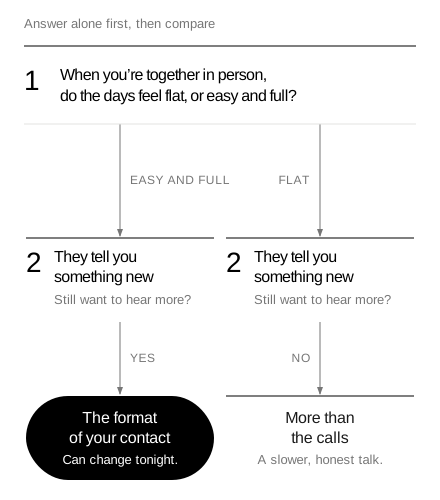
Two questions help separate the two. Answer them alone first, then compare.
- When you’re together in person, do the days feel flat too, or do they feel easy and full?
- When your partner tells you something you didn’t know about them, do you still want to hear more?
If in-person time feels full and new things still pull you in, the boredom lives in the format of your contact. That’s the easier case, because a format can change tonight. If in-person time feels flat as well, and new things about your partner leave you cold, the boredom is about more than the calls. That’s worth a slower, honest talk, and this post can only help with the first step of it.
What research says about couples apart
In a nationally representative US sample of 870 people, those in long-distance relationships reported higher relationship quality on a number of measures, higher dedication, and less feeling trapped than those living close by (Kelmer et al. 2013). At the start, they also expected a lower chance of breaking up. By the follow-up, though, they had broken up as often as couples living close. In that sample, living apart went along with higher reported quality. The study can’t say what made some couples last.
A diary study by Jiang and Hancock looked at how dating couples, apart and nearby, built intimacy across the media they used (Jiang and Hancock 2013). According to the abstract, it tested two routes to intimacy: how partners adapted what they disclosed to each other, and how much they idealized each other. Those effects depended on the medium. A plausible reading for a bored couple: what you choose to share on a call matters, and the same report of the day leaves little room for either.
Why “call more” doesn’t fix it
A familiar piece of advice is more contact: longer calls, more texts, a good-morning message. It can make the boredom worse. More of the same format means more repetition, and a long call with nothing new in it can leave both people more tired than a short one.
There’s a second reason couples don’t change the format. Saying “I’m bored on our calls” feels risky. It can sound like “I’m bored with you,” so a partner may keep quiet and the call stays the same. Naming the boredom as a shared problem with the call, in those words, makes it easier to hear. Try something like: “Our calls have turned into a report. I miss hearing the stuff that isn’t news. Can we try something different on Sunday?”
One word on the call
A change in format can be small. Pick one word before the call, and spend part of it on that word instead of the report of the day. One of you says what the word brings up: a memory, a person, a place, an object. The other asks one follow-up and listens. Then you swap.
The Thesis rule card offers three follow-ups that fit any word:
What did that feel like? Who else was there? Has it always meant that to you?
Both of you can open the online table on your own screens, or one of you can type the word into the chat. The rules start with one agreement that matters more at a distance, where it’s harder to read a face: “Before you start, agree together how passing works.” A pass on a call can be as small as saying “next.”
Three words for a couple apart
These three words from the Thesis deck fit a long-distance call. Each card has an everyday thing on its other side, which helps when energy is low.
Belonging has Headphones on its other side. Belonging asks where each of you feels you fit right now: in your city, your job, your friend group, with each other. At a distance those answers can drift apart without either of you noticing. Headphones is an easy start for a call you’re probably having through a pair of them: the music you play on the way to work, or a song you associate with the other person.
Nostalgia has Key on its other side. Nostalgia brings up stories from before you met, which a partner apart may not have heard yet, since so much of the talk goes to the present day. Key can lead to a first apartment, a parent’s house, or the key to a place you’ll share one day.
Hope has Teddy bear on its other side. Hope turns the call toward the future without making it a planning meeting about dates and flights. Teddy bear can lead to childhood: what each of you held on to, and who gave it to you.
The die adds another turn. Its six faces are MEMORIES · BODY · PEOPLE · VALUES · CHILDHOOD · FUTURE. Look at the word from that side.
Questions for a flat call
If you’d rather start with a question, these stay away from the report of the day and leave room for a story:
- What’s something you’ve noticed in your city this week that I’d like?
- What did you think about on your commute today?
- What’s a meal from your childhood you could still describe in detail?
- Who did you talk to today that I’ve never met?
- What’s something you’ve changed your mind about since we’ve been apart?
- Which place from your past would you show me first?
- What’s a small thing you’d do with me on an ordinary weekday?
- What did you want to tell me today and then forgot?
Use one per call and follow it with one of the three follow-ups.
When the talk about boredom gets hard
Bringing up boredom can open a harder topic: doubts about the distance, about the timeline, about whether one of you will move. If that happens, the pass agreement still holds. Either of you can stop and set a time to come back to it. The rules put it this way: “A short answer is a full answer. You can always ask for more.”
Try it on your next call
Before your next call, send your partner one word, with no explanation. Belonging works as a first one. At the start of the call, give it the first part of the call, before the report of the day. End the way a game of Thesis ends: each of you names one thing you found out about the other today.
For setting up a game over video, see long-distance relationship games. If the boredom feels bigger than the distance, see bored in a relationship. The three cards have their own pages: Belonging, Nostalgia, and Hope. More on playing as two is on Thesis for couples, and the research behind the deck covers the studies. To see the cards and die, read the rules and the box. Related: long distance relationship statistics: what five studies found. Related: long distance in a second language: how to talk past small talk. Related: sad after a call, long distance: the low after a good call and what helps.