A story pops up on your phone: your old friends around a table, a candle, a bottle you recognize. You weren’t asked. A week later, someone mentions a trip they took together in spring. You thought the group had gone quiet. It hadn’t. It kept meeting, and the plan stopped including you.
Here’s the short answer. The sting is normal, and one evening says little about your worth. Several ordinary reasons fit the same photo. The useful move is to check what you know, pick one next step, and make the next plan yourself. This guide covers why it hurts, what it can mean, five steps, and one way to make a meetup easier to join.
Why it hurts more than you expected
Being left out hits even when the stakes are tiny. In one online study, 1,486 people from 62 countries played a simple ball-tossing game with two computer partners. The more often the ball skipped them, the worse they felt and the lower their sense of belonging (Williams et al. 2000). That was a game against a computer. With friends from school or your twenties, the same signal carries years of history.
So a strong reaction to one photo is in proportion to what the group meant. It doesn’t need talking down. It does need a pause before you act on it, because a message written right away can read as an accusation.
What it can mean, and what it can’t
One evening without you is a fact. The story around it is a guess until someone tells you more. Several explanations fit the same photo, and they call for different responses:
- Logistics. Two friends live on the same street and the plan grew from there. You moved, or you have kids, or you work late.
- An old pattern. You turned down a few plans, and the group stopped asking to spare you the “no.”
- A smaller group. The dinner was a birthday, a work thing, or a couple’s evening that spread.
- Drift. Your lives moved apart, and nobody said it out loud.
- Something unspoken. There’s a tension nobody has raised with you yet.
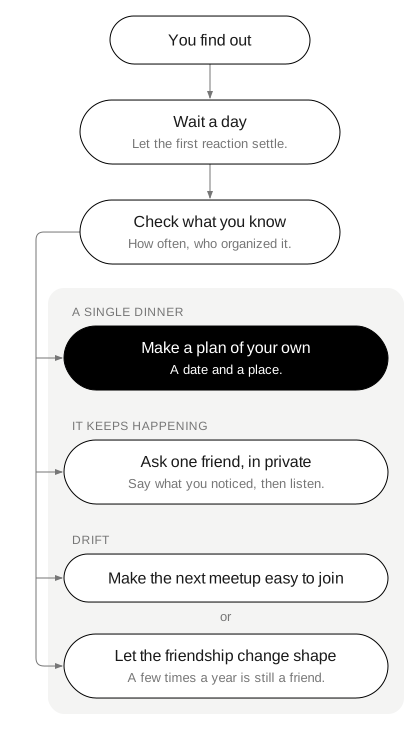
Only the last two are about the friendship itself. Even those leave room for a conversation. Before picking one, look at what you know for sure: how often it happened, who organized it, and when you last made a plan with any of them.
Five next steps
These steps run in the order of doing. The first three may be enough.
- Wait a day. Let the first reaction settle before you write anything. Mute the group chat for an evening if it helps.
- Check the pattern. Count the plans you’ve heard about over the last few months, and the ones you started. A single dinner and a year of trips are different situations.
- Make a plan of your own. Message one or two people from the group with a date and a place. Keep it specific: “Pizza at mine on Friday?” A concrete plan is easier to say yes to than “we should catch up.”
- Ask one friend, in private. If it keeps happening, pick the person you’re closest to. Say what you noticed and how it felt, plainly: “I saw you all went to the lake. I missed being there. Is there a reason I’m not hearing about these?” Then listen to the answer.
- Decide what the friendship is now. If the answers point to drift, the friendship can change shape. A friend you see a few times a year is still a friend.
Step 3 can feel like the wrong one, because it puts the effort on the person who was left out. It works anyway, because it gives the group a fresh plan to say yes to. Research on reaching out points the same way. In a series of preregistered experiments, people consistently underestimated how much others appreciated being reached out to, and the gap grew when the message was more surprising (Liu et al. 2023). A text after a long quiet is that kind of surprise. If you’re already the one who starts every plan, always the one reaching out covers that side.
What to say if you ask
The conversation in step 4 goes better with a few short questions ready. Pick two or three, not all of them:
- Is there a group chat I’m not in?
- Did I say no so often that people stopped asking?
- Is it easier to meet without me because of where I live now?
- Is something between us that I haven’t heard about?
- How do you all decide who comes along?
- What would make it easy to include me next time?
- Would you come if I hosted something next month?
- Do you miss how the group used to be?
Questions 1–3 offer a practical reason, which makes them easier to answer. Question 4 is the heavy one. Ask it only if you’re ready to hear the answer without arguing with it.
Make the next meetup easy to join
An old group can meet only for the catch-up, and the catch-up has a cost: whoever missed months of news sits outside the shared jokes. A format that starts everyone from the same place takes that cost away. One word on the table does this, because nobody has an advantage on a word.
Thesis is one way to set that up: 50 double-sided cards, an idea on one side and an everyday thing on the other, and a die with six faces: MEMORIES · BODY · PEOPLE · VALUES · CHILDHOOD · FUTURE. The only die line is “Look at the word from that side.” A word written on a napkin works the same way. If friends live in other cities, the online table runs on a phone or a shared screen.
Agree on passing before the first card. The rules open with “Before you start, agree together how passing works.” For a group that has drifted, the line “What is said at the table stays at the table” also matters, since some of what comes up will be about the group itself.
Three cards for this moment
These three cards fit a group where someone has felt left out. Each has a heavier idea side and a lighter thing side.
Belonging has Headphones on its other side. The idea side lets the group talk about where each person feels at home, without anyone naming the group directly. The headphones side is the light way in: the album you played on repeat at 19, the bus rides, who you shared earbuds with.
Loyalty has Camera on its other side. Friends can mean different things by loyalty, and hearing what each means can be the conversation the group skipped. The camera side brings back the photos from years ago, including the ones with everyone in them.
Jealousy has Kitchen table on its other side. This card is for groups ready to name things, and passing is fine. The kitchen table side goes to a childhood home, a shared flat, or the table where the group first met.
When the evening ends, use the last round from the rules: “each player names one thing they discovered about someone at the table today.” For a person who felt outside the group, hearing one of those may mean more than an explanation.
The other side
Sometimes the answer to step 4 is plain: the group meets near work, or your weekends are full, and nothing more. Sometimes it turns out messages stopped going both ways a while ago. Both answers give you something to act on, which a photo on your phone doesn’t.
Write one message today with a date in it. See the rules and the box, or open the online table for a first round. The cards above have their own pages: Belonging, Loyalty and Jealousy. For more on playing with a group, see Thesis for friends. For the studies behind the deck, see the research page. Related: how not to run out of things to say with friends.