In week one of a grief group, the check-in may be the first time members speak in front of strangers. By week eight, the same people know each other’s losses by name. One check-in question can’t fit both rooms. This guide stages the opening round by the group’s age, with grief group check-in questions for week one, week four and week eight, and notes on the weeks in between.
It’s written for volunteer and peer facilitators of closed grief groups that meet weekly. Thesis is a conversation format and makes no clinical claims. You know your group and its limits, and you decide what belongs in your opening. The examples use the Thesis card deck, which has an everyday object on one side of each card and an idea on the other. An object you name aloud works the same way.
Why the check-in changes as the group gets older
A check-in does two jobs. It gives each member a turn early in the session, and it shows the facilitator where people are today. The second job changes, because what members are willing to say changes.
In week one, members are guessing how the room will react. In experiments by Kardas, Kumar and Epley, people underestimated how much strangers cared about their personal disclosures, and their expectations were more accurate with close friends and family (Kardas et al. 2021). A new grief group is a room of strangers. A low first step makes sense while those guesses are still off.
Members of bereavement forums describe the same start in their own words. One felt scared in the first sessions, couldn’t face crying or hearing others cry, and didn’t open up while many people were present. Another found everything raw in the early weeks and came close to tears at most meetings. Both kept attending. A check-in for week one gives people like them something to say that doesn’t start with the death.
The second reason is repetition. A check-in that never changes can turn into a ritual answer that members give without thinking. Changing the prompt in steps keeps the frame familiar and moves the content a little closer to the loss each time.
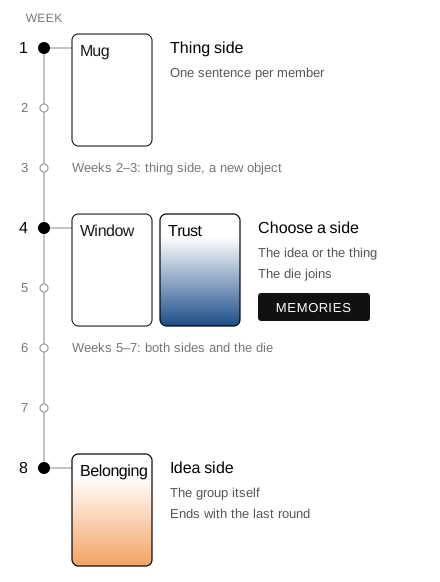
Week one: start with an object
The first check-in asks about a thing in the room or in the member’s day. A thing gives the member a place to start that they control. They can stay with the object, or mention the person they lost through it, and both count as a full turn.
Keep each answer to one sentence and say so before the round. The Thesis table card puts it this way: “A short answer is a full answer. You can always ask for more.” Go first yourself and keep your own answer short, so the length is set by example.
These four check-in questions work for a first session:
- What’s one object you brought with you today, and why that one?
- What did you hold in your hands this morning?
- Which thing at home did you notice most this week?
- What’s in your pocket or bag that you’d keep?
Independence is on the back of Mug. In week one, the mug side is the easy way in: who makes the tea now, which cup they reach for, the mug nobody else uses. For a widowed member, independence can mean managing alone for the first time. Lay the card mug side up and let members turn it if they want.
Weeks two and three: same frame, new object
Between the first and fourth sessions, keep the shape of the week-one round and change only the object. Members learn what a check-in is here: one turn each, one sentence, a pass allowed. People who arrived scared in week one can predict what’s coming in week two. When some members start answering with the person they lost before they reach the object, the group is ready for the next step.
Week four: offer the idea side
By the middle of the series, members have heard each other speak three times. Now the check-in can offer a word for the week, with the object still there as an option. In Thesis, that’s the second step of the rules: “Choose a side: the idea or the thing.” A card like Window, with Trust on the idea side, lets each member pick. Nobody asks why they chose a side.
Week four is also a good time to make room for harder feelings. Maruyama and Atencio evaluated an 8-week bereavement support group in a general hospital. Of the women in the study, those who dropped out had scored higher on anger and tension than those who stayed (Maruyama and Atencio 2008). The authors suggest people with high anger and tension may need approaches that focus on accepting negative emotions. A check-in word that names anger out loud lets members know it can be said here.
These four check-in questions suit the middle weeks:
- Which word fits your week better: tired, busy, quiet or angry?
- What took more out of you this week than you expected?
- What did you do this week that you couldn’t do in week one?
- Who or what got on your nerves this week?
Anger sits on the back of Ring. Both sides carry weight in a grief group, and that’s why the card belongs in the middle weeks and not the first. A member may talk about anger at a hospital, at a relative, or at the person who died. Another may talk about a ring they still wear or have taken off. If a member lost a spouse recently, you can hold it back for a later week.
Weeks five to seven: let members bring the word
Once the idea side has been offered, the next step is to hand the choice over. At the start of the session, one member draws the card for the week’s check-in, or names a word of their own.
A check-in can wear out in these weeks. A member-chosen word changes every week without the facilitator writing a new question. Keep the pass agreement the same: a member who passed in week one can pass in week six.
Week eight: look back and close
The last check-in looks at the series as a whole. Members now know each other’s stories, and the questions can refer to what they’ve heard.
These three check-in questions fit a final session:
- What’s one thing you can do now that you couldn’t in week one?
- What will you take from this room into next week?
- What did someone here say that stayed with you?
The Thesis rules end the game with the same move: “each player names one thing they discovered about someone at the table today.” A member who said little all series can take part by naming what they heard.
Belonging is on the back of Headphones. By the last week, belonging can be about this group: where members felt they fit, and where they’ll look for that after the series ends. Headphones gives the quieter way in, a song someone listened to on the way here or the music the person they lost played.
Try the stages with your group
You can test the week-one round today. Open the online table, pick an object card, and play one round with a colleague or co-facilitator before the first session.
The die has six faces: MEMORIES · BODY · PEOPLE · VALUES · CHILDHOOD · FUTURE. The only instruction is “Look at the word from that side.” In week one you can leave the die out and add it in week four, when members are ready for the idea side.
Before your next series starts, write the three stages on one index card: object in week one, a word in week four, a look back in week eight.
For more on running the game in a session, see Thesis for therapy groups. The three cards above have their own pages: Independence, Anger and Belonging. You can play online for free, see the rules and the box, or read the research behind the deck. For the rest of the session, see grief support group discussion questions. To end each session, see check-out questions for group therapy. Related: death Cafe or grief group? How to choose what to host. Related: check-in questions for group supervision.