It’s Tuesday, 9 p.m. The kids are asleep or there are no kids. You’ve covered what’s for dinner tomorrow, who picks up the package, and whether the noise from the furnace is new. Then the room goes quiet, and one of you wonders if that’s a bad sign.
This post is for couples who’ve been together for years and keep landing in that quiet. It helps you tell an easy silence from a drift, and gives you a 20-minute format for a weeknight: one word on the table and three follow-up questions. You need no app and no deck. A word written on a napkin works.
Quiet isn’t the problem by itself
Couples on marriage forums describe the same evening in nearly the same words. Talk covers food, chores, and the calendar. When they try for more, one of them finds there’s no news to tell, or the conversation repeats one they had last month. Many of them add that they’re happy together.
Some people in those threads say the quiet is the good part. After years together, nobody has to perform or fill the air. That’s a fair point. Sitting on the sofa without talking can be a sign of ease.
Two questions help separate ease from drift:
- Does the quiet feel restful, or does one of you feel lonely in it?
- When did you last hear something new about your partner’s inner life: a fear, a hope, a memory you didn’t know?
If the quiet feels restful and the second answer is “last week,” there’s nothing to fix. If one of you feels alone in it, or the answer is “I can’t remember,” the quiet has turned into distance.
Why the obvious advice doesn’t stick
The usual tip is “ask better questions.” Couples try a list, and after a few evenings it runs dry. A list also asks for performance: a big question at 9 p.m. on a Tuesday can feel like an exam.
There’s a second barrier. People expect a deeper talk to feel awkward. In experiments by Kardas, Kumar, and Epley, participants overestimated how awkward deep conversations would be, and the talks left them more connected than they predicted (Kardas et al. 2021). Those participants were strangers, so the result doesn’t transfer one to one to a couple. It does describe the hesitation many couples report: the sense that starting a real talk will be strange.
What people talk about may also matter for how they feel. In a study by Mehl and colleagues, 79 students wore a recorder for four days. The happiest participants had less small talk and more substantive conversations than the least happy ones. In conversations, substantive talk made up 45.9% for the happiest group and 21.8% for the least happy (Mehl et al. 2010). The study is correlational and wasn’t about couples. It can’t say that deep talk makes anyone happier.
A 20-minute Tuesday format
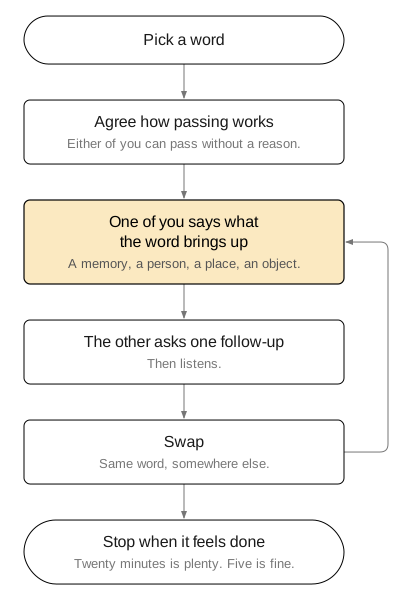
This format needs a word, two chairs, and no preparation. It works after dinner, on a walk, or in the car.
- Pick a word. Use a card, the online table, or a word one of you writes down.
- Agree how passing works before you start. Either of you can pass without a reason.
- One of you says what the word brings up: a memory, a person, a place, an object. Say as much or as little as feels right.
- The other asks one follow-up. Then listens.
- Swap. The second person takes the same word somewhere else.
- Stop when it feels done. Twenty minutes is plenty. Five is fine.
The Thesis rule card has three follow-up questions that fit any word:
What did that feel like? Who else was there? Has it always meant that to you?
The third one is the one long-term couples tend to skip. You’ve heard your partner’s story about their first apartment. You may not know what “home” meant to them then, and what it means now.
Words that work on a weeknight
A Tuesday word should be light enough to start with after a long day, with room to go deeper if both of you want to. These three from the Thesis deck fit.
Home has Spoon on its other side. Home is a word you share every day and rarely define. One of you may mean this apartment. The other may mean their parents’ kitchen, a town, or a person. Spoon is an easy start when energy is low: a spoon from childhood, a soup someone made, a drawer in a grandparent’s house.
Silence has Tree on its other side. It fits the exact worry this post is about. Talking about silence on a quiet evening can show you whether you read the quiet the same way. Tree is a gentler door: a tree you climbed, one outside a window, one you planted.
Curiosity has Sewing machine on its other side. It asks what each of you still wants to find out, about the world or about each other. The sewing machine often leads to a story about a parent or grandparent and the things they made with their hands.
Questions for when you want a list
If you prefer to start with a question, these ones stay away from logistics and leave room for a story:
- What’s something you’ve changed your mind about in the last year?
- Which room from your childhood do you remember best?
- What did you want to be at 12, and is any of it still there?
- Who taught you how to argue?
- What’s a smell that takes you back somewhere?
- What did your family do on weeknight evenings when you were a kid?
- What’s something small that made your week better?
- Which of your habits came from one of your parents?
Use one question per evening. Follow it with one of the three follow-ups, and let the answer run.
When the word lands somewhere hard
A light word can open something heavy. Home can bring up a move that still hurts. If that happens, the pass agreement from step 2 covers it. Either of you can stop, or turn the card to the object side. The rules put it this way: “A short answer is a full answer. You can always ask for more.”
If a word opens a real disagreement, set it aside and agree when you’ll come back to it. “Every view is welcome, especially one that differs from yours.”
Try it tonight
Write one word on a scrap of paper and leave it on the kitchen table. Home is a good first one. After dinner, one of you says what it brings up, and the other asks Has it always meant that to you? Then end the way a game of Thesis ends: each of you names one thing you found out about the other today.
For a longer evening, see deep date night questions for couples. The three cards have their own pages: Home, Silence, and Curiosity. More on playing as two is on Thesis for couples, and the research behind the deck covers the studies. To see the cards and die, read the rules and the box. When the evening opener gets “fine” every time, see what to talk about with your spouse. When the quiet feels like boredom, see bored in a relationship.