A cousin you rarely see sits down next to you and asks when you’re finally having kids. The table goes quiet for a moment. You laugh, say “we’ll see,” and spend the first course thinking about it.
The questions not to ask at a dinner party share one shape: they ask a person to report where they stand. Kids, salary, weight, a wedding date, a job title. This post sorts those status questions into eight types, gives one story question to swap in for each, and covers what to do once the wrong one is already out. It works for a dinner party, a reunion, or a holiday table.
What makes a question land badly
A status question has an expected answer, and the person asked knows it. “Are you married yet?” assumes yes is the goal. “What do you earn?” ranks the answer against everyone else at the table. Whoever doesn’t match the expected answer has to explain themselves in front of guests, between the bread and the soup.
The asker may mean well. They want a way in, and a status question is the one ready at hand, because it’s what they already know about the other person’s life. The trouble is that it puts the answer up for judgment. The person can give a fact and close the topic, or give a defense and keep the awkward moment going.
A story question asks for an experience instead of a position. There’s no right answer to “What’s the best thing you cooked this year?” The person picks the story, the depth, and the length. That choice keeps it safe at a table of people who don’t all know each other.
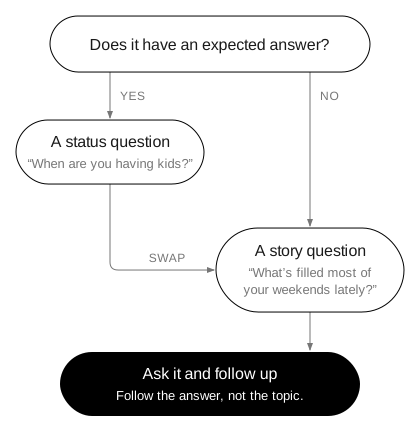
Eight swaps, from status to story
Each swap below keeps what the asker wanted to know and drops the verdict. The person can still bring up their status in their own words.
- Kids and wedding dates. Asking when someone is getting married or having kids touches health, a relationship, and money in one sentence, and some of the answers hurt. Ask instead: What’s filled most of your weekends lately?
- Being single. “Why are you still single?” asks someone to explain an absence. Ask instead: Who have you been spending time with this year?
- Salary and prices. What someone earns or paid for their apartment puts a number on the table that everyone compares with their own. Ask instead: What’s the best thing you bought this year, at any price?
- Bodies. Comments on weight, a new look or “you look tired” turn the person into the topic. Ask instead: What’s something you started doing this year?
- Job titles. “What do you do?” can close after one word. Ask instead: What are you working on these days, at work or outside it?
- Old news. “So what happened with your job?” or “Are you two still together?” asks someone to retell news they may have stopped wanting to tell. Ask instead: What’s been good this month?
- Drinks and plates. “Why aren’t you drinking?” asks for a reason that may be private. Pour the water and ask instead: What’s the best thing you’ve eaten lately?
- Politics as an opener. “Who did you vote for?” sorts the table into sides before the main course. Ask instead: What’s something you’ve changed your mind about in the last few years?
For more on the job question, see what to ask instead of “What do you do?”.
Reunions have their own versions
At a school or family reunion, status questions compare the present with the past. “Where are you living now?” and “Are you still doing that?” add up to a scoreboard of the years since you last met. Each answer can get measured against what everyone expected back then.
The swap is to ask about the years in between as a story. What’s a year you’d tell someone about? lets a person skip the scoreboard and start wherever they like. Someone who moved a lot can tell one move. Someone who stayed can tell what changed around them.
When the wrong question is already out
Sometimes a status question slips out anyway. The pause after it is the signal. Three moves repair it without making it bigger:
- Give an out. Say “You don’t have to answer that” and mean it. A short answer then counts as a full one.
- Follow the answer, not the topic. If they say “We’re not sure about kids,” ask about what they did mention, like the trip or the new apartment.
- Put something new on the table. A host can pass a dish, bring out a word, or ask the next guest a story question.
Follow-ups do more work than they seem to. In three studies of live conversations, people who asked more questions, especially follow-up questions, were better liked by their partners. Participants didn’t expect asking questions to make them more liked (Huang et al. 2017). A follow-up on what the person chose to say shows you heard them, and it moves the talk away from the question they didn’t want.
Why the story question feels riskier than it is
Status questions can feel safe to the asker because they’re short and familiar. Story questions feel personal, so guests may hold them back. That fear can be bigger than the risk.
In a series of experiments, participants overestimated how awkward deep conversations with strangers would be compared with shallow ones, and underestimated how much their partners would care about what they shared. The conversations felt less awkward than expected and left people more connected than they had predicted (Kardas et al. 2021). A question like “What’s a year you’d tell someone about?” asks more than “Where are you living now?” and still gives the other person the choice of how much to say.
One word instead of a question
A word on the table removes the asker altogether. Nobody has to choose a question, so nobody can choose the wrong one. Each guest decides what the word brings up for them.
The Thesis deck has 50 double-sided cards: an idea on one side, an everyday thing on the other. A die you fold from a card has six faces: MEMORIES · BODY · PEOPLE · VALUES · CHILDHOOD · FUTURE. The only instruction is “Look at the word from that side.” A word written on a place card works the same way.
The rule card answers the problem status questions create. It says “There are no right answers.” It also says “A short answer is a full answer. You can always ask for more.” Before the first card, “agree together how passing works,” so any guest can skip a word without a reason.
Three cards that replace status questions
Each of these three cards covers ground a status question tries to reach, and leaves the person to choose the way in.
Family has Bread on its other side. It covers what “When are you having kids?” reaches for, with room for parents, siblings, chosen family, or none. The bread side starts at a kitchen counter or a bakery on the way to school, and the people may come in on their own.
Enough has Photograph on its other side. It goes where salary and price questions go, and asks about a feeling instead of a number. A guest can talk about a quiet Sunday that felt like enough, or pick the photograph side and describe one picture on their wall.
Home has Spoon on its other side. It replaces “Where are you living now?” with what a place means to someone. A guest who has moved more than once can pick one home. The spoon side starts with a grandmother’s soup or the one spoon that came along to every apartment.
Before the next dinner
Pick the status question you catch yourself asking most and write its swap on your phone. At the table, ask the swap once and follow up on whatever comes back. If you’re hosting, put one word next to the bread instead.
See the rules and the box, or open the online table on a phone in the middle. The cards above have their own pages: Family, Enough, and Home. For more on playing with friends, see Thesis for friends. For the studies behind the deck, see the research page. Related: when the dinner conversation dies: a host’s rescue plan.