Your partner mentions a weekend in Lisbon, and you know they went there with an ex. Nothing happened tonight. The ex lives in another country and hasn’t called in years. Still, the picture of the two of them on that trip comes back on the train, at work, and in the middle of the night.
That loop has a name: retroactive jealousy. This post is for couples where one of you keeps circling the other’s past. It explains what the feeling is, what two studies found, and how to talk about it in a way that brings you back to the present. There’s a six-step talk and ten questions at the end. A word written on a scrap of paper is enough to start.
What retroactive jealousy is
Retroactive jealousy is distress about a partner’s past relationships, even when the exes play no part in the relationship now. Jessica Frampton and Jesse Fox use that definition in their study of how couples deal with it (Frampton and Fox 2018). The threat it reacts to is over. The feeling isn’t.
Ordinary jealousy can point at something that could happen: a coworker, a late reply, a friend who flirts. The difference between jealousy and envy is about what you fear losing. Retroactive jealousy points backward, at a time you weren’t there and can’t change.
It doesn’t always attach to an ex. In one advice thread, a married woman in her late twenties wrote that she felt jealous of her husband’s friendships from before they met: the trips, the inside jokes, the years she missed. The past that stings can be a city, a group of friends, or a version of your partner you never knew.
What the research found
Frampton and Fox interviewed 36 people about retroactive jealousy and social media. Participants said social networking sites fed the feeling through comparison with exes, old photos and posts that stayed online, and uncertainty about the relationship. Participants also used the sites to gather information: checking on exes, watching their partner’s activity, and fact-checking what their partner had told them. Some used the sites in place of asking their partner directly. The authors suggest that turning to social media to ease the feeling can sometimes make it worse (Frampton and Fox 2018). This was an interview study, so it describes what people did. It doesn’t measure how common any of it is.
A second study looked at jealousy in general. Cathy Dandurand and Marie-France Lafontaine surveyed 502 university students in relationships of at least 12 months. Cognitive jealousy, the suspicious thoughts that keep returning, went with lower couple satisfaction. Emotional jealousy, the feeling itself, went with higher satisfaction (Dandurand and Lafontaine 2014). The study wasn’t about the past, and it’s correlational. It does suggest one useful split: the feeling and the thought loop are two different things, and they may need different handling.
Why the obvious advice doesn’t stick
You may have heard two pieces of advice. One is “ask them everything and get it out.” The other is “let it go, it’s the past.”
Asking everything can feed the loop. Each answer can give the mind a new detail to replay, and the next question may feel urgent too. Letting it go may not work, because thoughts don’t stop on command. When the talk is off limits, the checking can move to a phone screen, close to the pattern the interview study describes.
The middle path is a talk with a shape: one feeling named, one question asked for a reason, and an agreement about what happens next.
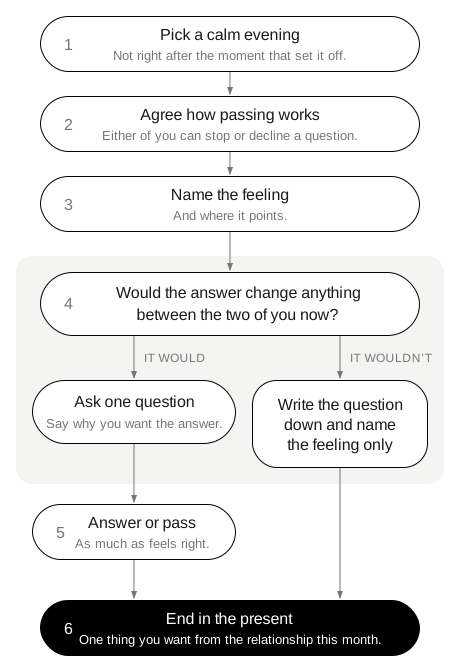
A six-step talk
This works for both people. The one who feels jealous starts. The one whose past it is decides how much to share.
- Pick a calm evening, not right after the moment that set it off. A talk right after a trigger can turn into a cross-examination.
- Agree how passing works before you start. Either of you can stop or decline a question without giving a reason.
- Name the feeling and where it points. For example: “When you mentioned Lisbon, I kept picturing it for days. It’s about me and the past, and I want to tell you.”
- Ask one question, and say why you want the answer. Before asking, check whether the answer would change anything between the two of you now. If it wouldn’t, write the question down and name the feeling only.
- The other person answers as much as feels right, or passes. The rule card puts it this way: “A short answer is a full answer. You can always ask for more.”
- End in the present. Each of you says one thing you want from the relationship this month.
You can add one more agreement about checking. The one who feels jealous agrees to stop looking up an ex’s profile for a while, and to say so if they slip.
For the partner whose past it is
Your past is yours. Privacy about old relationships is a fair boundary, and declining a question isn’t the same as hiding something. It helps to say what you’re keeping and why: “I’d rather not describe that trip. It’s over, and the details won’t help either of us.” That’s a short answer, and a full one.
What may help more than details is hearing why the past ended and what’s different now. Those are things your partner can’t find on a screen.
Three words for this talk
These three cards from the Thesis deck fit a talk about the past. Each card has an idea on one side and an everyday thing on the other.
Jealousy has Kitchen table on its other side. The idea side lets the jealous partner say what the feeling is like without accusing anyone. The kitchen table is a softer door: a table you grew up around, one you’ve shared with your partner, the place where hard talks happened at home.
Privacy has Diary on its other side. It suits the partner whose past it is. Talking about privacy can show where each of you draws the line between keeping something and hiding it. A diary can lead to a story about what you wrote as a teenager.
Trust has Window on its other side. It turns the talk from the past to the present: what trust looks like for each of you now. A window can bring up a home, a view, or the habit of looking in from outside, which fits the checking the research describes.
Ten questions about the past and the present
Use one or two per evening.
- What part of my past do you think about most, and when does it come up?
- What do you wish you knew about my life before we met?
- What would you rather not know?
- Which part of your own past do you keep to yourself, and why?
- What does privacy mean to you in a relationship?
- What did your family teach you about talking about exes?
- When you feel jealous, what are you afraid of losing now?
- What could I say or do that helps when the thoughts come back?
- What’s one thing about us that no one from the past had?
- What do you want the two of us to do together this year?
After an answer, the three follow-ups from the rule card fit: What did that feel like? Who else was there? Has it always meant that to you?
When it keeps coming back
One talk may be enough, and the feeling may fade. Or it may keep returning. If the thoughts take up hours of a day, or the checking keeps going after you’ve agreed to stop, a counselor who works with couples is one option to consider together. A game is a conversation format. It doesn’t replace that kind of help.
What to do tonight
Write one word on a piece of paper: Trust. Put it on the table after dinner. The one who has been circling the past says what the word means to them now, in this relationship. The other asks Has it always meant that to you? Then swap. End the way a game of Thesis ends: each of you names one thing you found out about the other today.
The three cards have their own pages: Jealousy, Privacy, and Trust. For more on playing as two, see Thesis for couples. The studies behind the deck are on the research page, and you can play on the online table. To see the cards and die, read the rules and the box. For a longer evening of questions, try the 36 questions for couples.