You’ve lived in Berlin for a few years, and the thing you’d most like to talk about has a German self-help group, or none at all. Your German works at the Bürgeramt but not for an evening about grief, burnout or a diagnosis. Berlin has a public network of self-help contact points, and their staff help people found new groups, find a room and reach members. This guide walks through the steps of Selbsthilfegruppe gründen in Berlin in the order you’ll take them, with notes on running the group in English.
The steps come from the founding guide that SEKIS, Berlin’s central self-help contact point, publishes in German (SEKIS 2022). Details such as fees and deadlines change, so confirm them with your contact point.
Step 1: Talk to your district contact point
Every Berlin district has a Selbsthilfe-Kontaktstelle, and SEKIS works across the whole city (SEKIS 2022). The Senate’s framework for these offices says they actively support people who want to found a group, and they provide rooms, media and equipment (Berlin Senate). SEKIS says it can be your partner before you’ve found other members (SEKIS).
Bring the topic, who the group is for, and the language. Ask whether someone on the team speaks English. SEKIS’s English brochure on self-help and migration listed the languages each district office offered, and English was on the list for several of them (SEKIS 2014).
Search the SEKIS database first. English groups are listed there, such as an English-speaking group for depression and anxiety at the Pankow contact point (SEKIS listing). If a group on your topic exists, joining it may be the shorter route.
Step 2: Write a call for members
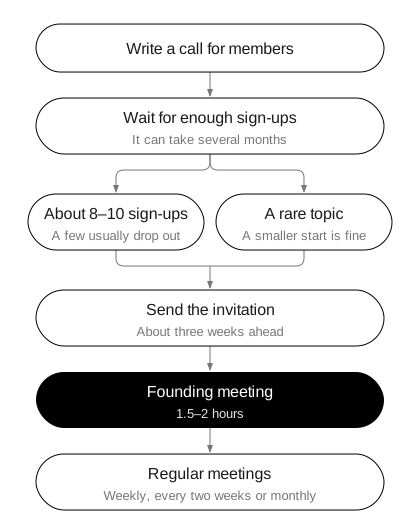
The most important condition for founding a group is finding other people with the same concern, and the SEKIS guide suggests a written call, a Gründungsaufruf, to reach them. It lists what the call contains:
- Topic. The condition, situation or concern the group is about.
- Content. What happens at meetings: sharing experience, mutual help, information.
- Who it’s for. An age range, a women’s group, people who moved to Berlin.
- Contact. Where people sign up.
For the contact line, the guide advises against a private phone number. Use the contact point’s address, which collects sign-ups for you, or an email address set up for the group. For an English group, write the call in English and add the language to the title, as in “Burnout self-help group (in English)”.
The guide lists channels for the call: the SEKIS database, the contact point’s newsletter, social media, topic forums, and notices in neighborhood centers, practices and universities. For an English group, add the channels your community already uses.
Step 3: Wait for enough sign-ups
A founding call needs patience. The SEKIS guide says it can take several months before enough people respond, and sometimes a founding attempt fails or leads only to one-to-one contacts.
Before you invite anyone, about 8–10 people should have signed up, because a few usually drop out at short notice. With a rare topic, a smaller start is fine. The guide’s example of a new group: 15 people at the first meeting, five at the third.
Step 4: Find a room
A self-help group meets in a neutral room, outside anyone’s home. The SEKIS guide gives the reason: a member who hosts takes on a special role that can unbalance the group. Contact points have rooms set up for self-help groups, for example in neighborhood centers with public transport access, step-free entry and a kitchen. Other options are counseling centers, parishes, clinics and community spaces.
A room can come with a small donation. SEKIS’s English brochure says participation is free, with the common exception of a small donation to the place that provides the room (SEKIS 2014). Decide early who collects that money and pays for the room.
Step 5: Hold the founding meeting
Agree the date with your contact point and send the invitation about three weeks ahead. Most meetings last 1.5–2 hours. SEKIS also offers to accompany individual meetings (SEKIS).
Start with a round of introductions. Everyone gives a name, first name only if they prefer, and says what brings them. Then agree on confidentiality: what’s said in the group stays in the group. The guide calls this one of five principles. The others are that people take part voluntarily and from their own experience, all members have equal say, each person is there mainly to help themselves, and each person shares responsibility for how the group runs.
The founding meeting doesn’t have to settle everything. These questions, adapted from the SEKIS guide, cover what a new group can decide in its first sessions:
- What do we want to get from this group?
- Who can join: only people affected, or relatives too?
- Do we speak only English, or can someone switch to German for a word?
- Which day, time and rhythm: weekly, every two weeks or monthly?
- Is the group open to newcomers, or closed for a while?
- What happens if we drop to three people, or grow past 20?
- Which messenger do we use, if any, given data protection rules?
- Who is the contact person for the contact point and for newcomers?
Write down the decisions, and leave personal stories out of the note.
Step 6: Give each meeting a shape
Many groups open and close with a Blitzlicht, a round where each person speaks for about two to five minutes about how they are, with no comments or discussion. The SEKIS guide describes this round as a way for people to arrive and for the group to see what’s on everyone’s mind. Moderation can rotate from meeting to meeting. The moderator keeps time and makes sure everyone who wants to speak gets a turn, and doesn’t set the content.
In a group run in English, the opening round can be hard for people who speak it as a second language. A single word as a prompt gives everyone the same starting point. Write a word on a card, or draw one from the Thesis deck, where each card has an idea on one side and an everyday thing on the other. For turns and pauses in a shared second language, see facilitating multilingual groups.
Home sits on the back of Spoon. In a group of people who moved to Berlin, the word can bring up two places at once. The spoon gives a lighter way in: the one from a parent’s kitchen, or the first one bought for a flat here.
Community is on the back of Mirror. It suits a session where the group talks about itself: who it’s for, what it’s become. A person can take the mirror side instead.
Loneliness sits on the back of Perfume. A scent tied to a person or a place gives an easier start, and the turn still counts. Before a word like this, a reminder of the pass agreement helps. The Thesis rules put it this way: “Before you start, decide together how passing works.”
Step 7: Check the funding rules, if they apply
Statutory health insurers in Berlin fund self-help groups jointly, but only groups on health topics, such as chronic illness, disability or mental health. Their 2023 leaflet sets the conditions (GKV Berlin 2023):
- Size. At least six members, with an average of at least four at each meeting.
- Rhythm. Reliable, regular meetings, usually monthly.
- Leadership. Members run the group as volunteers, with no professional leader.
- Record. A founding meeting held and recorded, and a listing in the SEKIS database.
- Money. A separate bank account and documented income and spending.
Funding is possible only after several meetings, and there’s no legal right to it. Ask your contact point for the current year’s leaflet and deadlines.
A self-help group has no professional leader, and that’s part of the format. You decide what your group is for and how far a game format fits it. Thesis is a conversation format and makes no clinical claims.
Try the opening round first
Before the founding meeting, test a word-based opening round with two or three friends, one turn each.
The die has six faces: MEMORIES · BODY · PEOPLE · VALUES · CHILDHOOD · FUTURE. The only instruction is “Look at the word from that side.” Thesis ends with a round that suits a self-help group’s closing Blitzlicht: each player names one thing they discovered about someone today.
This week, email your district contact point with three lines: your topic, who it’s for, and that the group will run in English.
For more on running sessions, see Thesis for therapy groups. The three cards above have their own pages: Home, Community and Loneliness. You can play online for free or see the rules and the box. Another format for an English-speaking group in this city: how to host a Death Cafe in Berlin.