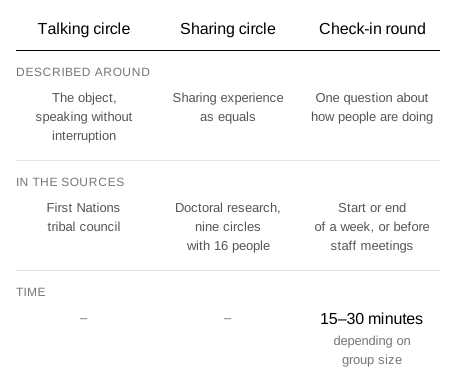
A talking circle and a sharing circle use the same basic form: people sit in a circle, one person speaks at a time, and the turn moves around in order. The names overlap, and some guides use them for the same thing. Where they differ, it’s in emphasis. A talking circle is described around the right to speak without interruption. A sharing circle is described around sharing experience as equals. A check-in round is a short version of the same form, used at the start of a meeting to hear how everyone is doing.
This explainer is for facilitators, teachers, group hosts and youth workers who see all three names in guides and want to know which one they’re running. It also covers where the practice comes from, because both circle formats have Indigenous roots in North America.
The three definitions in one place
Each format has a short working definition in the sources below. Read side by side, they look like this:
- Talking circle. A circle where whoever holds an agreed object speaks, and the others listen without interrupting.
- Sharing circle. A circle where people share their experiences, with everyone, including the facilitator, treated as equal.
- Check-in round. One round at the start of a session, with one question about how people are doing. One guide gives it 15–30 minutes.
Talking circle: one voice at a time
First Nations Pedagogy Online, a teaching project, states that “Talking Circles originated with First Nations leaders” and describes their use to make sure all leaders in the tribal council were heard (First Nations Pedagogy Online). The core rule is the object: “whoever is holding the object in their hand has the right to speak.” The same page names a talking stick or a talking feather as the object and adds that “Shared communications should be kept in confidence, especially if personal.”
In practice, a talking circle asks for two things from the room. The speaker can take the time they need. Everyone else listens and waits. Nobody replies, corrects or adds on until the object reaches them. That rule is the core of a talking circle in a classroom or a workshop too.
Sharing circle: experience shared as equals
Lynn Lavallée, a researcher at Ryerson University in Toronto, ran nine sharing circles with 16 people as part of her doctoral research and wrote up the method (Lavallée 2009). She describes sharing circles as comparable to focus groups, with one difference: “the sacred meaning they have in many Indigenous cultures.” In her account, everyone in the circle, the facilitator included, is equal, and information, spirituality and emotion are shared.
Lavallée lists the considerations she followed. The circle is nonjudgmental, helpful and supportive. Respect includes listening to others. People sometimes speak in turn around the circle, clockwise or counterclockwise, holding an object such as a talking stick or an eagle feather. She also told participants that if they didn’t feel like answering a question or sharing something, they didn’t have to.
So the form matches a talking circle. The word “sharing” points to the purpose: telling one’s own experience and having it received by equals.
Check-in round: a short circle at the start
A check-in round borrows the form for a narrower job. UC Berkeley’s Greater Good in Education describes a check-in circle where people “use a talking piece to respectfully take turns answering a question about how they are doing” (Greater Good in Education). It suggests it for the start or end of a week, or before staff meetings, and gives 15–30 minutes depending on group size.
The guide spells out the keeper’s role. The keeper explains the purpose, poses the question, answers first, and then passes the piece left or right. Each person has “the choice to speak or pass when the talking piece comes to them.” It also notes that using circles to resolve conflict or hold difficult conversations takes facilitator training. A check-in round sits at the light end of that range.
For the steps of running one, see how to run a check-in round. For how a check-in differs from a warm-up for strangers, see icebreaker vs check-in.
Where the circle comes from
The University of Pennsylvania’s guide to restorative circles says circles are informed by “sacred and secular practices of numerous Indigenous Peoples in North America” (Penn Restorative Circles). Its list of circle types includes “Dialogue: Talking, Sharing or Understanding” as one category. That’s one more sign the names overlap in everyday use.
The origin shapes a few practical choices for anyone outside those traditions. Lavallée worked with guidance from an Elder, and her circles opened with an offer of tobacco and a smudge. Ceremony like this belongs to the people it comes from. A facilitator who wants it in a group can invite someone from that tradition to lead it. A group that meets without it keeps the parts that are open to everyone: sitting in a circle, one speaker at a time, listening without interrupting, and the choice to pass.
Naming the origin once, in one sentence, is a respectful way to open a first circle. “This way of sitting in a circle draws on Indigenous practices in North America” is enough.
How to pick one for your group
The format follows what the session is for. These four questions can help you decide:
- Is the round the whole session, or the opening of a longer one?
- Do you want people to describe an experience, or say how they are today?
- Does the group need a firm no-interruption rule this time?
- How much time does each person get?
If the round opens a longer session and asks how people are today, it’s a check-in round. If the whole session is a circle with a firm no-interruption rule, call it a talking circle. If the whole session is about telling experiences as equals, sharing circle fits. In all three, agree on passing before the first turn. For the choice between going around in order and speaking when ready, see round robin vs popcorn sharing.
One word as the round’s prompt
Any circle needs a prompt, and one word can carry a whole round. Each Thesis card has an idea on one side and an everyday thing on the other. A word written on a sticky note works the same way.
Respect sits on the back of Blanket. It suits a first circle, because it names the rule the circle runs on. A speaker can talk about someone whose respect mattered to them, or about a blanket from a house they grew up in. Both are full turns.
Trust is on the back of Window. In a sharing circle it can open stories about who people trusted and when that changed. The window side gives a lighter way in: a view from one window someone remembers.
Community sits on the back of Mirror. It works for a group that’s starting to form. A speaker can describe a community they belonged to, or what they see when they look in a mirror in the morning, which also tells the circle how they are today.
The Thesis rules fit a circle without changes. Before the first turn: “Before you start, decide together how passing works.” On each turn: “Say as much or as little as you like. The others ask, gently.” Then “Hand the die to the left.” And for the room: “What is said at the table stays there.”
Try one round
Open the online table on a shared screen, agree on passing, and go around once.
The die has six faces: MEMORIES · BODY · PEOPLE · VALUES · CHILDHOOD · FUTURE. The only instruction is “Look at the word from that side.”
At your next session, say which of the three formats you’re running in one sentence before the first turn. Then name where the circle comes from, agree on passing, and answer first yourself.
For more on running it with a class or a team, see Thesis for teams and classes. The three cards have their own pages: Respect, Trust and Community. You can play online for free, see the rules and the box, or read the research behind the deck. Related: check-in questions for group therapy: a new word each week.