You see a photo of old classmates having dinner together, and long after, a younger version of you won’t leave your head. Nothing happened today, and still the feeling is stronger than anything that did.
This post explains why shame lands that hard. It covers three findings: shame follows how other people would judge you, it moves the body as well as the mind, and you judge yourself more harshly than you’d judge anyone else. It ends with a small way to say one shameful thing out loud to one person.
The short answer
Shame is powerful because it’s tied to your place among other people. One research team describes it as a defense against being devalued by others. In their account, shame works like pain: it’s unpleasant so that you’ll act to protect yourself from losing other people’s regard.
A memory, a photo or an imagined reaction can set that alarm off. If you want the line between shame and guilt first, see shame vs guilt.
Shame follows how others would see you
The clearest evidence comes from a study by Daniel Sznycer, John Tooby, Leda Cosmides and colleagues. They wrote 29 short scenarios, such as “He has poor table manners,” “He is not generous with others,” and “He does a bad job taking care of his children.” One group of people rated how negatively they’d view someone in each situation. A separate group rated how much shame they’d feel in the same situation themselves (Sznycer et al. 2016).
The two sets of ratings matched closely. The authors report that “shame closely tracks the threat of devaluation in the United States (r = .69), India (r = .79), and Israel (r = .67).” The samples were 118 people in the US, 155 in India and 165 in Israel. Shame in one country also tracked how people in the other two countries would judge the same act, with a mean correlation of .64.
The match was specific to shame. In a second study, the team asked about sadness and anxiety for the same scenarios. Sadness and anxiety can come together with shame, and both tracked other people’s judgment more weakly. When all three were looked at together, shame was the only one that still predicted other people’s judgment.
So shame works like an estimate of other people’s verdict. That’s why it can feel accurate even when it isn’t. Reviewing earlier work, the authors add that “Shame motivates one to avoid behaviors that could cause devaluation and to conceal damaging information.” The urge to hide is part of the design.
The study has limits. The data are correlational. The US and Indian samples came from an online panel and the Israeli one from one university. The authors also note that shared cultural history could explain part of the match across countries.
Shame moves the body
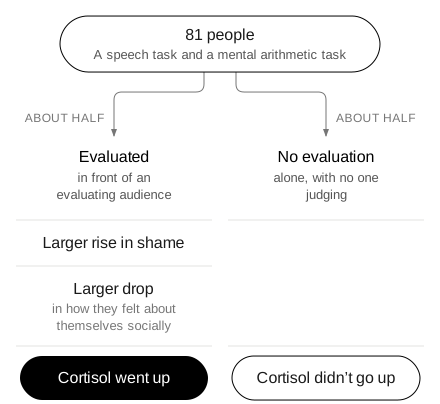
Shame shows up in the body as well. Tara Gruenewald, Margaret Kemeny and colleagues gave 81 people a speech task and a mental arithmetic task. About half did them in front of an evaluating audience. The other half did them alone, with no one judging (Gruenewald et al. 2004).
The people who were evaluated reported larger rises in shame and larger drops in how they felt about themselves socially. Their cortisol, a hormone measured in saliva in stress studies, went up. In the group with no evaluation, it didn’t. Within the evaluated group, cortisol rose more in the people who felt more shame.
A larger review points the same way. Sally Dickerson and Margaret Kemeny combined 208 laboratory studies of stress and cortisol. Tasks that were uncontrollable and also involved being judged by others produced the largest cortisol changes and the longest recovery times (Dickerson and Kemeny 2004). Being judged with no way to change the outcome is close to how shame feels from the inside.
You judge yourself more harshly than others do
Shame also has a blind spot. Anna Bruk, Sabine Scholl and Herbert Bless ran seven studies on moments of showing vulnerability, such as confessing love, revealing imperfections of one’s body, or asking for help. People rated these acts more negatively when they imagined doing them than when they imagined someone else doing them (Bruk et al. 2018).
The authors explain the gap through how close the situation feels. When you’re the one exposed, you picture it in concrete detail and see the downsides. When someone else is, you see it from further away and notice the upsides. The friend hearing your story may be closer to the second version.
Put next to the first study, this explains why shame convinces and misleads at once. It estimates others’ judgment, and the estimate leans harsh when the subject is you.
Ten questions about shame
These questions work for a quiet talk with someone you trust, or with a pen. Answer with a story where you can. Skip any that land too close.
- Whose opinion does your shame seem to be guessing?
- What’s a memory that still makes you wince, years later?
- Who in that memory would remember it today?
- Where in your body do you notice shame first?
- What did you hide as a teenager that you’d say out loud now?
- What’s something you’d forgive in a friend but not in yourself?
- When did telling someone make a thing feel smaller?
- What would your 15-year-old self be ashamed of in your life now?
- Which rules about shame did your family pass on?
- What would change if one person knew the thing you hide?
Look at your answers to 6 and 7 together. They may show the gap from the third study: the same act sounds lighter in someone else’s life.
Look at Shame from six sides
The Thesis deck has a card for Shame. The die has six faces: MEMORIES · BODY · PEOPLE · VALUES · CHILDHOOD · FUTURE. The only instruction is “Look at the word from that side.”
Shame has a Letter on its other side. Choose the idea when you want to talk about the feeling and where it comes from. Choose the Letter when a story is easier: a note passed in class, a message read by the wrong person, a letter you were afraid someone would find. A letter is about who sees what, which is close to what the research says shame tracks.
Belonging has Headphones on its other side. Shame is about your standing with other people, and Belonging is the other end of the same thread: the groups where you felt you had a place. Headphones can bring up the opposite, a way to be among people and still apart.
Pride has a Calculator on its other side. Pride sits near shame: both are about how others see you. Talking about a moment of pride may make it easier to talk about the shame that sits nearby. If the word feels too loud, choose the Calculator side, or pass.
Try it with someone
Shame pushes toward hiding, so a clear set of rules makes talking easier. The Thesis rules open with “Before you start, agree together how passing works.” Then the table takes turns.
- Whoever suggested the game goes first.
- Draw a card. Choose a side: the idea or the thing.
- Roll the die.
- Look at the word from that side. Say as much or as little as feels right.
- The others ask what they’re curious about, gently, without judging.
- Hand the die to the left.
Two lines from the rule card matter most for Shame. “A short answer is a full answer. You can always ask for more.” And: “What is said at the table stays at the table.” The follow-up questions stay short: What did that feel like? Who else was there? Has it always meant that to you?
What to do tonight
Pick one small thing you still feel ashamed of, something from years ago. Write the word Shame on a piece of paper, and next to it, the name of the person whose opinion the feeling seems to be guessing. Tell the story to one person you trust, and ask them what they’d think if a friend told it to them. Their answer is a second estimate, made from further away.
When you’re done, end the way every game of Thesis ends: each player names one thing they discovered about someone at the table today. “Sometimes one word is enough.”
See the rules and the box, or open the free online table. The cards above have their own pages: Shame, Belonging and Pride. For a few close people around one word, see Thesis for friends. For more on the research behind the deck, see research. For a related pain with its own alarm, see why loneliness is so painful.