Someone at the table says, “I keep thinking about the last phone call.” The room goes still. A death café guest might hear a story about time. A grief group member might hear their own unfinished sentence. The same word, regret, lands in two different places.
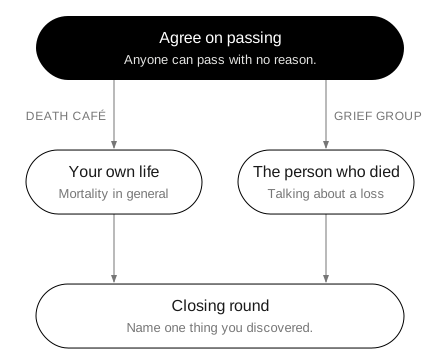
This guide gives death café hosts and grief group facilitators ten discussion questions about regrets, split into two sets. One set is about the speaker’s own life. The other is about the person who died. Pick the set that fits your room, agree on passing first, and use one card to open the topic.
Two kinds of regret at the same table
Regret comes up in two shapes when people talk about death. The first looks forward: what would I want to have done by the end? It fits a death café, where the topic is mortality in general. The second looks back at a relationship: what did I say, or not say, before they died? That’s the one grief groups hear.
Both are worth time, and they need different questions. A forward question asks for a plan or a value. A backward question touches a specific person and a specific day. Mixing them in one round can catch a bereaved guest off guard. If you’re unsure which kind of room you have, death café vs. grief support group sets out how the two formats differ.
What groups talk about when the topic is death
In one study, people talking about death in small groups talked about the people in their lives. A content analysis of 17 recorded games of an end-of-life conversation game, with 68 adults playing in groups of 2–6, found four themes. They were people and relationships, values and preferences about end-of-life care, preparing for the aftermath of one’s death, and personal stories that shaped those preferences (Van Scoy et al. 2016). The games ran without a facilitator.
Regret sits close to all four. A wish to call someone, a value that didn’t get lived, a story about a parent’s last months. Questions that start from a person or a story match the themes that study found.
Regret and self-blame are two different things
A regret and a sense of guilt can sound alike in the room, and they behave differently. In a study of 60 bereaved spouses followed for about two years, the researchers measured both. They described regret as the belief that one could have done something differently for a better outcome. Self-blame meant holding oneself responsible for the death, or for failing the standards of the person who died or one’s own. Self-blame was linked to higher grief and a slower decline in grief. Regret wasn’t linked to grief or to how it changed (Stroebe et al. 2014).
Another study points the other way for some people. Among 201 widowed older adults followed from 6 to 48 months after the loss, researchers found three regret patterns: stable low, stable high, and high and getting worse. The group whose regrets grew over time had the poorest grief outcomes. The authors suggest checking in on bereavement regrets more than once (Holland et al. 2014).
For a host, the two studies give one practical point. Listen for the difference between “I wish I had” and “it was my fault.” The first can go into a discussion round. The second may need more than a group round can hold, and you decide where it goes next. Thesis is a conversation format and makes no clinical claims.
Five questions about your own life
This set suits a death café or any room talking about mortality in general. The questions look forward and ask for values, so a guest can answer without naming anyone.
- What would you like to have done that you haven’t started yet?
- Which regret of yours has changed shape over the years?
- What’s something you once regretted and now feel fine about?
- Who would you want to say something to before the end, and what is it?
- If you could leave one sentence about regret for someone younger, what would it be?
Question 3 can lighten a round. It shows that regret can move, and it gives quieter guests an easy way in.
Five questions about the person who died
This set is for a grief group, or a death café session where the group agreed to talk about a loss. Each question can be answered with the wish or with the story, and a short answer counts.
- Is there something you wish you’d said to them?
- What would they say about the thing you regret?
- Which moment with them do you replay, and does it change each time?
- What did you do for them that you’re glad you did?
- What would you like to do now, in their name or for yourself?
Question 4 balances the set. Regret questions pull toward the missed moments, and this one asks about a moment that went well. Question 5 points the round toward something a person can do this week.
After any answer, three short follow-ups keep the questions gentle: What did that feel like? Who else was there? Has it always meant that to you?
Agree on passing before the first question
A question about regret can ask more than a person wants to give that evening. The Thesis box puts the agreement first: “Before you start, decide together how passing works.” Settle it out loud. Anyone can pass with no reason, or turn to an easier question from the same set.
A pass costs less when the host shows it. Answer the first question yourself, in two sentences, and stop. Then the next person knows that two sentences are enough.
Start with one card
A single word can open the topic with less weight than a full question. Put a card in the middle and let each person say what it brings up.
Regret is on the back of Lamp. The word names the topic, so it works when the group has already chosen regret as the theme. The lamp side gives a gentler start. A guest might talk about a lamp left on in an empty room, or a bedside light in a hospital. Both lead back to a person and a time without anyone saying “regret” first.
Forgiveness is on the back of Door. It sits next to regret and points the conversation outward, toward someone else or toward oneself. In a grief group it can open a question some members may carry: can I forgive myself for the last visit I missed? The door side lets a player talk about a door they closed or one they wish they’d knocked on.
Nostalgia is on the back of Key. It’s a softer neighbor of regret and suits the end of a session. A player can talk about a key to a house that’s been sold, or a time they miss. The room ends on what was good.
Try a round with your group
You can run one round on a shared screen. Draw a card, roll the die, and let the word set the direction.
The die has six faces: MEMORIES · BODY · PEOPLE · VALUES · CHILDHOOD · FUTURE. The only instruction is “Look at the word from that side.” The face picks the angle, and the player picks how much to say.
To close, each player can name one thing they discovered about someone at the table. After a session on regret, that round ends on what people heard from each other.
Before your next session
Decide which set fits your room. Write the five questions on one card, add your pass agreement on the back, and read the agreement aloud before the first question.
For more questions for a loss group, see grief support group discussion questions and grief group check-in questions. For running the format with a group, see Thesis for therapy groups. The three cards have their own pages: Regret, Forgiveness and Nostalgia. You can play online for free, see the rules and the box, or read the research behind the deck.