The call ended badly. Maybe it was about the visa, or a missed weekend, or a remark that landed wrong at the end of a long day. One of you said goodnight too fast, or the screen froze in the middle of a sentence, and now there’s a dark phone and a whole day before the next call. In an LDR after a fight, that gap is the hard part.
This post is for couples apart who’ve had an emotional call and don’t know how to start the next one. It gives you a short message to send in between, a reset call in six steps, and a way to decide when to go back to the fight. You need no app and no deck. A word written on a sticky note works.
Why a fight lands harder at a distance
A couple who lives together has the morning after. Someone makes coffee, someone touches a shoulder in the hallway, and the fight shrinks without a word said. Apart, there’s no hallway. The next contact is a scheduled call, and both of you walk into it carrying the last one.
One person in a long-distance forum described a fight like this. It was about the distance itself: missing each other, stress over work, the visa process. Then came the question of how to talk to each other after an emotional call. The next call can feel heavy before anyone speaks. One of you may want to finish the argument, and the other may want to talk about anything else.
Research on couples apart suggests why each call carries so much. In a diary study by Jiang and Hancock, long-distance couples disclosed more about themselves and idealized each other more than couples who lived close, and both shaped how intimate they felt. How much depended on the medium they used (Jiang & Hancock 2013). When a relationship runs mostly through calls, one bad call is a large share of it.
Stafford and Merolla found that long-distance dating partners idealized each other more and stayed stable while apart. Longer gaps between visits and extreme idealization predicted instability once the couples were reunited (Stafford & Merolla 2007). The study didn’t look at fights. It does point at something a fight shows you: the real person, on a bad day.
Why texting it out between calls backfires
The obvious move after a bad call is to finish the fight by text that night. In practice, a long apology or a paragraph of explanation arrives without a voice or a face, and it can get read in the worst tone.
A Brigham Young University study of 276 young adults in committed relationships looked at how couples use texts. For women, using texts to apologize, work out differences, or make decisions was associated with lower relationship quality (Schade et al. 2013). The study was correlational and didn’t focus on long-distance couples.
A shorter message does more. It names the next call and says you want it, without reopening the topic:
I’m still thinking about last night. Can we talk tomorrow evening and start with something easy?
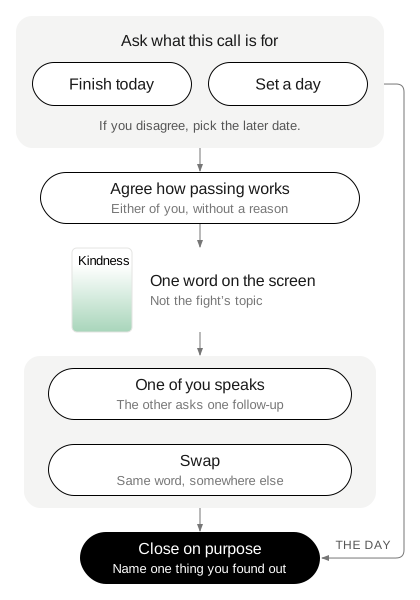
A reset call in six steps
This format is for the first call after the fight. It works on a phone or a laptop.
- Ask what this call is for. At the start, each of you says one thing: finish the fight today, or set it aside and come back on a named day. If you disagree, pick the later date. A tired call may not settle anything.
- Agree how passing works. Either of you can pass on a word or a question without a reason. Say it out loud before you start.
- Put one word on the screen. Use a card held up to the camera, the online table, or a word one of you writes down. Pick a word that isn’t the fight’s topic.
- One of you speaks. Say what the word brings up: a memory, a person, a place, an object. Say as much or as little as feels right. The other asks one follow-up, then listens.
- Swap. The second person takes the same word somewhere else.
- Close the call on purpose. Each of you names one thing you found out about the other today. If the fight is still open, repeat the day you’ll come back to it. Then hang up together, with no fast goodnight.
The Thesis rule card has three follow-up questions that fit any word:
What did that feel like? Who else was there? Has it always meant that to you?
After a fight, the first one does the most work. It asks about the person, and it carries no argument. The rules also say: “There are no right answers.”
Three words for the call after a fight
A word for this call should sit near the feeling without pointing at the fight. Each of these three from the Thesis deck has an everyday object on its other side, so either of you can choose the lighter side.
Kindness has Book on its other side. It’s a soft word to open with when both of you feel raw. One of you may talk about a stranger who was kind on a bad day. The other may talk about a teacher. The book side is easier still: a book someone gave you, one you read on a train, one you left at the other’s place.
Forgiveness has Door on its other side. It’s closer to the fight, so save it for a call where both of you feel steady. The word can go to childhood: how your family made up after a fight, or didn’t. That can explain more about last night than going over last night. Door is the gentler side: the door of a first apartment, the one you wait at during a visit.
Honesty has Radio on its other side. Some fights start with something left unsaid on an earlier call to keep the peace. Talking about honesty as a word, away from the fight, shows how each of you learned it. Radio leads to car rides, a parent’s kitchen, a song from the year you met.
Questions for the call after a fight
If you’d rather start with a question, these ones stay off the fight and leave room for a story:
- What did your family do after an argument when you were a kid?
- What’s a small thing that helps you calm down?
- Where do you go in your head when you miss someone?
- What did you want to tell me this week that you didn’t?
- What’s a sound from your street that I’ve never heard?
- Who in your life is good at making up after a fight?
- What’s something you’d show me if I were there tonight?
- What’s a call of ours you still think about?
Use one or two per call. Follow each with one of the three follow-ups, and let the answer run.
When the word goes back to the fight
Sometimes a light word leads straight back to the argument. Kindness can turn into “you weren’t kind last night.” If that happens, the pass agreement from step 2 covers it. Either of you can turn the card to the object side, or stop. The rules put it this way: “A short answer is a full answer. You can always ask for more.”
If both of you want to go back to the fight, keep it on the call, with voices and faces. Agree on one topic and a time to stop. “Every view is welcome, especially one that differs from yours.” The day you named for coming back is a promise, so keep it.
Before your next call
Send the short message from above today, with a time. Before the call, write Kindness on a sticky note and put it next to the screen. Start with step 1, then let one of you say what the word brings up, and the other ask What did that feel like?
The three cards have their own pages: Kindness, Forgiveness, and Honesty. For calls when nothing’s wrong, see long distance relationship games for a video call, and when the calls feel flat, see bored in a long-distance relationship. The studies on couples apart are in long distance relationship statistics and on the research behind the deck. More on playing as two is on Thesis for couples. To see the cards and die, read the rules and the box. Related: stuck at “wyd, did you eat?”: changing the LDR call routine.