You want to talk about something bigger than the week, and you don’t want to sink the evening. The hard part is picking the idea. Loneliness asks for more than Luck does, and it helps to know that before the word lands on the table.
This page sorts the 50 ideas in the Thesis deck into three groups: light, in between and heavy. Each word links to its own page, and each one has an everyday thing on the other side of the card. Pick a group that fits the people and the hour, then pick a word.
How the sort works
The sort follows one question: how big a story can this word ask for? Light words can bring a scene from this week or a good memory. Words in between bring an opinion and the story behind it. Heavy words bring loss, hurt or something a person rarely says out loud.
The weight belongs to the person as much as to the word. Home can be a light word for someone who still lives near their parents and a heavy one for someone who left a country. Treat the groups as a starting guess. Every card has a second side, so a player can turn a word over and talk about the thing instead. The Thesis rules start with the same safety line: “Before you start, agree together how passing works.”
Why heavier words can feel riskier than they are
People can expect a deep talk with a stranger to go worse than it does. Michael Kardas, Amit Kumar and Nicholas Epley ran a series of experiments where strangers had deep or shallow conversations. The talks felt less awkward and created more connection and happiness than participants expected. Participants overestimated how awkward deep talks would be more than they did for shallow ones, and they felt more connected to deep partners than shallow ones after trying both (Kardas et al. 2021).
The same paper found the gap came from expecting others to care less about what they heard than they did. With close friends, family and partners, people predicted the outcome more accurately.
Light: 16 words for a first round
Light words open a story without much at stake. They suit a first round, a mixed table, or a tired evening.
- Joy · Chair: the best part of the week.
- Play · Laptop: what play looks like at 30 or 60.
- Luck · Passport: a lucky break, or where you happened to be born.
- Beauty · Suitcase: a place, a face, a song.
- Home · Spoon: a kitchen, a town, a person.
- Nature · Car: a wild place or a city park.
- Curiosity · Sewing machine: the last thing you looked up.
- Talent · Bed: born with it, or practiced.
- Passion · Guitar: what keeps you up past midnight.
- Rest · Clock: a day off, with or without guilt.
- Friendship · Ball: who counts as a friend.
- Tradition · Fridge: the one your family won’t drop.
- Kindness · Book: a small act you still remember.
- Gratitude · Fence: a thank-you never said.
- Nostalgia · Key: a smell, a street, an old phone.
- Community · Mirror: neighbors, or people who share a hobby.
For more topics, see meaningful topics to talk about.
In between: 25 words with an opinion inside
These words carry a view, and people can disagree on them. They suit a second round, or a table where everyone already knows each other a little.
- Love · Candle: said out loud, or shown with food.
- Family · Bread: blood, chosen, or both.
- Success · Notebook: whose marks you’re still meeting.
- Work · Stone: work to live, or live to work.
- Money · Backpack: what “broke” meant in your house.
- Balance · Watch: where the week tips over.
- Competition · Bench: sports day, a sibling, a job.
- Courage · Bicycle: acting while scared, or walking away.
- Pride · Calculator: self-respect, or a family’s name.
- Self-discipline · Teapot: a habit kept, or one dropped.
- Independence · Mug: doing it alone, or knowing when to ask.
- Freedom · Compass: options, a state of mind, or an ideal.
- Respect · Blanket: earned by rank, or owed to everyone.
- Fairness · Sweater: equal rules, or according to need.
- Honesty · Radio: the white lie you’d tell again.
- Trust · Window: open phones, or never needing to look.
- Boundaries · Shoes: a limit on yourself, or a rule for others.
- Privacy · Diary: a right, or something to explain.
- Silence · Tree: peace, or a pause that feels long.
- Adulthood · Coin: the day you first felt grown.
- Hope · Teddy bear: a lifeline, or a setup.
- Enough · Photograph: a number, or a feeling.
- Belonging · Headphones: the center of a group, or its edge.
- Loyalty · Camera: standing by someone, or telling them the truth.
- Duty · Ticket: owed by birth, or earned.
Heavy: 9 words for when the table is ready
Heavy words touch loss and hurt. They can fit later in an evening, with people who trust each other, and with passing agreed in advance.
- Death · Phone: a first funeral, or what scares you about it.
- Betrayal · Chess: a friend, a partner, a workplace.
- Loneliness · Perfume: a crowded room, or an empty apartment.
- Shame · Letter: something you hid at 14.
- Regret · Lamp: what you did, or what you didn’t.
- Anger · Ring: what anger was allowed in your family.
- Jealousy · Kitchen table: siblings, friends, partners.
- Failure · Washing machine: a step, or an ending.
- Forgiveness · Door: a decision, or a release.
For more on one heavy word, see how to talk about failure.
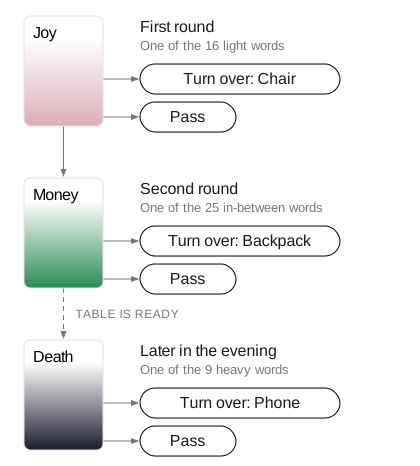
One card from each group
The three groups meet on one card. A heavy word can have a light thing behind it, and a light word can open onto something larger.
Joy has a Chair on its other side. Joy is a good first word for people who’ve met tonight, because a recent scene can be close at hand. The Chair side pulls toward older memories: a grandparent’s armchair, the chair at a first job, an empty seat at a holiday table.
Money has a Backpack on its other side. Money sits in the middle because the opinions can come fast and the stories behind them slower. The Backpack is an easier way in: a school bag, a backpacking trip on little money, what you packed when you left home.
Death has a Phone on its other side. For a table that isn’t ready, the Phone side keeps the turn going: a first phone, a call you waited for, a number you still haven’t deleted. Either side is a full turn, and a pass is one too.
Turn any word with the die
A light word can grow heavier, and a heavy one lighter, depending on the angle. The Thesis die has six faces: MEMORIES · BODY · PEOPLE · VALUES · CHILDHOOD · FUTURE. The only instruction is “Look at the word from that side.”
Play a round tonight
A short game tests the sort with your own people. It works for 2–6 players.
- Agree together how passing works.
- Whoever suggested the game goes first.
- Draw a card. Choose a side: the idea or the thing.
- Roll the die and look at the word from that side.
- The others ask what they’re curious about, gently, without judging.
- Hand the die to the left.
The rule card gives three follow-ups that fit every word on this page: What did that feel like? Who else was there? Has it always meant that to you? “A short answer is a full answer. You can always ask for more.”
Start with one word
Pick one word from the light group and one from the middle. Write both on a napkin, say both out loud, and let the people at the table choose. Save the heavy group for the night someone reaches for it.
To end, use the last round from the rules: each player names one thing they discovered about someone at the table today. “Sometimes one word is enough.”
See the rules and the box, or open the free online table. For more on playing with friends, see Thesis for friends. For the studies behind the deck, see the research page.